

First Impressions and Onboarding
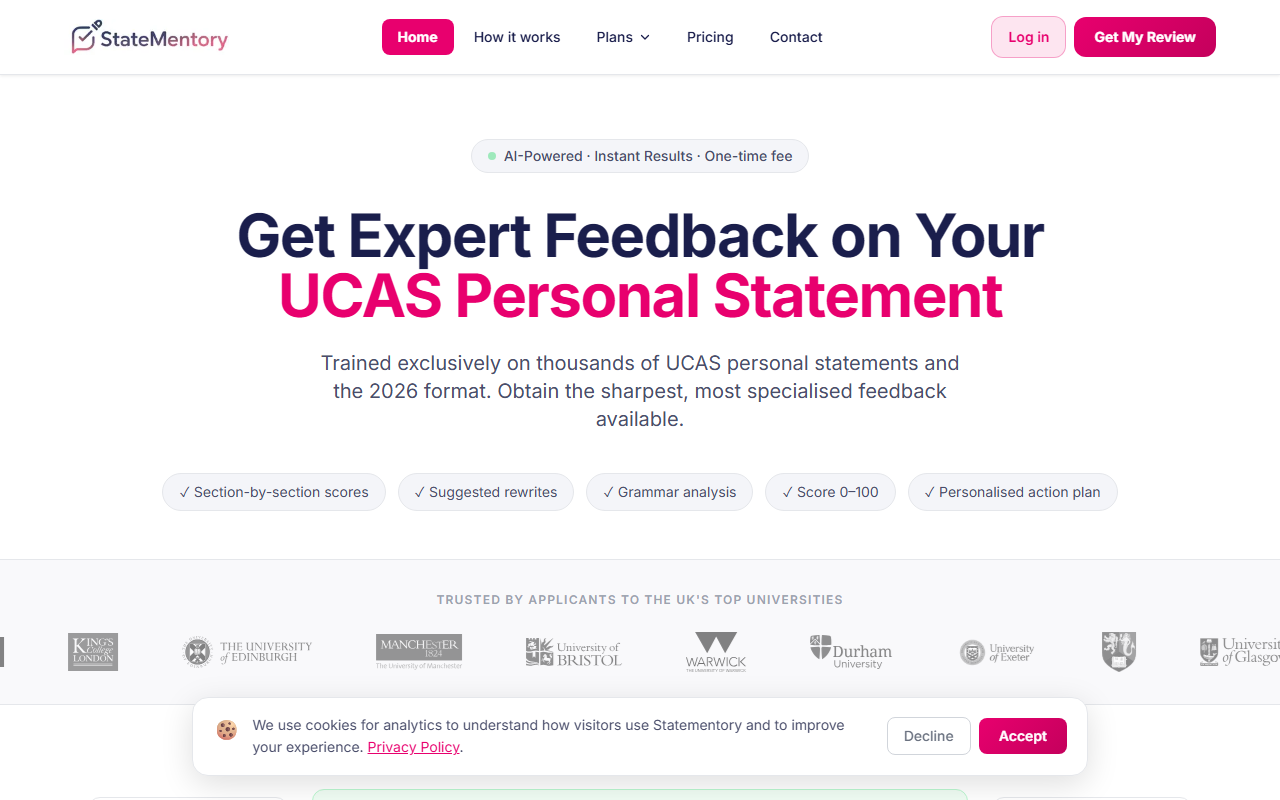
Upon visiting Statementory, the landing page is laser-focused on a single use case: reviewing UCAS personal statements. The design is minimal but effective, with a prominent call to action to paste your statement immediately. I initiated the free preview option by entering a short sample text and selecting a mock course. Within seconds, the tool returned an on-screen score (0–100) and a short breakdown of strengths and weaknesses, all without requiring payment. The user interface is clean: a form collects your name, target degree, universities, and the three UCAS section responses. The site prominently displays a privacy notice, stating that statements are processed securely and deleted after review. Pricing is clearly shown as a one-time fee of €7.49 via Stripe, with a 24-hour refund policy. The onboarding experience is frictionless and tailored to its niche audience.
How It Works and What You Get
The tool claims to be trained exclusively on thousands of UCAS personal statements and the 2026 format. When testing the free tier, I saw an overall score and a brief list of category highlights. The full report, unlocked after payment, includes eight components: a 0–100 overall score with a competitiveness rating, section-by-section scores and analysis, original-to-improved sentence rewrites, a language quality table covering six dimensions, differentiation and uniqueness analysis, subject-specific content recommendations, a prioritised step-by-step improvement plan, and an estimated impact on admission chances. The report is delivered instantly on screen after payment and can be saved or printed. The process requires you to fill in all three UCAS sections manually, each up to 4,000 characters. The AI then evaluates each section individually. The level of detail is impressive for a single-fee service: suggested rewrites are concrete and tied to the content you provide.
Market Positioning and Alternatives
Statementory occupies a narrow but valuable niche. Unlike general AI writing assistants such as ChatGPT or Grammarly, this tool is purpose-built for UK university applications. It does not offer generic essay feedback or support other statement formats. Competitors include human editing services and other AI-based tools like The Uni Guide’s personal statement checker, but Statementory differentiates itself with its specialised training data and structure-specific analysis. The testimonials from users who gained offers at Durham, Exeter, and UCL add social proof. The one-time fee is notably lower than most human editing packages, which can cost £30–£100 per review. This tool is best suited for applicants to UK universities who want instant, AI-driven feedback before their final submission. Applicants to US colleges or other systems will need to look elsewhere.
Strengths, Limitations, and Verdict
Statementory’s greatest strength is its focus. The AI’s training on UCAS-specific statements means its feedback is relevant and actionable. The instant delivery and one-time fee (€7.49) are also strong advantages, making it affordable for budget-conscious students. The inclusion of a free preview lowers the risk of a poor purchase. However, there are limitations. The tool requires you to manually type or paste your statement into three separate text boxes, which can be tedious. There is no integration with the UCAS platform or ability to upload a file. The AI cannot evaluate non-text elements such as extracurricular portfolios or references. Also, the free preview is very basic—little more than a score and a hint—so the real value is locked behind payment. That said, for the price, the depth of the full report is substantial. I recommend Statementory to any UK university applicant seeking a fast, data-driven review of their personal statement. It is not a replacement for human feedback but an excellent supplement. Visit Statementory at https://statementory.com/ to explore it yourself.


Comments