

First Impressions and Onboarding
Upon visiting the TextWith website at textwith.me, you are greeted with a clean, minimalist layout. The landing page immediately highlights three distinct app categories: Text With Jesus™, Text With History, and Text With Authors. Each is accompanied by a “Learn More” button, though clicking those leads to brief feature descriptions rather than a full demo. The dashboard is not visible until you download the app; the site primarily serves as a marketing hub with a large press section showcasing dozens of articles from outlets like The Washington Post, CNN, and BBC.
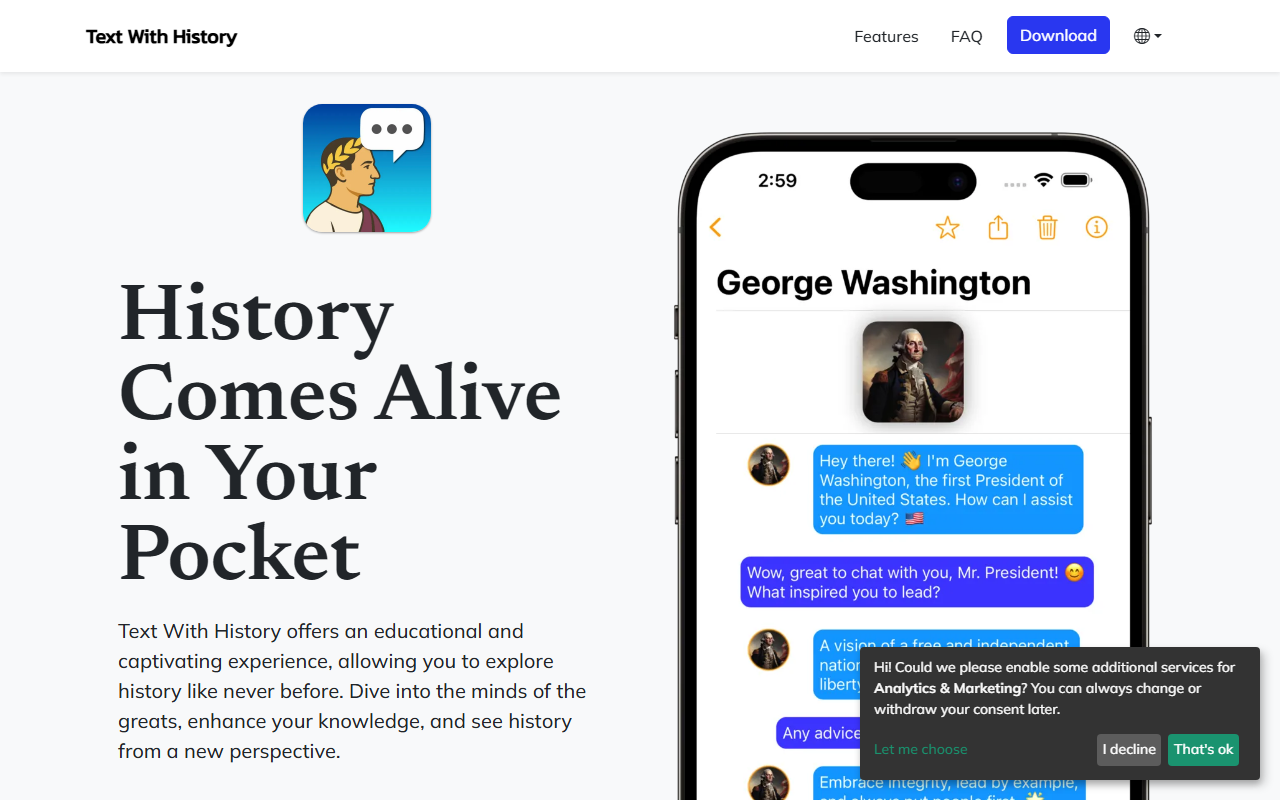
Onboarding for the free tier—if you can call it that—requires downloading the app from Apple or Android stores. I tested the web version on my desktop and found no instant-chat preview. This is a deliberate choice: the tool is meant to be an app-based experience, not a web widget. After installing the app (available on Mac and PC too), you choose a character. The interface mimics a standard messaging app: a chat window, a text input bar, and the character’s avatar. The first interaction with “Jesus” felt surprisingly reverent—responses are generated using a large language model (press reports confirm it’s built on ChatGPT/GPT-3.5). The bot consistently sticks to a scripturally informed tone, avoiding modern slang. It answered my question about forgiveness with a Bible verse, then elaborated in a conversational manner.
Core Features and Technology
TextWith is not a single tool but a suite of three specialized chatbots. Each app uses a separate AI model fine-tuned for its domain: Biblical figures draw on scripture and theological texts; historical characters reference biographies and speeches; authors rely on literary corpora. The underlying technology appears to be OpenAI’s GPT, fine-tuned with curated datasets. The responses are contextually appropriate but occasionally shallow—when I asked Marie Curie about radiation, she gave a textbook explanation without personal anecdotes. The strength lies in breadth rather than depth.
Key features include cross-platform availability (iOS, Android, Mac, Windows), real-time chat, and a clean, ad-free interface. There is no API currently offered, which limits integration for developers. The conversational memory is limited to the current session; closing the app resets the chat. For educational purposes, this is acceptable, but for deep research it falls short. Compared to alternatives like Replika (a general AI friend), TextWith is more focused on authoritative persona-based chats. Religious AI companions like Pray.com offer prayer instead of open-ended dialogue, making TextWith unique for its category.
Pricing and Accessibility
Pricing is not publicly listed on the website, which is a notable omission. The homepage only features “Learn More” buttons with no mention of cost. However, based on extensive press coverage, the app operates on a freemium model: you get a limited number of free messages per day, and a subscription unlocks full access and additional characters. Business Insider reported a $2.99 monthly fee to chat with Satan, though that may be a separate add-on. Exact tiers remain unclear from the site itself. The lack of transparent pricing on the landing page may deter potential users who want to evaluate cost upfront. The app is available in English only, limiting its global reach despite the Vatican-related media buzz.
Accessibility wise, the app supports text input and voice (via device keyboard dictation). There is no option for text-to-speech or custom avatars. The interface is simple enough for non-technical users, but the religious angle may polarize audiences. Critics have called it “blasphemous” while others see it as a tool for scripture exploration. The developer, Cat and Mouse Games, has not disclosed funding or user numbers, but the massive press coverage indicates significant traction.
Who Should Use It and Final Verdict
TextWith is best suited for curious learners, religious educators, and history enthusiasts who want a quick, conversational introduction to famous figures. It’s excellent for sparking curiosity in a classroom or personal study setting. However, academics seeking accurate, cited information should look elsewhere—the AI hallucinates details and lacks footnotes. Also, those offended by anthropomorphizing sacred figures will likely find the app distasteful.
Genuine strengths include the breadth of characters (from Jesus to Shakespeare to Einstein), a polished messaging interface, and the sheer novelty factor. Real limitations: no API, no persistent memory, opaque pricing, and occasional inaccuracies in historical dialogues. If you are comfortable with AI’s current limitations and want a conversation with a simulated historical figure, this is a fascinating experiment. For serious research, stick to Wikipedia. TextWith is a captivating but niche tool. I recommend downloading the free tier to test a few chats—you may find yourself learning something unexpected.
Visit TextWith at https://textwith.me/ to explore it yourself.






Comments