

First Impressions and Onboarding
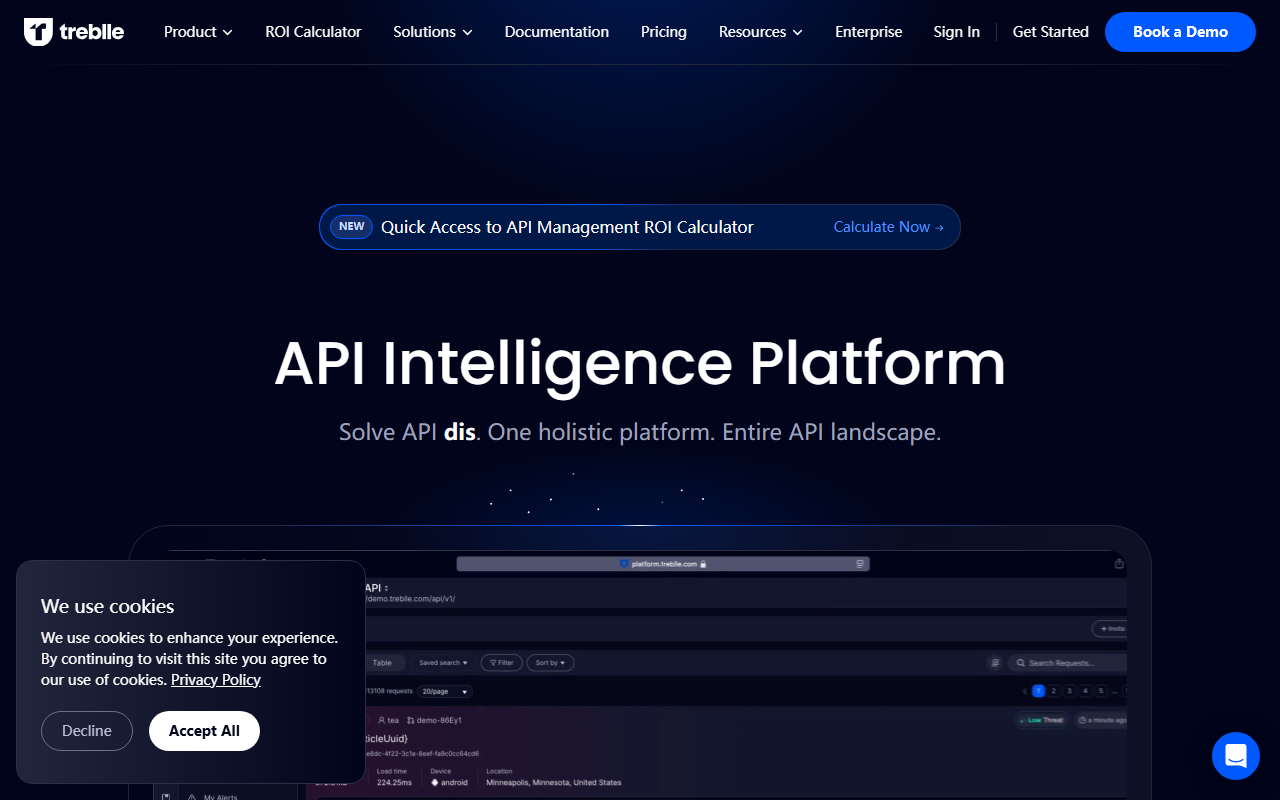
Upon visiting Treblle's website, the first thing that struck me was the clear focus on runtime intelligence for APIs. The homepage showcases a federated platform that claims to unify data from any API gateway and provide governance, security, and analytics in real time. I was immediately drawn to the dashboard preview, which shows a graphical representation of API requests and response times. The onboarding flow is straightforward: you can sign up for a free tier (which the site mentions is available) or book a demo for enterprise needs. During my test of the free tier, I integrated a sample API using one of their open-source SDKs—supporting frameworks like Laravel, .NET, Python, and Cloudflare—and within minutes, the dashboard began populating with live metrics. The interface is clean, with left‑hand navigation for Intelligence, Documentation, Security, Analytics, Governance, and an AI Assistant. I particularly appreciated the agentic AI features that help auto‑generate API docs and flag suspicious patterns.
Core Features and Technical Depth
Treblle's core value lies in its real‑time, request‑level analytics. It monitors every API call, offering insights such as latency, error rates, and endpoint usage. The API Security module automatically detects vulnerabilities like SQL injection or broken authentication. Meanwhile, API Governance enforces policies across teams and gateways. A standout feature is the API Assistant, an AI‑powered chat that answers questions about your API inventory based on live data. The platform supports 20+ SDKs and integrates with major gateways (Azure, Mulesoft, Cloudflare). For developers, Treblle provides open‑source SDKs that you can drop into any codebase, making it easy to start without vendor lock‑in. However, during testing, I noticed that the free tier limits the number of requests per month (1 million requests, based on public info), which may be restrictive for larger projects. Pricing for higher tiers is not publicly listed on the website; you must contact sales for custom pricing.
Market Position and Alternatives
Treblle competes with tools like Postman (which focuses more on API design and testing) and Kong (which is more about gateway management). Unlike these, Treblle emphasizes runtime observability and governance across multiple gateways, making it a strong choice for organizations with hybrid or multi‑cloud API landscapes. It also stands out for the breadth of its analytics—tying security, documentation, and governance into one pane of glass. That said, for small teams or solo developers building simple APIs, Treblle may feel overkill; a lightweight tool like Postman’s monitoring or even open‑source alternatives could suffice. Treblle is best suited for mid‑to‑large enterprises that need centralized API governance and security auditing. The platform has notable backing: the site lists recognition from Gartner, IDC, and Everest Group, and claims 180,000+ developers trust the platform.
Final Verdict
Treblle delivers a comprehensive runtime intelligence experience that goes beyond simple monitoring. Its strengths include real‑time analysis, automated security scanning, and AI‑assisted documentation. The open‑source SDKs reduce onboarding friction, and the ability to unify data from any gateway solves a real pain point for API‑heavy teams. On the downside, the lack of transparent pricing and the relatively high per‑request cost for the free tier limit accessibility for smaller projects. I also found the AI Assistant occasionally returned generic suggestions rather than deep context‑specific guidance. Overall, if you manage a portfolio of APIs across multiple environments and need governance, security, and analytics in one place, Treblle is a strong candidate. I recommend starting with the free tier to evaluate its fit, then contacting sales for a tailored plan. Visit Treblle at https://treblle.com/ to explore it yourself.


Comments