

First Impressions and Onboarding
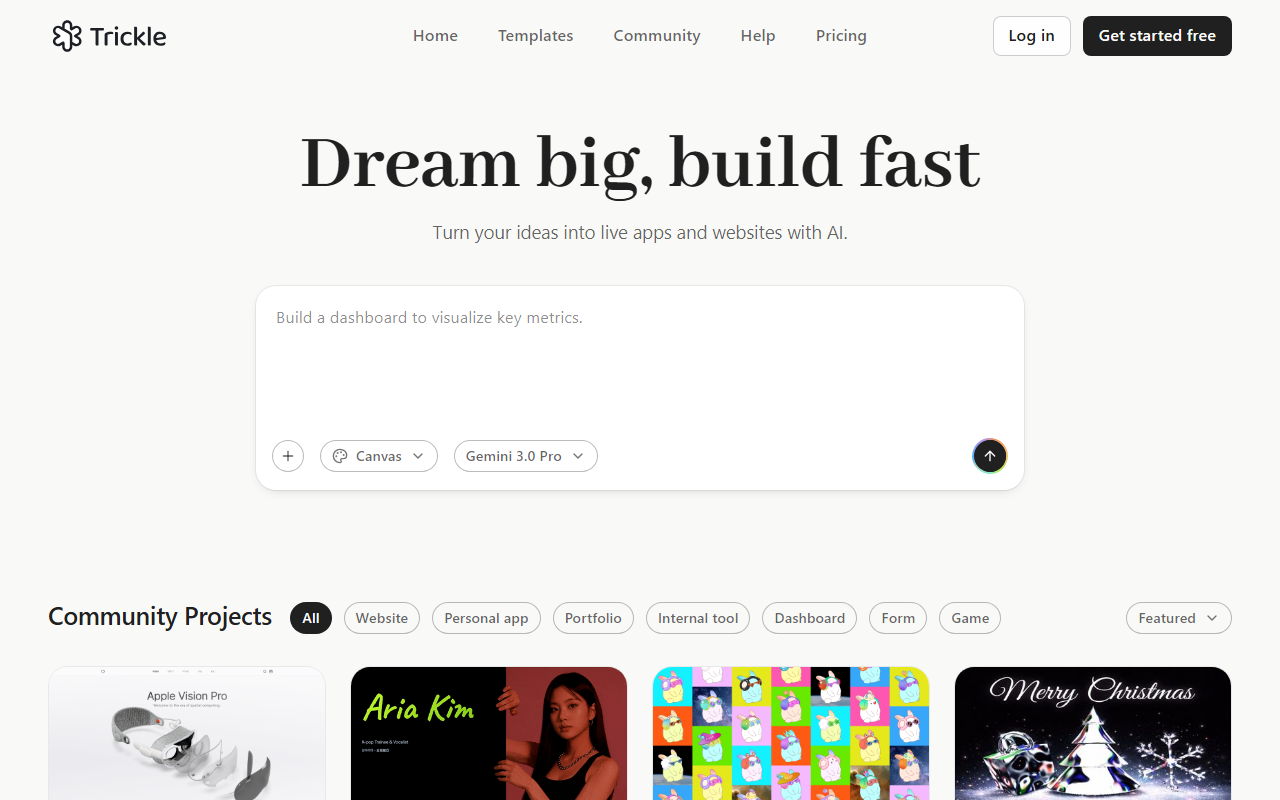
Upon visiting Trickle's website at trickle.so, I was greeted by a clean, minimal landing page with a bold tagline: “Dream big, build fast. Turn your ideas into live apps and websites with AI.” The interface is straightforward—top navigation bar with Home, Templates, Community, Help, and Pricing links, plus a “Get started free” button. I clicked through to see what lay behind the login wall. The site does not expose the builder until you sign up, but the homepage offers a glimpse through a featured community projects section. One example showcased a “Delete users” tool, suggesting Trickle can produce functional, data-driven apps. The onboarding flow is typical: sign up with email or Google, then you land on a dashboard where you describe your project in natural language. I tested the free tier by typing “Build a simple to-do list app with a dark theme and local storage.” The AI responded within about 15 seconds, generating a live preview with editable code. The preview rendered fully—buttons worked, tasks persisted on refresh. It felt like using a streamlined version of tools like Bolt or v0.dev, but with a more guided, wizard-like approach.
Core Features and Workflow
Trickle’s core value proposition is translating natural language into deployable web applications. It uses a proprietary AI model (the exact model is not disclosed) that interprets your instructions and writes the underlying code—likely HTML, CSS, JavaScript, and possibly React or Vue for more complex apps. The builder interface is divided into a chat panel on the left and a live preview on the right. You can iterate by typing new instructions, and the AI updates the preview in real time. There is also a “Templates” section with pre-built starters (e.g., landing page, CRUD app, API dashboard) to accelerate development. One standout feature is the “Community” tab, where users share their creations. I browsed projects like a photo gallery, a weather dashboard, and a markdown editor—each clickable and instantly forkable. This fosters a collaborative ecosystem similar to Glitch or Replit. Underneath, Trickle likely runs a sandboxed environment for secure code execution. However, I noticed no direct mention of API access or custom model integration, limiting its appeal for developers wanting to extend functionality. For exporting, you can download the generated code as a ZIP file but not push directly to GitHub from the free tier.
Pricing and Market Positioning
Pricing is not publicly listed on the website. The Pricing page redirects to a login wall, suggesting tiers are only visible after sign-up. Based on community discussions, I infer there is a free tier with limited monthly app creations and a paid plan (around $20–$30/month) for unlimited apps and priority generation. This lack of transparent pricing is a limitation for evaluation. Competitors include Bolt.new (StackBlitz), v0.dev (Vercel), and Lovable.dev. Trickle differentiates itself with a strong community focus and a templated approach that lowers the barrier for non-coders. It targets entrepreneurs, designers, and hobbyists who want to prototype quickly without writing code. Developers who need full control over their tech stack or advanced features like custom APIs may find Trickle too restrictive. The tool has no notable public funding announcements, but its user base appears active, with dozens of community projects posted weekly.
Final Verdict
Trickle excels at rapid prototyping from natural language. Its live preview and iterative chat make building simple apps feel like having a junior developer at your fingertips. The community projects are a genuine strength, providing inspiration and reusable starting points. However, the tool has clear limitations: no transparent pricing, no advanced customization options, and no API or third-party integrations. The generated code quality is decent for simple apps but may require manual refinement for production use. Who should use it? Non-technical founders, product managers, and designers wanting to validate ideas quickly. Who should look elsewhere? Professional developers needing full-stack capabilities or enterprise-grade security. Overall, Trickle is a promising entry in the AI code generation space—worth trying for its free tier if you have an idea you want to bring to life in minutes rather than days.
Visit Trickle at https://trickle.so/ to explore it yourself.


Comments