

First Impressions and Onboarding Experience
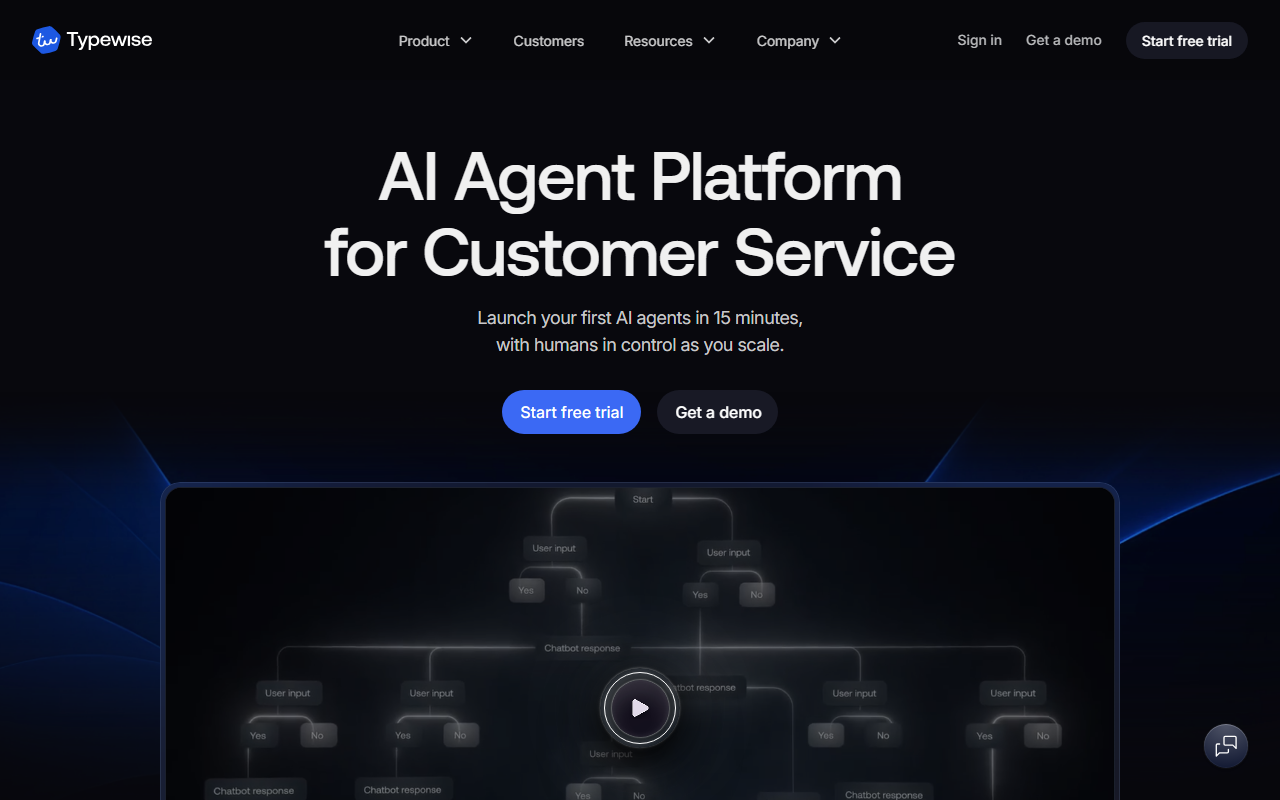
Upon visiting the Typewise website, the bold claim of launching your first AI agents in 15 minutes immediately sets the tone. The landing page emphasizes speed and control, with a clear call to action to start a free trial or book a demo. I was struck by the emphasis on natural language instructions: business teams can define and run workflows without writing a single line of code. This is a significant departure from traditional automation platforms that require technical expertise. The onboarding flow described on the site is refreshingly straightforward—create a specialist agent, connect it to your knowledge base via existing docs or help center articles, validate simulations, and go live with human oversight. The typical timeline from Day 1 (first agent live) to Week 4+ (scale across teams) is both ambitious and well-documented. I also noticed the platform integrates deeply with over 200 tools, including CRM, ERP, billing, and ITSM systems, which is critical for enterprise adoption.
Core Features and Workflow Capabilities
Typewise’s multi-agent orchestration is its standout capability. An AI supervisor coordinates domain specialists to handle support, sales, and commerce workflows simultaneously across channels like chat, email, WhatsApp, and voice. The platform does not just read from your systems—it can write and take actions across CRM, billing, and order management, making it a true end-to-end automation layer. The hybrid intelligence feature allows the AI to escalate to humans for approvals or full handoffs when complexity increases, ensuring control is never sacrificed for speed. Automated evaluations with simulation and policy validation ensure every change is safe before going live. The Insights Hub tracks resolution rates, customer satisfaction (CSAT), intent trends, and quality compliance. I was particularly impressed by the MCP-native architecture supporting 6,000+ connectors, which is rare among customer service platforms. The ability to define workflows in plain language and have them executed without IT bottlenecks is a genuine productivity win for business teams.
Pricing, Competitors, and Verdict
Typewise uses success-based pricing starting at $1 per resolution, with an ROI estimator available on the site. While this outcome-oriented model aligns incentives with customers, the lack of transparent per-seat or monthly tiers may be a deterrent for smaller teams. Competitors like Zendesk AI and Intercom's Fin also offer AI automation but typically charge per ticket or per resolution. Where Typewise differentiates is in its enterprise-grade governance—approval workflows, audit logs, and data residency options make it suitable for regulated industries. However, the extensive integration requirements mean it is best deployed in mid-market to enterprise settings with complex tech stacks. Strengths include rapid deployment, natural language configuration, and deep action capabilities across systems. Limitations include opaque pricing beyond the base $1 per resolution and a learning curve for teams without existing integration maturity. I would recommend Typewise to any enterprise customer service team looking to automate complex, multi-channel workflows while keeping humans in the loop. For very small businesses or those with simple email-only support, a lighter tool like Tidio may suffice. Overall, Typewise is a powerful solution for scaling customer operations with confidence.
Visit Typewise at https://typewise.app/ to explore it yourself.




Comments