
First Impressions and Onboarding
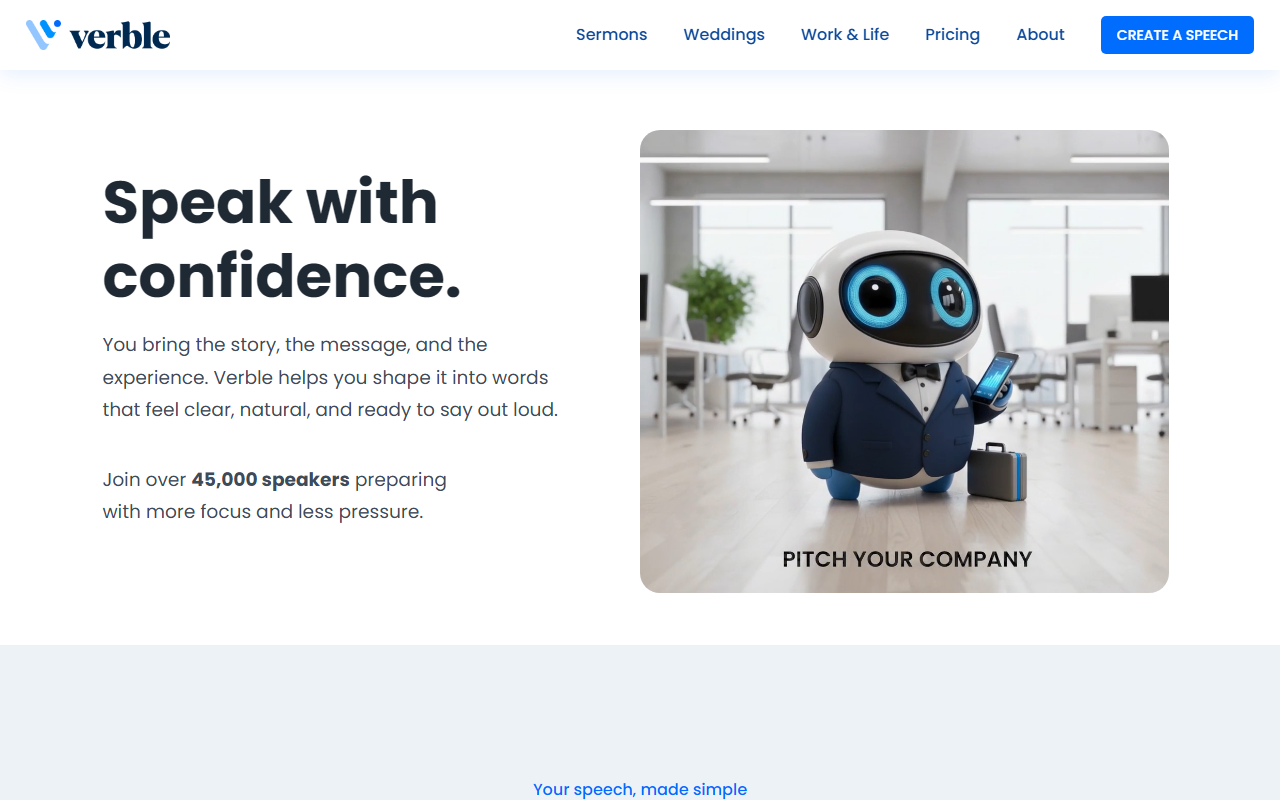
Upon visiting Verble at verble.app, I was immediately struck by the tool's clarity of purpose. The homepage greets you with a simple choice: Speech App, Sermon App, or Wedding App. This is not a generic AI writer that tries to do everything. Verble is laser-focused on helping people prepare spoken content—keynotes, sermons, wedding toasts, pitches, lessons, and more. I clicked into the Speech App to see how it works. The onboarding is remarkably smooth. No account creation is required to start exploring; the interface presents a series of guiding questions rather than a blank page. The tool asks about the occasion, audience, and the core message you want to convey. It feels like a thoughtful partner asking, "What's the event? Who are you speaking to? What feeling do you want to leave?" This guided approach eliminates the anxiety of facing a cursor. For someone who has struggled with writer's block for speeches, this was a welcome change.
The dashboard is clean and minimal. On the left, you see your current speech outline; on the right, suggestions and refinement prompts appear. The AI doesn't write full paragraphs for you—it helps you structure your ideas and suggests phrases you can adapt. I tested it with a hypothetical wedding toast. Verble asked me to describe the couple, a funny memory, and the sentiment I wanted to share. Within a few minutes, I had a coherent outline with placeholders that felt personal. The free tier lets you create one speech at a time, but you can upgrade for more. The tool's emphasis on "your voice" is genuine: the output never sounds robotic because you are doing most of the writing. Verble just ensures you don't wander into tangents.
How Verble Differs from Generic AI Writers
Most AI writing tools in the market, such as Jasper or Copy.ai, focus on generating marketing copy, blog posts, or social media content. They often produce full text from a prompt, which can be useful but also risks sounding generic. Verble takes a different approach. It positions itself as a speech companion that helps you think clearly, not just write quickly. The underlying technology is not explicitly stated on the site, but from the interaction patterns, it appears to leverage a large language model fine-tuned for structuring spoken narratives. The key innovation is the step-by-step prompting that guides users through the creative process of speechwriting. Unlike competitors, Verble does not claim to replace the speaker; it insists on collaboration. The tool even warns against relying on it for fully scripted content—the goal is to prepare something that still sounds like you.
Another differentiator is the specialization. Verble offers separate app experiences for sermons and weddings, acknowledging that those contexts have different emotional and structural needs. For pastors, the Sermon App includes prompts for scripture reference and thematic coherence. For wedding speeches, it emphasizes personal stories and timing. This depth of contextual awareness is rare among general-purpose AI writers. The site claims over 45,000 speakers have used Verble, and it is used by students and educators from renowned universities. While I cannot verify the exact number, the testimonial from a Senior AI Specialist at Microsoft lends credibility to its quality.
Pricing and Target Audience
Pricing is not publicly listed on the Verble website, which is a limitation for potential users. The homepage offers a free tier ("Start free, upgrade when it feels helpful") but does not specify what the paid plans cost or what they unlock. This lack of transparency could deter people who want to evaluate the long-term cost before investing time. Based on common SaaS models for such tools, I suspect there is a monthly or annual subscription for unlimited speech creation and advanced features like exporting to PDF or sync across devices. However, without official figures, I cannot confirm.
The tool is best suited for anyone who needs to deliver a spoken message with clarity and confidence: business professionals preparing keynotes or pitches, pastors writing sermons, best men or maids of honor crafting wedding toasts, and educators developing lessons. It is less ideal for people who want a fully automated script generator or for those who prefer to write completely from scratch without guided structure. If you are a novelist writing dialogue or a content creator needing bulk content, Verble is too narrow. But if your goal is to stand up and speak well, this tool is a strong ally.
One genuine strength is how it reduces the "blank-page panic." I found that even when I had only a vague idea, the prompts helped me uncover a clear structure. A real limitation is the lack of integration with presentation tools like PowerPoint or Google Slides. You can export the speech as text, but it does not format slides. Additionally, the free tier is limited to one speech at a time, which may feel restrictive for heavy users. The tool also relies on internet access; there is no offline mode mentioned.
In conclusion, Verble is a focused AI tool that fulfills its promise: helping you prepare a speech that sounds like you, without the pressure of starting from zero. I recommend it to anyone facing an upcoming speaking engagement who wants a structured, collaborative writing experience. Visit Verble at https://verble.app/ to explore it yourself.





Comments