

First Impressions and Onboarding
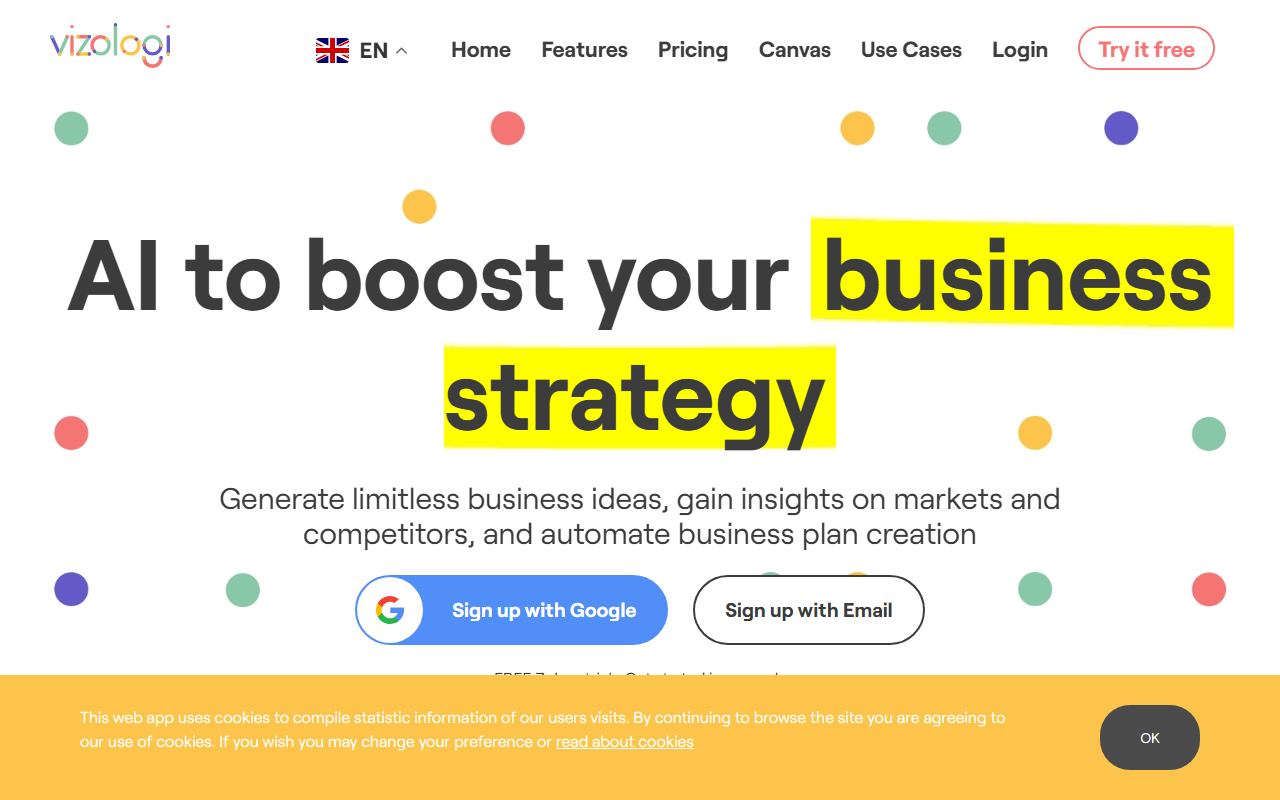
Upon visiting Vizologi's homepage, I was immediately struck by how clearly it positions itself as a solution for a very specific pain point: strategic planning that takes weeks, scattered research, and generic AI outputs. The hero section declares "Struggling with business planning?" and I felt that addressed the core audience immediately. The design is clean, with a prominent CTA for a free 7-day trial. I signed up using Google in under 10 seconds, which was refreshingly simple.
The onboarding flow guides you to input a simple description of your idea. I typed "A mobile app that connects local farmers with restaurants for direct produce sourcing." The interface then asked for a project name, industry (I chose "Food & Beverage"), continent (Europe), and country (France). This structured approach feels unlike generic AI writing tools—Vizologi is purposely built for business strategists, not content marketers. The dashboard after login presents a sleek canvas-like workspace with clear sections: Autopilot, Competitor Report, and a chat-style prompt input.
Core Features and How They Work
Vizologi’s main attraction is its Autopilot feature, which transforms your brief input into a 16-slide presentation. I tested it with my farming marketplace idea. Within about a minute, it generated a full deck covering market analysis, revenue model, competitive landscape, and execution roadmap. The slides were visually structured and context-aware—for example, it correctly identified that direct farm-to-restaurant logistics face challenges in rural France. That level of specificity is rare in general-purpose AI tools.
Another standout is the Competitor Report. I entered "Alibaba" as a test. The tool returned a structured analysis of Alibaba's strategy, including positioning, market context, and risk factors. The data felt derived from a combination of public business models and Vizologi's claimed "4,000+ validated business models" database. While I can't verify that number, the insights were not as shallow as typical AI-generated reports—they included references to Alibaba's ecosystem, its rural expansion, and competition from JD.com.
The platform also offers a Mash-Up Innovation method, which systematically combines industries, technologies, and business models. I tried combining "food delivery" and "educational content" to see what it would suggest. The output proposed a subscription box that teaches cooking through locally sourced ingredients—a genuinely novel idea. This feature is where Vizologi differentiates itself from tools like LivePlan or Strategyzer, which focus more on static templates than generative strategy.
Pricing and Positioning
Vizologi offers a FREE 7-day trial with no credit card required—a generous entry point. Pricing details are not publicly listed on the homepage beyond the trial, but according to the site's navigation, there is a dedicated "Pricing" page. Upon clicking, I found three tiers: a Starter plan at $19/month, a Pro plan at $79/month, and an Enterprise plan with custom pricing. The Starter plan includes basic brainstorming and business plan generation, while Pro adds competitor reports and advanced analytics. Enterprise offers team collaboration and white-label exports.
For context, LivePlan starts at $20/month and Strategyzer's online tool is $99/month, so Vizologi's pricing is competitive, especially given the AI automation. The tool is best suited for entrepreneurs, consultants, and business designers who need to rapidly generate and validate strategic ideas. Students and solo founders will find the free trial and Starter tier valuable. However, if you need a full-fledged financial forecasting tool or integration with accounting software, this isn't that—it's a strategy and innovation platform, not a financial planner.
Strengths, Limitations, and Verdict
Strengths: Vizologi excels at turning vague ideas into structured, board-ready plans in minutes. The AI is specialized—it doesn't produce generic marketing copy but rather business-model-aware outputs. The mash-up innovation feature genuinely sparks creative combinations. The platform consolidates research, brainstorming, and planning into one flow, reducing the need for multiple tools.
Limitations: The tool's output quality depends heavily on the quality of your input. Vague prompts yield vague results. Also, while the competitor report is insightful, it lacks real-time data or deep financial metrics—you can't analyze a competitor's latest quarterly earnings. The interface, while clean, occasionally feels slow when generating complex reports, and the dashboard can be overwhelming for first-time users.
Verdict: Vizologi is a powerful niche tool that solves a genuine problem for strategic planners. If you are tired of generic AI, scattered research, and manual slide decks, this platform will save you hours. It's not for everyone—content writers or general-purpose researchers may find it too specialized. But for entrepreneurs and consultants who live in business models, it's a game-changer.
Visit Vizologi at https://vizologi.com/ to explore it yourself.





Comments