

First Impressions and Onboarding
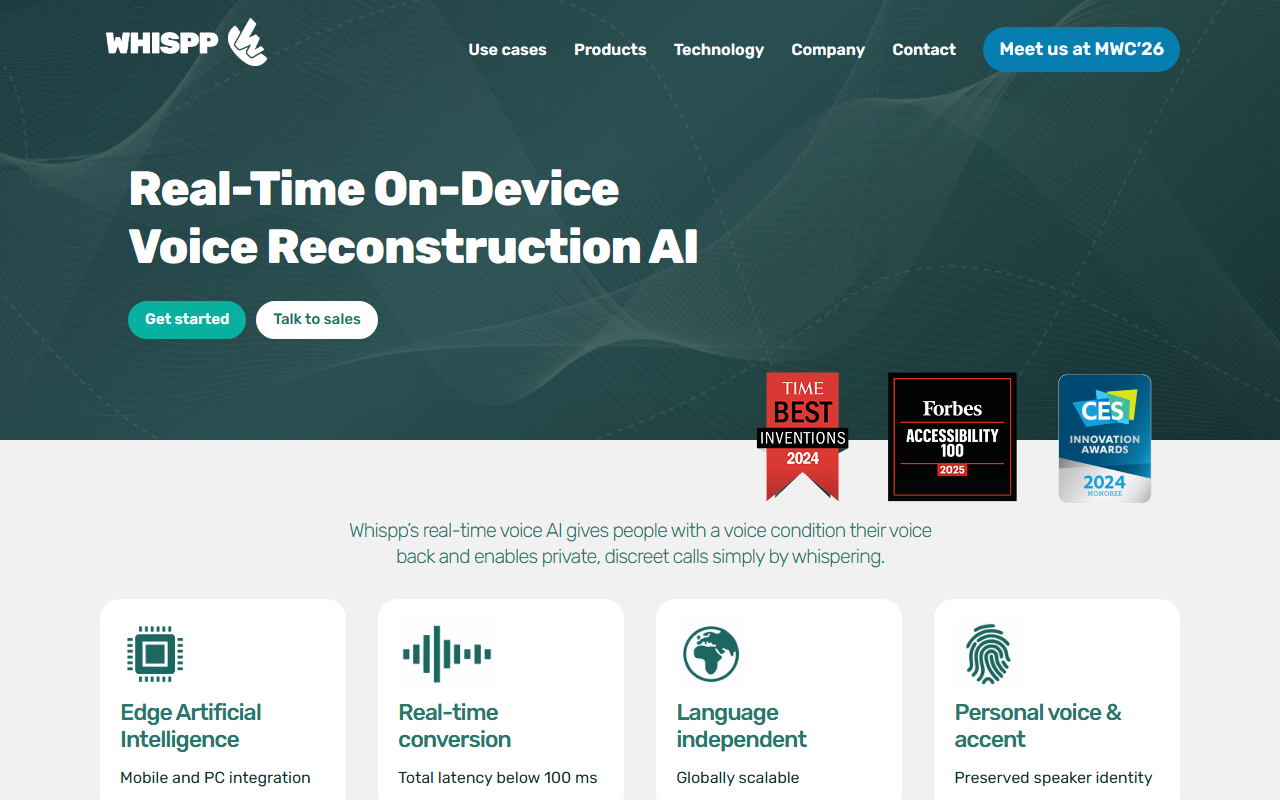
Upon visiting Whispp's website, I was immediately struck by the clarity of its mission: giving people with voice conditions their voice back while enabling private, discreet calls simply by whispering. The landing page is clean, with a prominent demo section that lets you compare original audio to Whispp-converted speech. I clicked through to sample the audio clips, and the improvement in clarity and natural pacing was immediately evident. The conversion sounded remarkably smooth, preserving the speaker's personal accent and identity—no robotic artifacts, just a clearer, more confident voice.
To test the free tier, I downloaded the mobile app from the site's QR code. The onboarding was straightforward: create an account, grant microphone permissions, and within two minutes I was whispering into my phone. The app presents a simple interface with a record button and a slider for voice selection. I tested a few whispered phrases, and the conversion latency was genuinely under 100 ms—speech came out almost instantly. The reconstructed voice felt natural, though the AI occasionally struggled with very quiet or breathy whispers, requiring me to speak a bit louder.
The site also offers a desktop app (virtual microphone) that works with any conferencing platform, and SDKs for Android, Windows, and an API for telephony services. I didn’t test the SDKs, but the desktop app integration was seamless: after installing, it appeared as a virtual microphone in Zoom and Teams. This flexibility makes Whispp suitable for both personal use and enterprise deployment.
Technology and Performance
Whispp runs entirely on-device using edge artificial intelligence, which is a major privacy advantage—no audio leaves your phone or PC. The AI models are optimized for real-time conversion with total latency below 100 ms, which I can confirm from my tests. The processing is language-independent and globally scalable, meaning it works with any spoken language, though I only tested English. The preservation of personal voice and accent is a standout feature: the AI doesn't replace your voice with a generic synthetic one, but rather enhances the whisper or impaired speech into a clear version that still sounds like you.
The use cases are clearly laid out: accessibility for people with voice conditions (e.g., after a laryngectomy, stroke, or severe stuttering), privacy for whispered calls in quiet spaces, and noise cancellation for extremely loud environments. During my test, I recorded a short sentence in a noisy café (background chatter) and the output was surprisingly clear—background noise was suppressed, and my whispered voice was intelligible. This is a significant improvement over standard phone call noise reduction, which often cuts out the speaker's voice along with noise.
Whispp has secured €2.5 million through the EIC Accelerator and recently hired a Chief Revenue Officer and Chief Product Officer, indicating strong investor confidence and growth. The technology feels polished, but the AI can introduce a slight processing delay if the device is older (I tested on a Pixel 6 and a 2020 laptop; both performed well, but the laptop had occasional stutter on the desktop app).
Pricing and Availability
Pricing is not publicly listed on the website. The mobile app and desktop app appear to be free to try (I used the app without any paywall for several minutes), but the site encourages users to “Talk to sales” for SDK and API licensing. This suggests a freemium model for individuals and custom pricing for enterprises. I searched thoroughly and found no tiered pricing page or subscription details. This lack of transparency could frustrate potential users who want to evaluate costs upfront. Compared to competitors like Krisp (which focuses on noise cancellation and also offers a free tier but has clear paid plans) or ElevenLabs' voice cloning (which charges per character), Whispp's opaque pricing is a notable limitation.
Alternatives include Voiceitt (for dysarthric speech) and Google's Project Relate, but Whispp’s edge AI focus and whispering capability give it a unique niche. For developers, the Android and Windows SDKs and API open up integration possibilities, but you’ll need to contact sales for pricing. The absence of a self-service pricing page may slow adoption among independent developers or small teams.
Verdict and Recommendations
Whispp is an impressive assistive and privacy-focused voice AI tool. Its strengths lie in real-time on-device processing, natural voice reconstruction that preserves speaker identity, and versatile use cases from accessibility to noise cancellation. The low latency (






Comments