

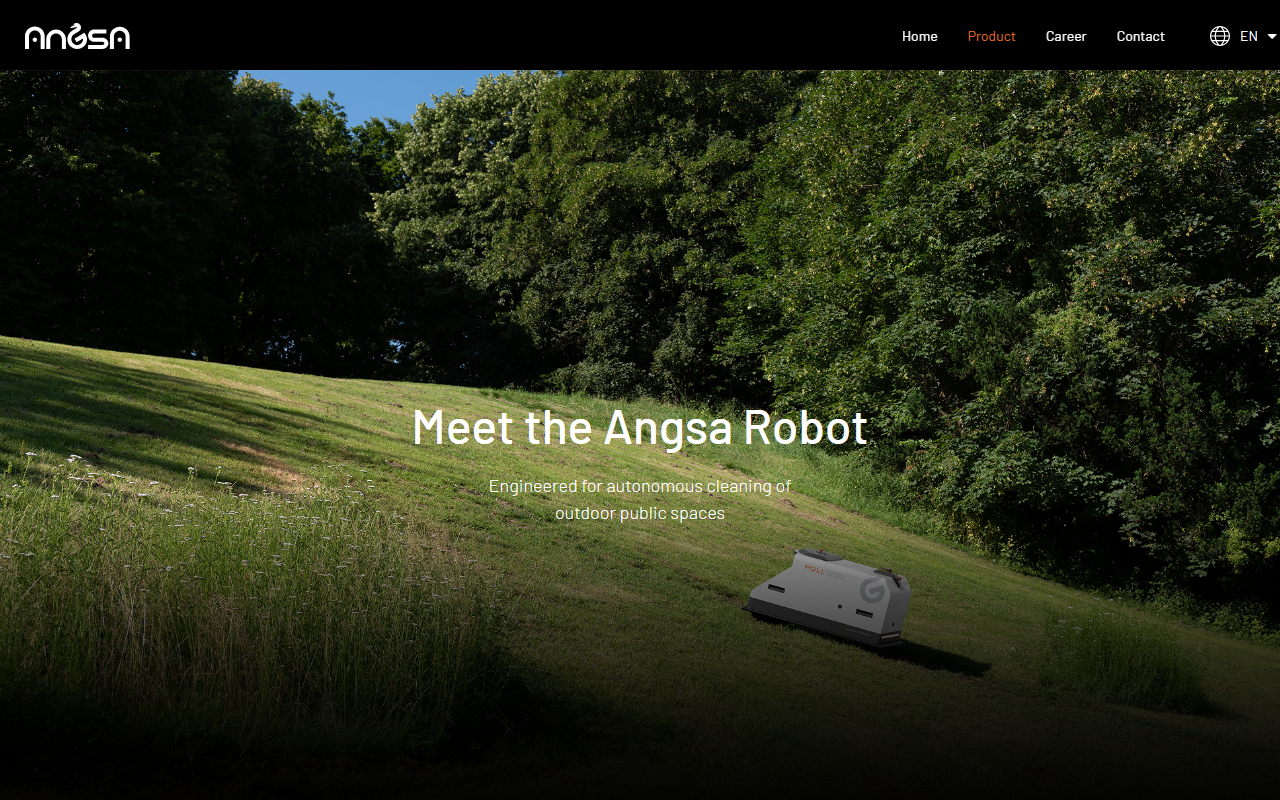
First Impressions: A Robot Built for Real-World Mess
Upon visiting the Angsa Robotics website, I was immediately struck by the clarity of their value proposition: an autonomous robot that picks up litter from public green and grey spaces. The homepage features a clean, modern design with customer logos and a clear list of capabilities—AI-based litter recognition, autonomous cleaning, obstacle detection, and staff relief. Unlike many AI tools that exist purely in software, Angsa is a physical robot paired with a smart app. The dashboard-like layout makes it easy to understand the workflow: deploy the robot once, let it work a full shift, and monitor results remotely.
During my exploration, I noticed the site offers a direct call to contact for a demo rather than a self-service trial—understandable for a hardware product. The navigation is intuitive, switching between German and English seamlessly. The customer logos are mostly from German-speaking regions, suggesting a strong initial focus on European municipalities.
How Angsa Robotics Works: AI Meets Autonomous Cleaning
The core technology is a mobile robot equipped with cameras and AI models that distinguish between litter and natural objects like leaves or stones. This prevents unnecessary removal of soil or surface materials, a problem with traditional street sweepers. The robot operates fully autonomously for up to eight hours without human supervision. It uses a multimodal perception system for obstacle detection, avoiding people and objects safely. The cleaned area is logged via GIS integration—users draw boundaries once in the app using Google Maps or their own GIS data, and no additional infrastructure is needed.
The Angsa App provides live status updates, including battery level, position, and cleaning progress. It also collects data on litter type and quantity, compliant with GDPR. This data insight allows municipalities to optimize cleaning schedules and allocate resources more effectively. The robot is designed to handle both green surfaces (parks, pools) and grey surfaces (cobblestone, gravel) without damaging the ground.
Real-World Application and Strengths
Angsa addresses a specific pain point: the labor-intensive and inconsistent nature of manual litter collection in public spaces. By deploying a robot, cleaning teams can focus on more complex tasks while the robot handles micro-litter. The robot's ability to operate on diverse surfaces and its full autonomy over an 8-hour shift are genuine strengths. The data collected also enables evidence-based decision-making, turning cleaning from a reactive task into a measurable service.
Compared to alternatives like CleanRobotics' TrashBot (which sorts waste inside bins) or autonomous lawn mowers (limited to grass), Angsa fills a unique niche for outdoor spatial cleaning. The emphasis on GDPR compliance is a plus for European customers—many competing solutions lack that transparency.
Limitations and Market Positioning
Pricing is not publicly listed on the website, which likely means custom quotes based on deployment scale, terrain, and support needs. This can be a barrier for smaller organizations or pilot projects. Additionally, the robot requires physical deployment and initial setup of mapped areas, so it's not a plug-and-play solution for every environment. The hardware component also entails maintenance costs and potential downtime. The robot is best suited for well-defined public spaces like parks, large plazas, and recreational areas. It is not designed for high-traffic urban streets or indoor facilities.
For municipalities struggling with litter and staffing shortages, Angsa offers a promising, scalable answer. But budget-conscious buyers should prepare for a significant upfront investment. If you're looking for a purely software-based AI cleaning solution, this isn't it—but if you need a physical robot that actually picks up trash, Angsa delivers a polished, data-driven package.
Visit Angsa Robotics at https://angsa-robotics.com/ to explore it yourself.







Comments