

First Impressions and Onboarding
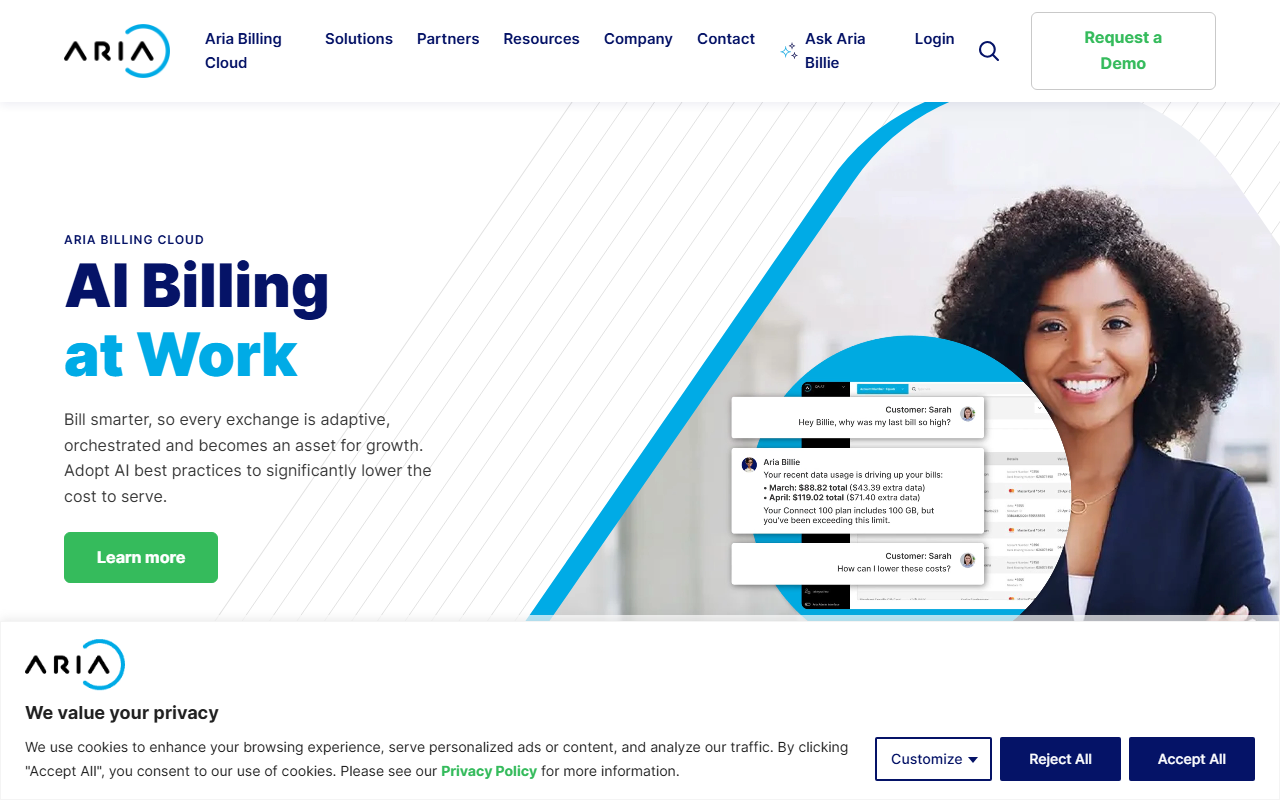
Upon visiting the Aria Systems website, I was struck by the business-first tone. The homepage highlights "AI Billing at Work" with a clean, professional layout. Navigation is straightforward—sections for solutions, partners, resources, and a prominent "Request a Demo" button. There is no self-service signup, as this is clearly an enterprise platform. The search modal and AI assistant "Ask Aria Billie" are accessible from the top bar. I clicked through to the platform overview, which reveals a no-code workflow builder for billing logic, rate plans, and invoicing. The dashboard preview shows real-time analytics on revenue leakage, subscription metrics, and customer health. While I couldn't test a live instance, the interface appeared designed for finance and operations teams, not developers—though API documentation is available.
Core Capabilities: AI-Powered Billing Automation
Aria Billing Cloud is a SaaS platform that manages end-to-end billing for usage-based and subscription models. Its standout feature is the AI layer: Aria Billie and Billie Connect. Aria Billie is a conversational AI agent that handles customer inquiries about invoices, usage, and plan changes. Billie Connect extends this to external CRM and customer service systems. According to the site, these tools can boost employee productivity by 40–70% and reduce assisted care inquiries by 15–40%. The AI uses generative models to provide contextual responses. Technically, the platform is cloud-native and TM Forum compliant, supporting any mix of one-time, recurring, and usage-based charges. It integrates deeply with Salesforce and ServiceNow via pre-built "Billing Studio" connectors, enabling a seamless lead-to-care lifecycle. Aria also offers an API for custom integrations and supports complex pricing like tiered, volume, and dynamic rating.
Pricing, Integrations, and Market Position
Pricing is not publicly listed on the website—typical for enterprise billing platforms. Interested companies must request a demo and likely receive custom quotes based on transaction volume, number of subscriptions, and required modules. Aria integrates tightly with Salesforce CRM and ServiceNow, as highlighted in separate solution pages. It also partners with Tenon for BSS stacks. Competitors include Zuora (similar usage-based billing with AI features), Recurly (more mid-market), and Chargebee (SMB to mid-market). Unlike Zuora, Aria positions itself as a "strategic asset" for monetizing AI products themselves, not just supporting AI-assisted billing. The customer list includes recognizable names like UGG and Superloop, indicating a strong enterprise footprint. The blog post on monetizing AI confirms Aria's focus on helping companies bill for AI-driven services, which is a timely niche.
Strengths, Limitations, and Recommendation
The genuine strengths of Aria Systems are its deep billing automation for complex models, AI-powered customer care, and robust integrations with Salesforce and ServiceNow. The AI assistant is not a gimmick—it directly reduces support costs and uncovers upsell opportunities. However, there are real limitations. First, the lack of transparent pricing and vendor lock-in risk may deter smaller businesses. The platform is built for large enterprises with dedicated billing teams, not startups. Second, the AI features likely require historical data to train effectively, which means a longer ramp-up. Third, the onboarding process seems hands-on and consultative, which can be slow. Who should try this tool? Established enterprises with complex subscription or usage billing—especially those already using Salesforce or ServiceNow—will find Aria powerful. SMBs should look at Recurly or Chargebee. If you need a billing system that grows with AI monetization, Aria is a strong candidate, provided you have the budget and support staff. Visit Aria Systems at https://ariasystems.com/ to explore it yourself.













Comments