

First Impressions and Onboarding
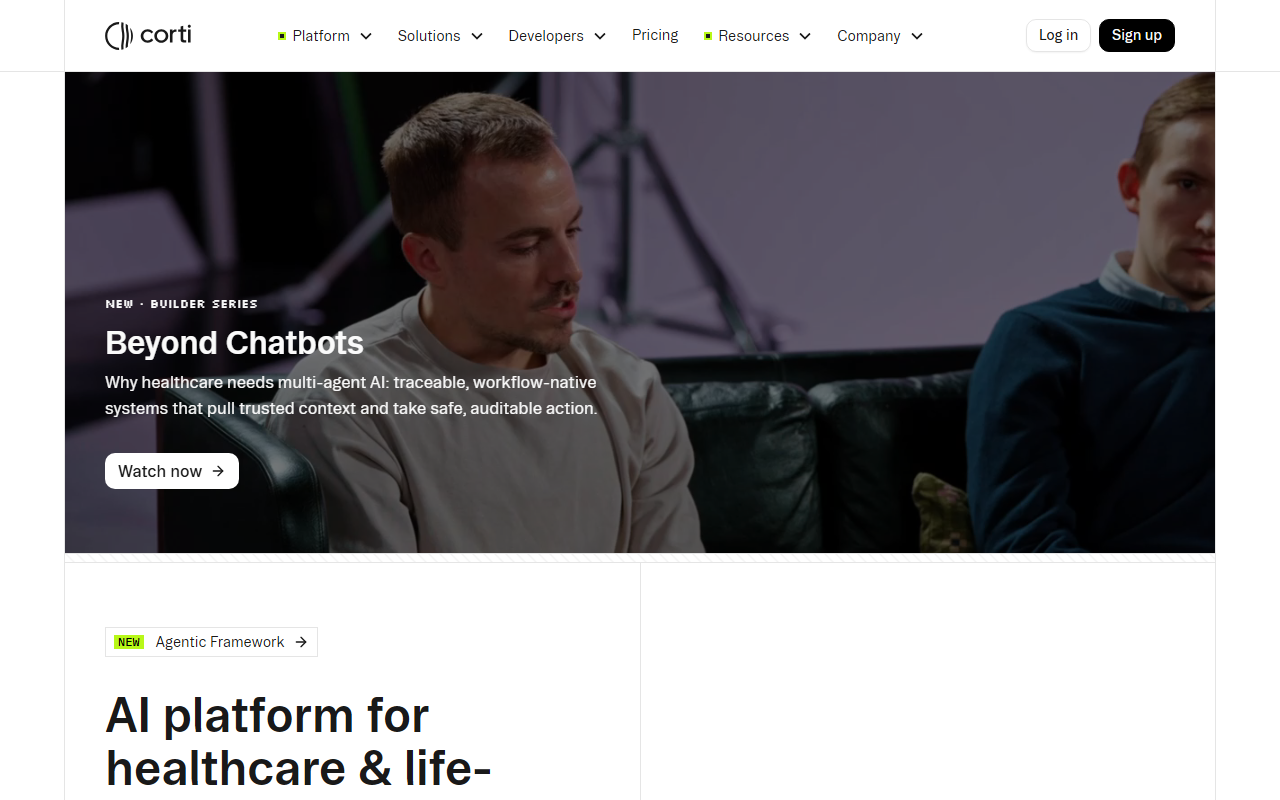
Upon visiting the Corti website, I was immediately struck by the clarity of its value proposition: an AI platform built specifically for healthcare and life-science developers. The dashboard prominently features a call to action to get an API key and introduces "Symphony for Medical Coding," a new feature that hints at the platform's core strength. The site is well-structured, with sections for developers, pricing, and an extensive agent library listing over 20 pre-built AI agents. I signed up for a free account, which granted $50 in credits to start prototyping—a generous sandbox that let me test the Medical Coding API without immediate financial commitment.
During my testing of the free tier, I uploaded a sample clinical conversation transcript. The API returned structured ICD-10 codes along with supporting evidence and a full audit trail in seconds. The response was impressively fast, and the level of detail—including confidence scores and code-specific reasoning—made it clear this was not a generic NLP wrapper. The console itself is clean, with usage dashboards that show real-time credit consumption across different APIs.
Core Capabilities and Technical Architecture
Corti solves a specific, painful problem: medical coding. Manual coding is error-prone, time-consuming, and requires deep knowledge of thousands of codes. The platform offers a suite of APIs—Medical Coding, Speech-to-Text, and Text Generation—that are all trained on medical data. The Speech-to-Text API is designed for clinical conversations, boasting high accuracy on medical terminology. The Text Generation API can transform transcripts into structured notes, referrals, or discharge summaries. Under the hood, Corti uses proprietary models fine-tuned on healthcare data and has published research at top venues like NeurIPS and ICML. The Agentic Framework allows developers to compose multiple agents into workflows, such as prior authorization or triage. Each agent, like the Medical Coding Agent or Clinical Guidelines Agent, can be called via a single API endpoint, making integration seamless.
From a developer perspective, Corti provides a JavaScript SDK, comprehensive documentation, and a sandbox console. Audio consumption is priced per minute, while text is by tokens—all drawn from a single credit pool. This unified billing simplifies cost tracking. Unlike alternatives like Amazon Transcribe Medical or Google Healthcare Natural Language API, Corti offers an end-to-end pipeline specific to medical coding, not just transcription or entity extraction. The platform also emphasizes compliance and safety, though specifics on HIPAA posture are not detailed on the public site.
Strengths and Limitations
Corti's greatest strength is its specialization. The pre-built agents for ICD-10, CPT, and revenue cycle management are ready for production, reducing development time from months to weeks. The audit trail feature is critical for billing compliance and payer audits. The $50 free credit is also a genuine differentiator for developers evaluating the tool. However, the platform has notable limitations. Pricing is not transparent—while it mentions credits, there is no public price list for credit per minute or per token. This opacity could be a barrier for teams needing predictable costs. Additionally, Corti is heavily focused on US medical coding standards (ICD-10-CM/PCS, CPT). International users or those needing other classification systems (e.g., SNOMED CT for problem lists) may find the offering incomplete. The agent library is impressive, but some agents (like the Duck agent) seem whimsical rather than functional. GitHub integration or support for open source models is absent, which may deter developers wanting more flexibility.
Who Should Use Corti
Corti is best suited for healthcare SaaS startups, EHR vendors, and hospital IT departments building automated coding, documentation, or clinical decision support tools. It is less ideal for researchers needing federated learning or for teams targeting non-US markets. Competitors like Abridge focus on ambient documentation, while Nuance Dragon Medical One offers speech recognition but not coding. Corti bridges both. The platform is backed by a solid research pedigree and processes over a million interactions weekly, indicating real-world validation. If you value out-of-the-box accuracy for medical coding and don't mind a credit-based billing mystery, Corti is worth a serious look. Start with the free credits and test your most complex use case against the Medical Coding API.
Visit Corti at https://corti.ai/ to explore it yourself.













Comments