

First Impressions and Onboarding
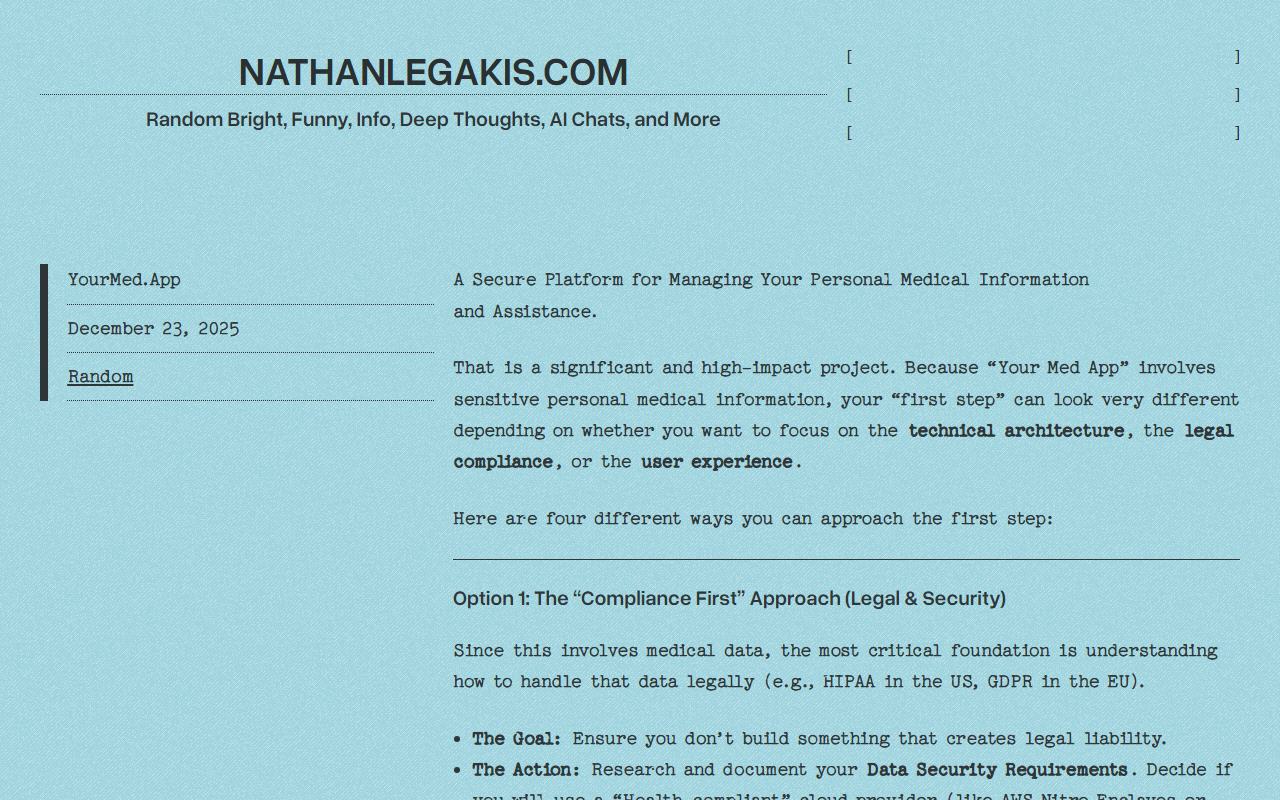
Upon visiting doctor.yourmed.app, I was redirected to a personal blog hosted on NathanLegakis.com. The landing page presents a single post titled "YourMed.App," dated December 23, 2025. The interface is a standard WordPress layout with a sidebar for subscription prompts. The core content is not an actual application but a detailed AI-generated conversation—powered by Google Gemini—offering strategic advice on building a secure medical information platform. The chat is embedded via a link to gemini.google.com/share/3d34da294af4. There is no sign-up flow, no demo, and no dashboard to explore. Instead, the entire "tool" is a static blog post containing a structured breakdown of four development approaches: compliance-first, user-centric, MVP prototyping, and brand positioning. Testing the free tier is essentially reading the post and following the Gemini link to view the original conversation.
Core Capabilities and Technology
The tool does not provide a working app for managing medical records; rather, it serves as a generative AI writing assistant that produces a customized project roadmap. The underlying technology is Google Gemini, though the website does not specify which model version is used. The output is a well-organized table and bullet points covering HIPAA/GDPR considerations, wireframing tools like Figma, database schema planning, and domain acquisition. The AI demonstrates strong reasoning by splitting the advice into four distinct paths, each with a clear "best for" audience and a first deliverable. There is no API, no database backend, and no user authentication system—the tool is purely a text-generation interface for planning. Pricing is not publicly listed on the website, as the blog post is free to read; the Gemini chat is also accessible without charge via a shared link.
Strengths and Limitations
The main strength is the depth and relevance of the guidance. For anyone starting a health-tech project, the AI offers actionable steps that cover legal compliance, user experience, rapid prototyping, and branding in a single coherent response. The use of a summary table makes it easy to compare approaches. The AI also injects practical details, such as "AWS Nitro Enclaves" and "2FA," which show attention to real-world constraints. However, the limitations are significant. The tool is not an interactive application—it is a one-off blog post with a static AI conversation. There is no way to input your own project details, receive custom follow-up advice, or integrate with any medical data system. The website itself is cluttered with subscription prompts, and the navigation is minimal. The overall experience feels like reading a consultant’s memo rather than using a software product.
Comparisons and Final Verdict
Alternatives like ChatPDF or Jasper AI offer more general-purpose AI writing, but they lack the specialized health-tech focus. A competitor like HIPAA Guide provides compliance documentation, but without generative advice. YourMed.App is best suited for aspiring health-tech founders and indie developers who need a structured starting point for their product plan. It is not appropriate for patients seeking to store medical records or for developers needing an API. The website shows no backing or user base indicators. In summary, it functions as a thoughtful blog post powered by Gemini rather than a full-fledged AI tool. If you want a quick, free brainstorm for building a medical app, this is a helpful resource. For any actual medical data management, look elsewhere.
Visit YourMed.App at https://doctor.yourmed.app/ to explore it yourself.













Comments