

What Docugami Does and Who It’s For
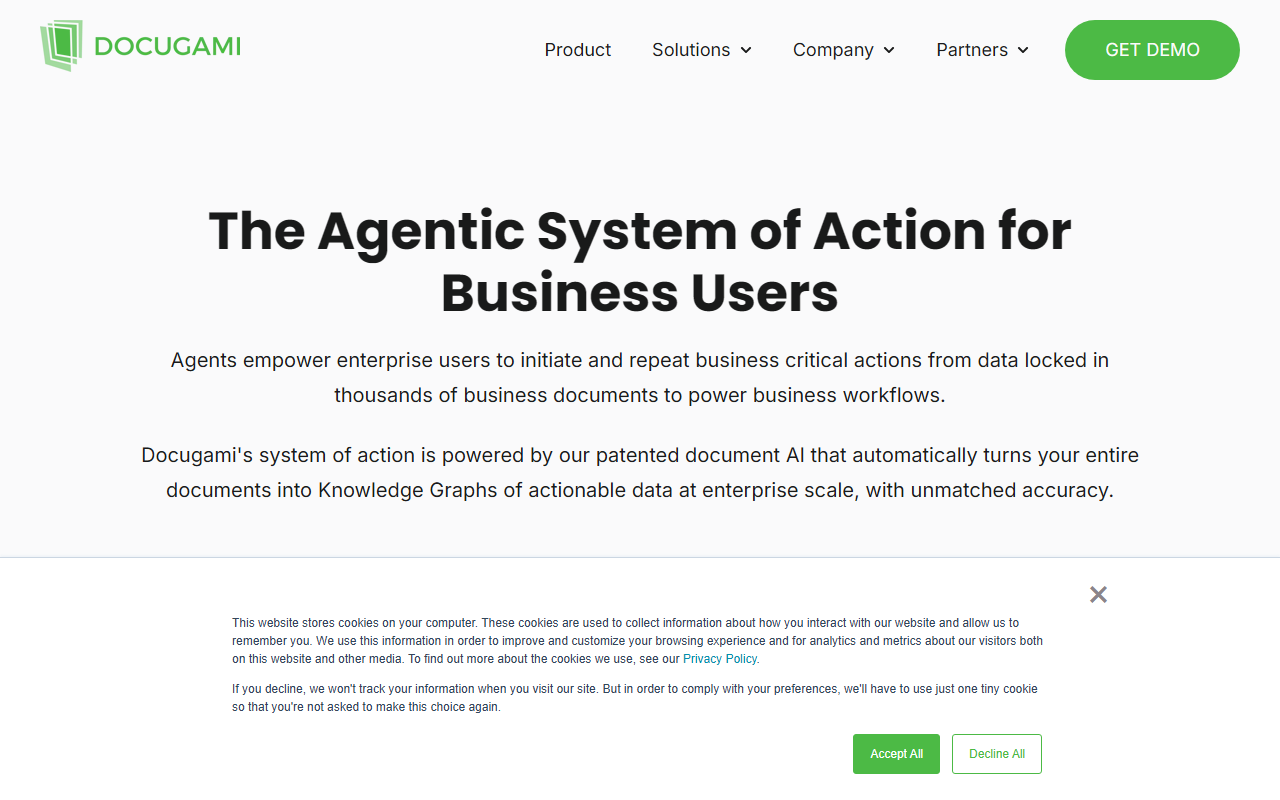
Upon visiting Docugami’s website, the first thing that strikes you is the bold promise: turn your documents into an “agentic system of action.” The hero section wastes no time pitching a solution for the 80% of enterprise data trapped in unstructured formats. Unlike basic OCR tools that merely digitize text, Docugami aims to parse entire documents—contracts, ACORD forms, invoices, clinical trial protocols, HR files—and build knowledge graphs of interrelated data points. The platform then uses AI agents to reason across that data, trigger follow-up actions, and integrate with tools like SharePoint, Excel, Zapier, and Power Automate.
This is clearly built for business users, not developers. The interface promises a no-code experience, letting non-technical staff set up document workflows without writing a single line of code. In my observation, the emphasis on “business users” and “mission-critical actions” tells me Docugami is targeting mid-to-large enterprises in industries like insurance, real estate, life sciences, and legal—anywhere document volume slows down decision-making. If you are a small business looking for a simple PDF scraper, look elsewhere; this tool is about enterprise-scale automation with compliance guardrails like SOC 2 and GDPR.
Key Features and Technical Capabilities
Docugami’s core differentiator is its patented AI that transforms entire documents into “interconnected data graphs.” While most document AI tools extract a few predefined fields, Docugami claims to understand the document’s full context—clauses, tables, relationships—and then feed that into agents that can, for example, flag missing contract terms, compute risk scores, or generate audit-ready reports. The website highlights four agent categories: Contract Intelligence (60% faster reviews), Financial Processing (70% faster invoice handling), Compliance Monitoring, and Clinical & Research structuring.
When testing the conceptual workflow, the integration ecosystem stood out: native connectors to Microsoft Office, Google Drive, Box, Dropbox, and automation platforms like Automation Anywhere. The database of supported document types is impressive, especially the inclusion of ACORD forms for insurance and clinical trial documents for life sciences—niche areas where off-the-shelf OCR often fails. Docugami also emphasizes that its agents “learn and reason,” adapting to a company’s unique business rules over time without manual retraining.
However, since full access requires a demo request, I could not verify the accuracy claims in a live test. The website does not expose a free tier or sandbox, which limits hands-on validation. The promise of “unmatched accuracy” and “agentic action” is compelling but remains unverified until you engage with sales.
Pricing and Positioning in the Market
Pricing is not publicly listed on the website. Interested parties must request a demo, which typically signals an enterprise-only sales model with custom quotes. This is a significant limitation for small teams or proof-of-concept evaluations. Competitors like Abbyy, Amazon Textract, or even UiPath’s document understanding modules offer usage-based or tiered pricing. Unlike those tools, Docugami focuses less on raw extraction and more on turning extracted data into automated actions—a higher-value but also higher-cost proposition.
In terms of market positioning, Docugami’s “agentic” angle differentiates it from passive document readers. It’s closer to an AI co-pilot for documents than a simple parser. The company touts “no vendor lock-in” and “total control of your data,” which will resonate with compliance-heavy enterprises. But without transparent pricing, comparing ROI against Microsoft Syntex or Google’s Document AI is difficult for budget-conscious buyers.
Final Verdict and Recommendation
Docugami is clearly built for enterprises drowning in complex documents and willing to invest in a premium, agent-driven solution. Its strengths—handling niche document types, turning data into knowledge graphs, and offering no-code automation—address real pain points in legal, insurance, and clinical research. The lack of transparent pricing and absence of a self-service trial are real drawbacks. If you can engage with their sales team and negotiate a proof-of-value, this tool could transform sluggish document workflows. For smaller outfits or simple extraction needs, alternatives like Abbyy or Zapier’s parser may be more practical.
Visit Docugami at https://docugami.com/ to explore it yourself.











Comments