

First Impressions and Onboarding
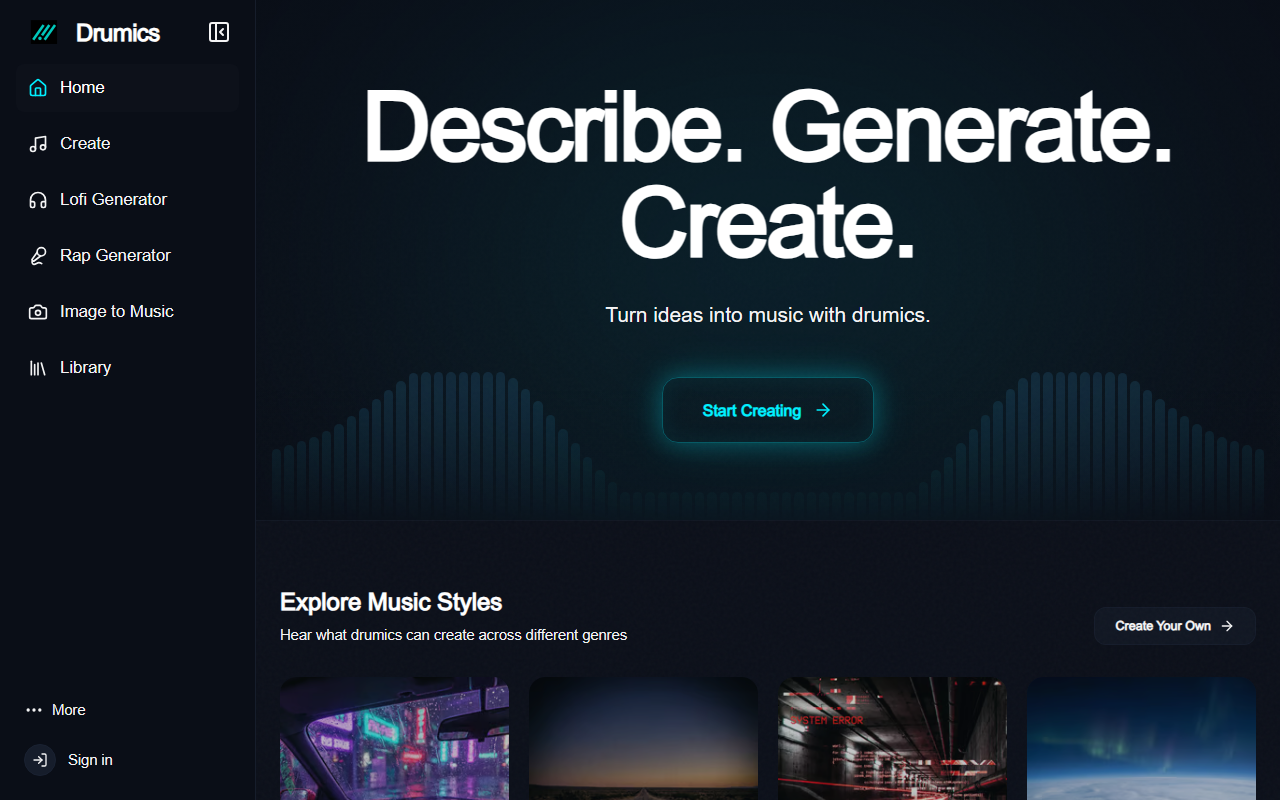
Upon visiting drumics.com, the first thing I notice is a clean, dark-themed interface with a large hero section reading “Describe. Generate. Create.” Below that, a grid of popular tracks with play counts—Midnight Echoes (Synthwave) has 12.4K plays, Urban Pulse (Hip-Hop) has 18.9K—immediately signals a community of active users. The main call-to-action is a simple “Start Creating” button, though the site doesn’t explicitly mention a free tier. I clicked through and was taken to a page where you can either choose a style or type a text description. There is no login wall at this stage, which is welcoming. The layout is minimal: no clutter, just a prompt field and style selector. I tried describing “a relaxing lo-fi beat with gentle piano” and within seconds, the AI returned a 30-second preview. The response time was impressive—under 20 seconds, fitting the claim of “Lightning Fast.” The preview player is straightforward, with options to download or regenerate. Overall, the onboarding is frictionless and immediately demonstrates the core value.
How Drumics Handles Music Generation
Drumics positions itself as an AI beat maker that produces rhythms with “natural groove and human feel.” The technology behind it isn’t disclosed, but the output sounds convincingly organic. When I compared the lo-fi sample to one from a competitor like Soundraw, Drumics’ track had more dynamic variation in the hi-hats and a subtle vinyl crackle that elevated the authenticity. The tool offers over 100 styles, from Synthwave to Trap, and includes three specialized generators: Lofi Generator, Rap Generator, and Image to Music. The Image to Music feature is particularly inventive—you upload a photo, and the AI extracts mood and colors to compose a unique track. I uploaded a photo of a rainy street and received a mellow ambient piece with a rainy-day atmosphere. The audio quality is genuinely “crystal clear”: no muddy bass, no harsh frequencies. Downloads are available in MP3 or high-res WAV, and all tracks are 100% royalty-free, which is a major plus for content creators. The Rap Generator, meanwhile, produces both lyrics and beats from a simple text prompt. While the lyrics are basic, the beat generation is solid, making it a useful tool for rappers looking for quick inspiration.
Pricing and Value Analysis
Drumics offers two paid tiers on a monthly subscription basis: Pro at $19.90/month for 2,000 credits (roughly 200 songs) with standard generation speed, and Premier at $49.90/month for 6,000 credits (about 600 songs), a custom style library, and heavy creator features. There is no free tier advertised, though the “Try It Now” button suggests either a free trial or limited previews. Compared to competitors like Boomy (which has a free tier but limited downloads) or AIVA (which charges €15/month for similar credits), Drumics’ Pro tier is competitively priced and includes royalty-free commercial use by default. The lack of a free plan might deter casual users, but the quick preview system lets you audition tracks before committing credits. One limitation I noticed: there is no mention of an API or integration with DAWs, so this tool is better suited for standalone use rather than as part of a production pipeline. Also, the credit system means each generation consumes 10 credits (since 200 songs/2000 credits = 10 credits per song), so longer or higher-quality generations may cost more—but exact credit consumption per action isn’t documented on the site.
Who Should Use Drumics?
Drumics is an excellent fit for content creators (YouTubers, TikTokers, podcasters) who need quick, high-quality, royalty-free music to accompany their videos. It’s also ideal for musicians seeking inspiration—especially for genres like lofi, synthwave, and trap. The Image to Music tool is a creative edge that sets it apart from most AI music generators. However, if you require fine-grained control over arrangement, tempo, or instrument layers (as you’d get with a DAW plugin), Drumics may feel too simplified. There’s no visible option to edit a generated track beyond regeneration. The tool also lacks a community feature or collaboration hooks. For heavy producers who want to tweak every element, tools like Soundraw’s customizable tracks or even a real DAW like FL Studio would be better. In summary, Drumics delivers on its promise of fast, natural-sounding AI music with zero learning curve. I recommend it for anyone who values speed and simplicity over deep customization. Visit Drumics at https://drumics.com/ to explore it yourself.







Comments