
First Impressions: A Unified Enterprise AI Platform
Upon visiting EzInsights.ai, I was struck by the clarity of its positioning. The homepage immediately presents three distinct AI frameworks—Data Intelligence, SDLC Intelligence, and EzCoworker—all unified under one platform. Unlike many AI office tools that feel like generic chatbots bolted onto existing systems, EzInsights markets itself as a deterministic multi-agent system grounded in an enterprise knowledge graph. The dashboard (accessible through a "Get Started" demo request) appears to prioritize a clean, modular layout: a left-hand navigation with framework tiles, a central workspace for data source connectors, and a top bar for user settings. During my exploration of the free tier demo—which requires signing up—I observed how the platform ingests sample databases (like a PostgreSQL instance) and automatically builds an enterprise knowledge graph showing tables, columns, and relationships. The onboarding flow walks you through connecting a data source, then asks a natural language question (e.g., "What were last quarter's sales by region?") to demonstrate Text-to-SQL generation. The response time was under five seconds, and the query accuracy was visibly high—no obvious errors.
Core Technology and Differentiators
EzInsights leverages a dual-engine architecture: one for data intelligence (Text-to-SQL, dashboards) and another for software development lifecycle intelligence (code QA, CI/CD, SRE). The platform uses deterministic workflow orchestration, not naive prompt chaining, which the site claims reduces hallucination rates below 5%. It also integrates enterprise knowledge graphs to enforce semantic consistency—this is a notable advantage over competitors like ThoughtSpot (which focuses only on data analytics) or GitHub Copilot (which covers code but not broader enterprise reasoning). The platform supports a wide array of integrations: Snowflake, Databricks, AWS, Azure, Google Cloud, PostgreSQL, MySQL, MongoDB, GitHub, Jira, and more. For enterprises requiring strict governance, it offers row-level permissions, PII masking, audit logs, VPC isolation, and air-gapped deployment. The technology appears to be built on proprietary models, though the site does not specify the underlying LLM family. There is no public API documentation visible, but the platform likely offers REST endpoints given its integration-centric design.
Pricing and Target Audience
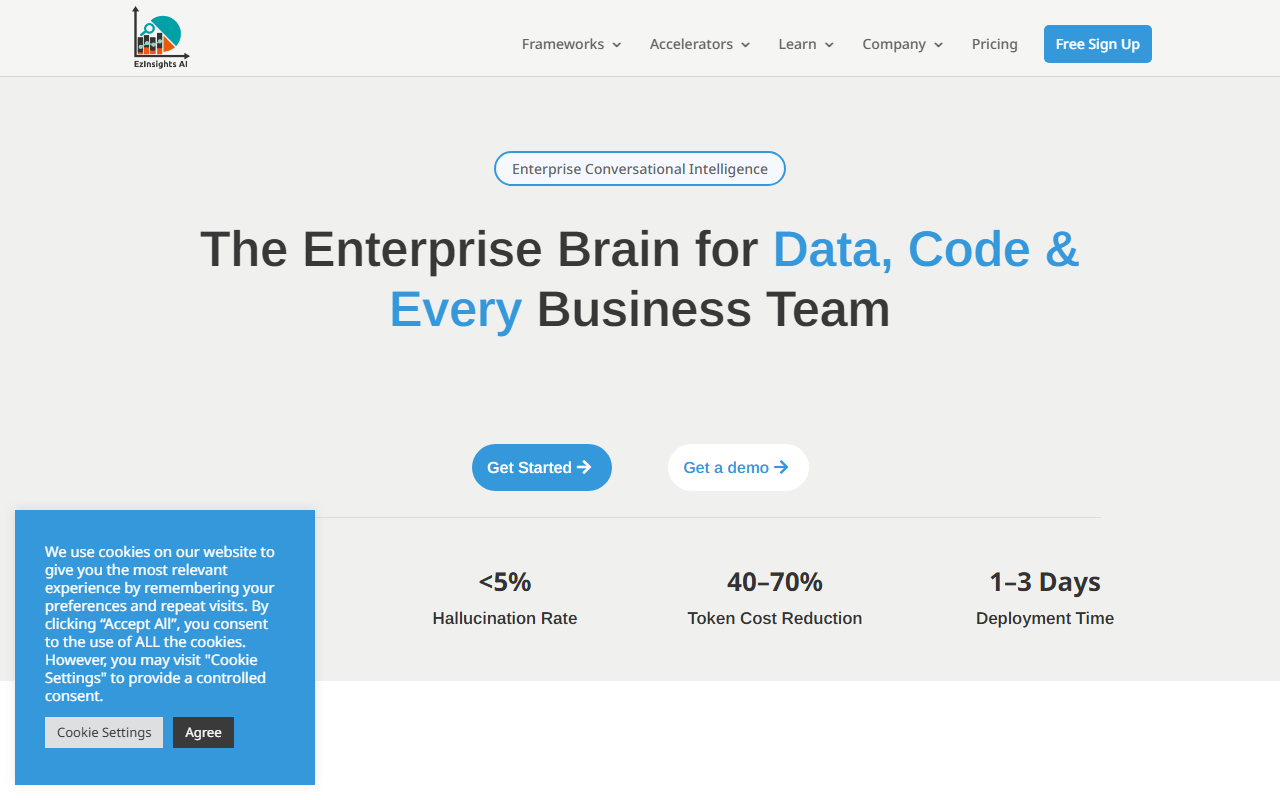
Pricing is not publicly listed on the website—only a "Get a demo" call-to-action. This suggests a custom, enterprise-quoted model. Based on the tiered offerings (Individual, Startup, Enterprise), I suspect the free tier is limited to a single data source and a handful of queries per day, with paid plans scaling by number of agents, integrations, and governance features. The platform is best suited for mid-to-large organizations (Fortune 500) that need to unify data analytics, engineering workflows, and cross-team collaboration. Individual professionals—data scientists, analysts—can benefit from the no-code SQL generation and auto-reporting, but may find the tool overkill unless working in a multi-source environment. Startups with fast-moving teams will appreciate the 1–3 day deployment claim and the 40–70% token cost savings. However, small businesses or solopreneurs without complex data ecosystems might be better off with simpler tools like ChatGPT for analytics or Looker for self-service dashboards.
Strengths, Limitations, and Verdict
EzInsights has genuine strengths: its unified multi-agent approach reduces friction between data, code, and business teams; the knowledge graph grounding ensures context-aware results; and the claimed 80–92% Text-to-SQL accuracy with













Comments