

First Impressions and Onboarding
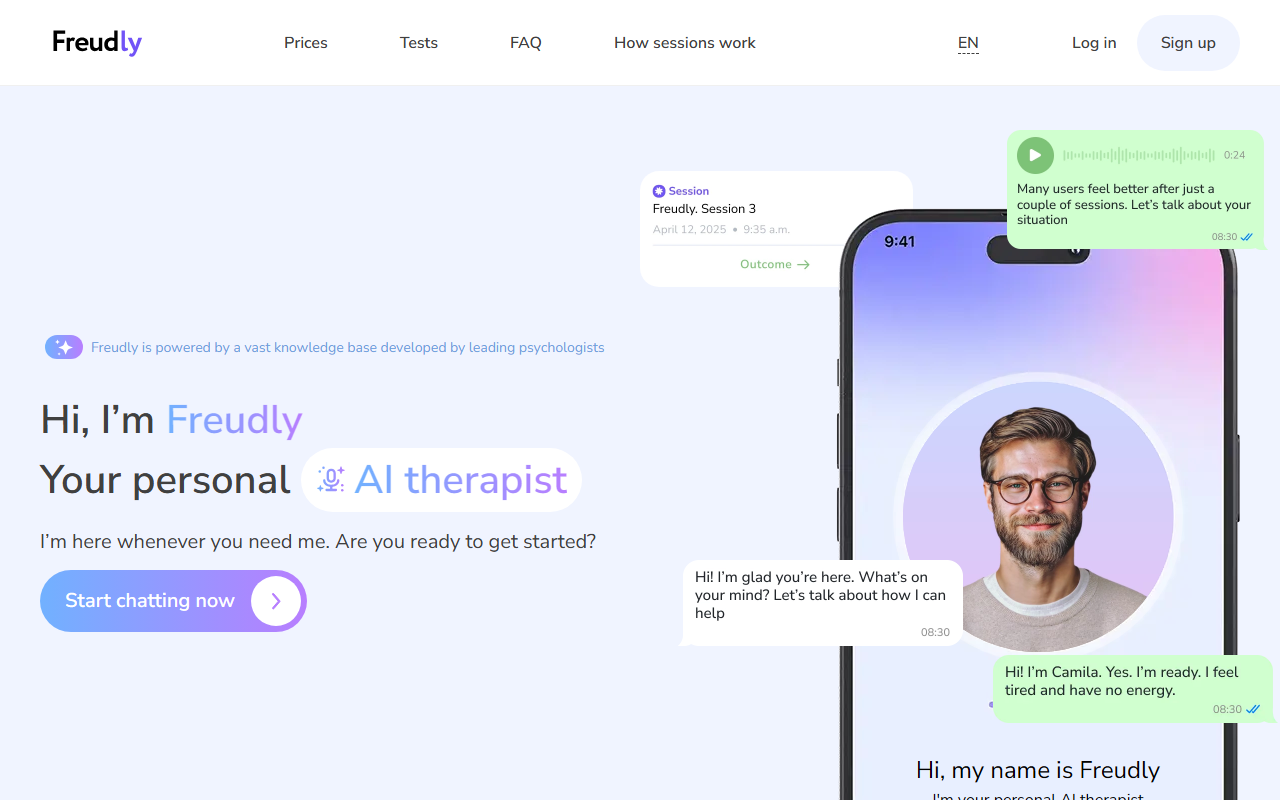
Upon visiting Freudly.ai, I was greeted by a clean, calming interface with a prominent chat window. The tagline “Your personal AI therapist” appears immediately, paired with live user statistics: 0 online (fluctuates), 93% satisfaction, and 489,000 sessions per year. The palette uses soft greens and whites, evoking a clinical but reassuring feel. Onboarding is minimal—no account required to start a session. I clicked “Start chatting now” and was immediately prompted to describe what was bothering me. The bot introduced itself as Freudly, emphasizing its training on 840,000 scientific papers and 1.2 million psychotherapy cases. Within seconds, I was typing my first message about general anxiety. The experience felt frictionless, which is crucial for a mental health tool aimed at reducing barriers to help.
Core Functionality and Therapeutic Approach
Freudly’s core value lies in its conversational AI that applies cognitive behavioral therapy (CBT) techniques. During my test, I described feeling anxious without a clear trigger. The AI responded by validating my emotions and then guiding me toward structured exploration: identifying patterns, examining thoughts, and suggesting self-regulation exercises. It proposed a three-step plan and used emojis to keep the tone friendly—a deliberate choice to mimic human warmth. The tool also offers AI-powered self-awareness tests based on validated scales like the Beck Depression Inventory. I accessed the test library via the top menu; it contains over 3,000 questionnaires covering anxiety, self-worth, relationships, and more. Results are analyzed immediately, and the AI integrates them into a personalized psychological profile. Voice chat is another feature—I tested it briefly; the AI claimed it could interpret tone and pauses, though I found the transcription accuracy acceptable. The claimed training data (840k papers, 1.75 million hours of lectures) lends authority, but without peer-reviewed validation, I treat this as marketing. Nonetheless, the conversational flow felt logical and empathetic, not generic.
Privacy, Pricing, and Limitations
Freudly emphasizes end-to-end encryption for all chats, stating that no human can access conversations. This is a strong claim for a free service. However, I could not find a detailed privacy policy or data retention terms on the site itself—the footer links were minimal. Pricing is not publicly listed on the website; the “Prices” link in the navigation leads to a sign-up page, suggesting a freemium model after initial free sessions. For context, alternatives like Woebot offer similar CBT approaches but require a subscription for full features, while BetterHelp connects users with human therapists at a cost. Freudly’s major strength is 24/7 availability and zero financial barrier to start. The limitation is critical: as an AI, it cannot diagnose clinical conditions, handle crisis intervention, or replace a licensed professional. The tool itself warns in fine print (found in the FAQ) that it is not a substitute for therapy, but the landing page’s bold “AI Therapist” label may mislead users with serious mental health needs. Also, the AI’s reliance on predefined CBT structures might feel robotic to those who need more flexible or psychodynamic approaches.
Conclusion and Recommendation
Freudly is a well-designed, accessible tool that excels at providing immediate, evidence-informed emotional support. Its extensive test library, voice chat, and personalized profiling set it apart from simpler chatbots. I recommend it for people experiencing mild anxiety, stress, or self-exploration who want a judgment-free, always-available sounding board. It is not suitable for those with severe depression, suicidal thoughts, or complex trauma—those individuals should seek human therapists. The combination of 840k research papers and 1.2 million therapy cases as training data is impressive, but transparency about accuracy and limitations would build more trust. If you’re curious about AI-assisted mental health and want a free entry point, Freudly is worth a session. Visit Freudly at https://freudly.ai/ to explore it yourself.













Comments