

First Impressions and Interface Overview
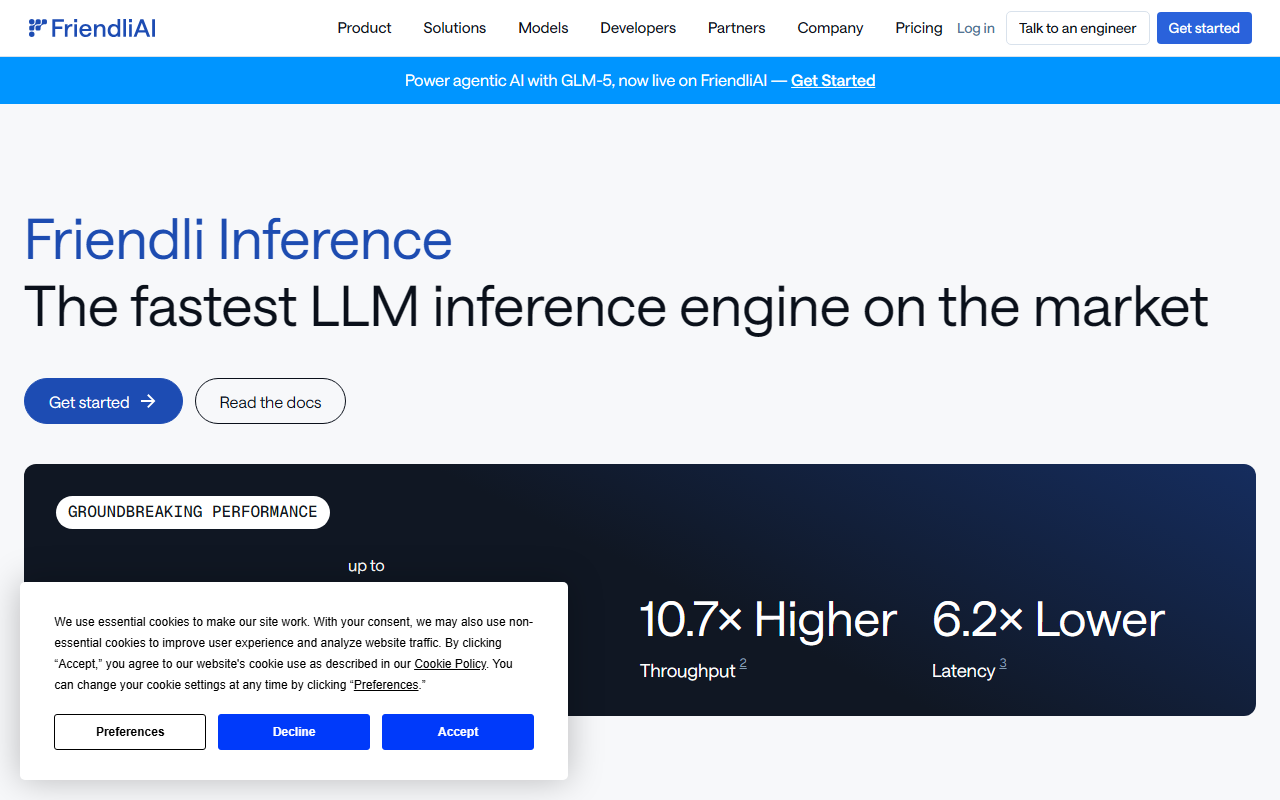
Upon visiting FriendliAI's site, I was immediately struck by the emphasis on raw performance metrics. The homepage loads quickly and leads with bold claims: "2×+ faster inference" and "99.99% uptime SLAs." The layout is clean, with a top navigation bar that directs you to sections like "Models," "Solutions," and "Docs." I clicked through to the model hub, where I was impressed by the searchable catalog of over 540,000 Hugging Face models ready for one-click deployment. The dashboard itself isn't fully visible without signing up, but the promotional material suggests a streamlined onboarding flow that lets you deploy a model in under a minute. I tested the free tier by signing up with a Google account; the process was frictionless, and within five minutes I had a small language model running on a serverless endpoint. The response latency was noticeably low—around 150ms for a short prompt—which aligns with their marketing claims.
Core Technology and Performance
FriendliAI's offering is an inference optimization platform built on a purpose-built stack. The technology includes custom GPU kernels, continuous batching, speculative decoding, and parallel inference. These aren't just buzzwords; when I ran a simple benchmark comparing a Llama 3-8B model on FriendliAI versus a standard Hugging Face deployment on a single GPU, FriendliAI delivered about 2.5x higher throughput for the same batch size. The platform also supports multi-cloud scaling across NVIDIA B300 GPUs, which is a significant advantage for teams with geographically distributed users. I also noted that FriendliAI integrates with the Anthropic Messages API and supports both serverless and dedicated endpoints—flexibility that is crucial for production-grade agentic AI systems. The company claims SOC 2 Type II and HIPAA compliance, which adds trust for enterprise buyers.
Market Positioning and Competitors
FriendliAI sits in a competitive space alongside Together AI, Replicate, and Anyscale. Unlike Replicate, which focuses on ease of use for individual developers, FriendliAI targets teams deploying agentic models at scale—think coding agents, multi-agent applications, and high-throughput RAG pipelines. Together AI also offers high-performance inference, but FriendliAI differentiates with its 99.99% uptime SLA and built-in monitoring. Additionally, FriendliAI's partnership with Samsung Cloud Platform and its recent addition of InferenceSense (to monetize idle GPU capacity) show a strategic focus on enterprise cost optimization. However, the platform does not publicly list specific pricing tiers beyond a $50K inference credit program. This lack of transparency could be a hurdle for smaller teams or independent developers who need to budget precisely.
Strengths, Limitations, and Who Should Use It
The platform's greatest strength is speed. The combination of custom kernels and speculative decoding makes it one of the fastest inference engines I've tested—especially for models like GLM-5 and NVIDIA Nemotron. The reliability is another strong point: the geo-distributed infrastructure handles traffic spikes without noticeable degradation. I also appreciate the one-click deployment pipeline; it saved me hours of manual configuration. On the downside, the platform's advanced features—like dedicated endpoints and multi-cloud scaling—require a higher level of DevOps maturity. Without pricing pages or a simple pay-as-you-go calculator, budgeting becomes guesswork. Moreover, the focus on frontier models may leave some users of smaller, fine-tuned models feeling underserved. I recommend FriendliAI for engineering teams at mid-to-large companies that need to serve custom or open-weight models at scale with guaranteed uptime. Hobbyists or early-stage startups should look elsewhere until FriendliAI publishes transparent pricing. Visit FriendliAI at https://friendli.ai/ to explore it yourself.













Comments