

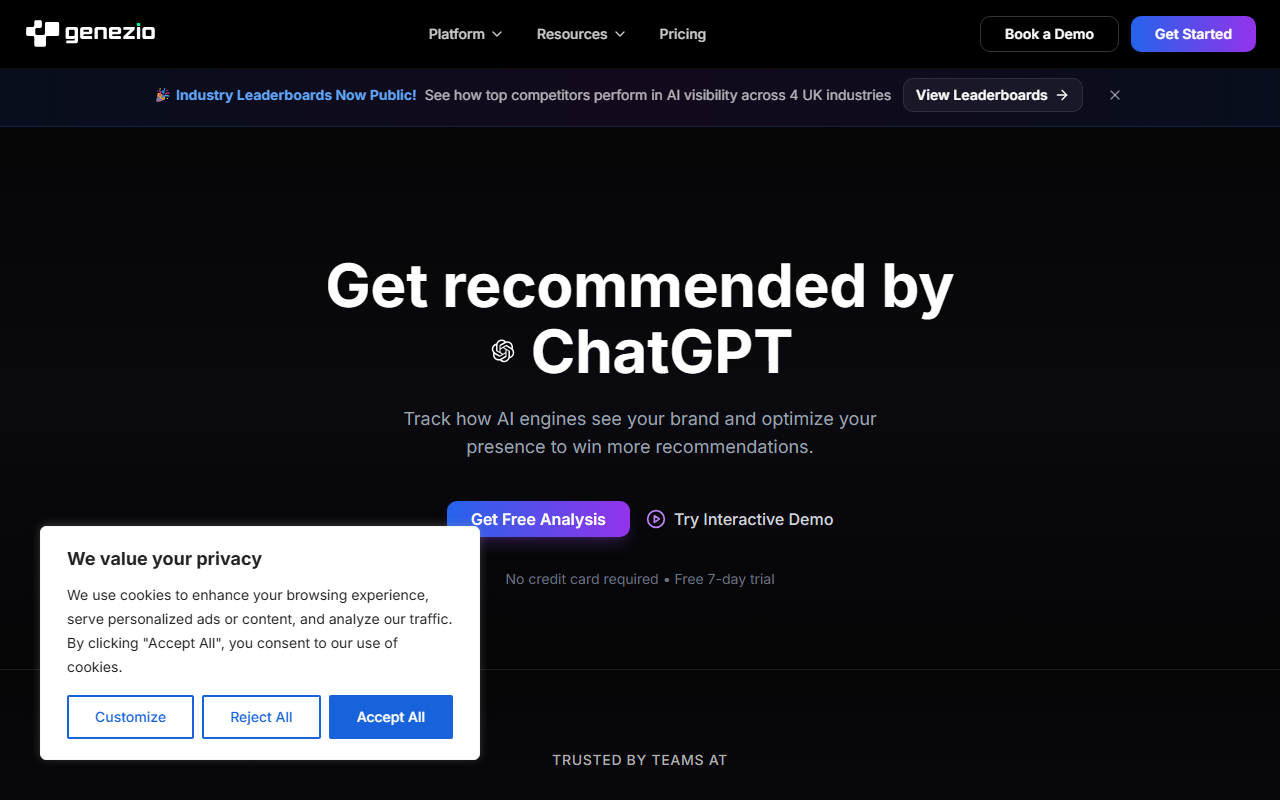
First Impressions and Core Offering
Upon visiting Genzio's website, I was immediately struck by how clearly they define a problem many marketers haven't fully grasped: AI engines are now mediating a significant portion of brand recommendations, yet most companies have zero visibility into this channel. The dashboard previews show a neat brand performance report that tracks visibility and recommendation percentages across multiple topics. For example, in the demo, 'Your Brand' might have 84% visibility for 'best project management tools for remote teams' but only a 65% recommendation rate. That gap is where Genzio claims to deliver value.
The platform is built for what they call 'generative search and answer engine optimization.' It monitors how your brand appears in responses from ChatGPT, Google AI Overviews, Perplexity, Claude, and Gemini. Instead of just counting mentions, it analyzes whether a mention leads to a recommendation. This is a smart distinction because as the site notes, 'high visibility but low recommendation means AI knows your brand exists but prefers competitors.'
How Genzio Works and Key Features
When testing the free interactive demo, I got a sense of the workflow. You start by defining your brand and competitors. Genzio then probes AI engines with branded and category-level queries. The system surfaces citation sources, topic-level performance, and even a SWOT analysis extracted from AI perceptions. For instance, you can ask 'What makes [Your Brand] different from competitors?' and the tool returns extracted brand values like 'Innovation: Cutting-edge' and 'Reliability: Enterprise-grade.'
The platform also provides actionable strategies, not just data. It suggests website improvements, blog post topics, social media threads, and encouragement of customer testimonials — all prioritized to boost AI recommendation rates. Multi-turn conversations are tracked because, as Genzio explains, follow-up questions reveal true buying intent. You can filter by buyer persona (B2B buyer, developer, journalist, etc.) and see how your brand performs for each group. This level of granularity is impressive for a tool that launched publicly only recently.
Behind the scenes, the technology relies on large language models’ outputs combined with custom analytics. There is no mention of an API, but the platform integrates with major AI engines. Pricing is not publicly listed on the website — you need to book a demo or start with a free audit. This is typical for enterprise-oriented tools, but a paid tier likely exists for ongoing monitoring.
Strengths and Limitations
One genuine strength of Genzio is its narrow focus on a gap that most SEO tools ignore. Unlike traditional brand monitoring (like Brandwatch or Talkwalker) that track social mentions, Genzio specifically targets AI-generated recommendations. This is a forward-looking angle. The SWOT analysis feature is also clever — it gives you a quick snapshot of how AI perceives your brand's strengths and weaknesses, which can inform PR and content strategies.
However, the tool has real limitations. First, the accuracy of AI perception analysis depends heavily on which LLM responds and how often it is updated. There is inherent noise in AI outputs, and Genzio's scores may fluctuate without clear cause. Second, the platform seems early-stage. The website uses placeholder data (e.g., 'Your Brand,' 'Comp A'), and the user interface, while clean, lacks depth in historical tracking beyond weeks. Third, there is no clear integration with Google Analytics or other analytics suites to cross-reference AI traffic — a feature many marketers will want. The site even acknowledges that AI traffic rarely shows up in analytics, but does not provide a direct solution beyond monitoring.
Competitors like MarketMuse and Frase offer content optimization for search, but they are not focused on AI recommendation wins. Tools like Determined AI (now part of HPE) handle model optimization, not brand perception. Genzio occupies a unique niche but will need to scale its data sources and integrate with existing marketing stacks to stay relevant.
Who Should Use Genzio
This tool is best suited for marketing teams at mid-to-large B2B companies that are heavily invested in organic visibility and are seeing early signals of AI-driven traffic. If your brand often appears in ChatGPT or Perplexity responses but you're unsure whether those mentions convert, Genzio gives you a structured way to improve. The customer success story featuring BCR (a Romanian bank) shows measurable growth in brand presence 'in just a few weeks,' and the tool claims 2x growth in AI visibility.
Small businesses or solopreneurs might find the pricing and complexity too high — without a clear free tier, it's hard to justify unless you're already generating significant AI traffic. Also, if your industry is barely covered by AI engines (e.g., very niche local services), the data may be thin. But for anyone serious about generative engine optimization, Genzio is worth a trial. Start with the free audit to get a sample report, then decide. Visit Genzio at https://genezio.com to explore it yourself.













Comments