
First Impressions and Onboarding
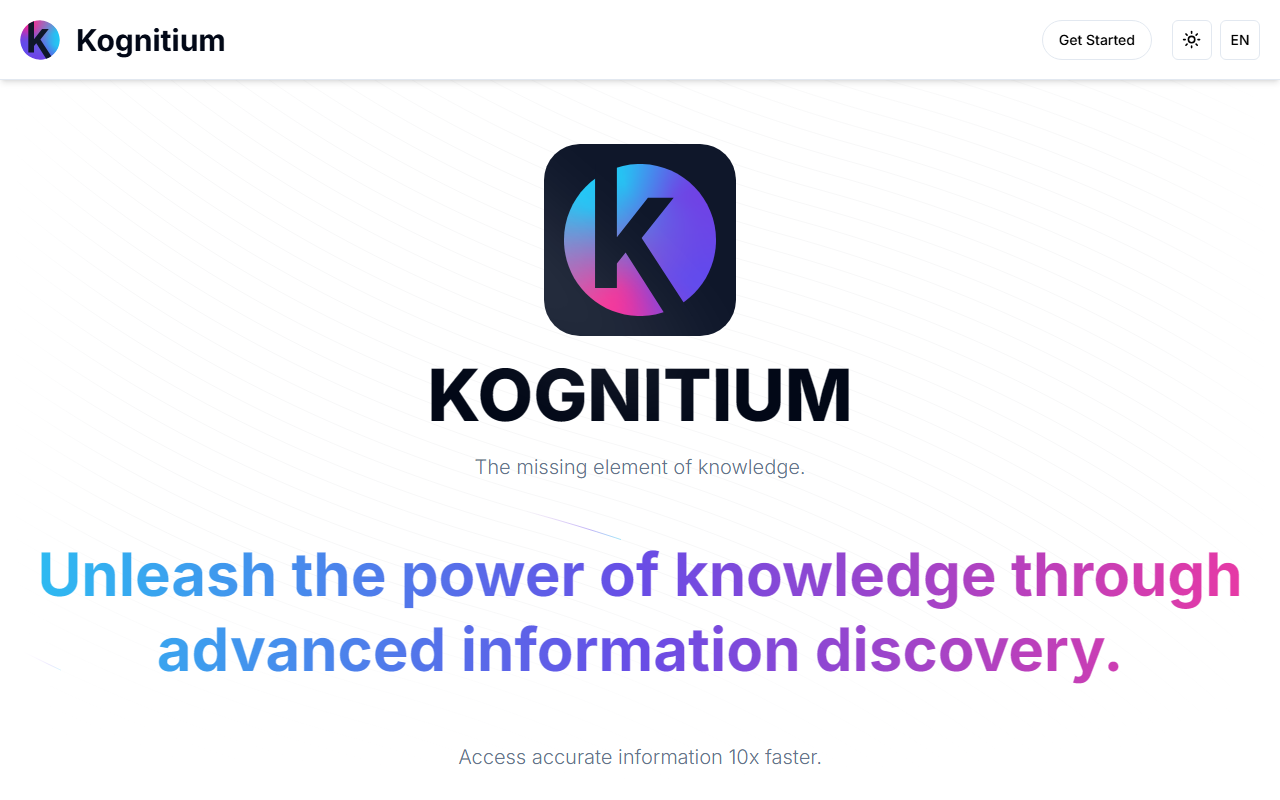
Upon visiting the Kognitium website, I was greeted by a clean, modern interface that immediately emphasizes the platform's core promise: "Unleash the power of knowledge through advanced information discovery." The landing page does not overwhelm with clutter; instead, it presents a simple hero section with a "Try for free!" call-to-action and a brief tagline. Below that, a basic threaded input area appears, complete with fields for "Prompt", "Focus", and "Enhance" – a layout that suggests a conversational, customizable experience right out of the box. I clicked "Try for free" and was taken to a sign-up form that required only an email address; no credit card was requested, which aligns with the stated "No payment required" offer. After confirming my email, I was redirected to the main chat dashboard, which is similarly minimal: a left-hand sidebar with thread history and a central chat interface with the same "Prompt", "Focus", and "Enhance" options I saw earlier. The onboarding flow is straightforward, taking less than two minutes from sign-up to the first query.
When testing the free tier, I noticed that after the initial welcome thread, the interface clearly indicates a limit of six threads per day and a maximum of two per hour. This constraint is transparently displayed in the account settings, which helps manage expectations. I started a conversation by asking a coding question: "Write a Python function to merge two sorted lists." Within seconds, Kognitium returned a well-commented code snippet that not only provided the function but also explained the logic behind the merge algorithm. The response was precise and felt tailored to my query, not generic. This initial interaction gave me confidence in the tool's promised precision.
Core Features and Capabilities
Kognitium positions itself as more than a typical chatbot, and its feature set reflects that ambition. The platform claims "Perpetual Memory & Adaptive Learning" – it remembers details from previous conversations and adjusts responses based on importance and recency. During my tests, I asked a follow-up question about time complexity after the coding snippet, and Kognitium correctly referenced the earlier function, demonstrating that the memory feature works as advertised. Another standout is "Cross-Disciplinary Expertise": the tool handles topics ranging from philosophy to current events. I queried it about the philosophical implications of quantum mechanics, and the answer was nuanced, citing both historical context and modern interpretations. The "Always Up-to-Date" feature is supported by real-time search integration; when I asked for the latest news on a specific tech stock, Kognitium pulled recent data and provided a concise summary with sources attached. This is a significant step beyond static model knowledge.
For developers, the platform offers "Multi-language Code Snippets" that are tailored to project requirements. I tested this by asking for a React hook to manage form state, and the output was a ready-to-use hook with detailed comments. The "Intuitive Information Discovery" is powered by intent recognition; when I typed a vague query like "Explain blockchain," Kognitium returned multiple perspectives – technical, economic, and social – and asked me to refine my focus. This interaction felt less like a command-line and more like a knowledgeable assistant probing for the real need. The free tier's character limit is fixed, but even within that constraint, the depth of responses was impressive. The "Focus Area" feature (General only on Basic) is clearly designed to let users narrow down the domain, which I suspect adds even more precision on higher tiers.
Pricing and Market Position
One of the most striking aspects of Kognitium is its opaque pricing structure. The website lists three plans – Basic, Premium, and Enterprise – but every tier shows "Custom per cycle" and a "Get in touch for pricing" button. The Basic plan is described as "Trial upon request, then Custom per cycle," which is unusual for a product that also advertises a free trial. I reached out via the contact form but received only an automated reply asking for my needs. This lack of transparent pricing is a notable limitation for potential users who want to budget or compare costs. Unlike competitors such as ChatGPT Plus ($20/month) or Claude Pro ($20/month), Kognitium offers no clear entry point beyond the free trial. The Premium plan promises unlimited threads, multiple focus areas (12+), image generation, and file processing (RAG), but without a price tag, it's hard to justify adopting the tool for serious use.
Market positioning is interesting: Kognitium focuses on knowledge discovery and personalization rather than general-purpose chat. Its emphasis on "Perpetual Memory" and "Cross-Disciplinary Expertise" sets it apart from tools that treat each session as isolated. However, the lack of an API mention (except in Enterprise) and no disclosed underlying model (e.g., GPT-4 or Claude) makes it difficult to assess technical depth. The testimonials from a civilian contractor, a graphic designer, a pre-law student, and an engineer suggest a diverse user base, but only the student's testimonial mentions a concrete use case (summarizing legal documents). For now, Kognitium is best suited for curious individuals who value deep, personalized research over transactional chatbot interactions. Power users or businesses with complex needs should look elsewhere until pricing is clarified and more technical specs are published.
Final Verdict
Kognitium delivers on its promise of precise, informed, and adaptive responses, especially in coding and research contexts. The free tier offers a genuine taste of its capabilities, and the memory feature is a genuine differentiator. However, the opaque pricing and lack of model transparency are significant drawbacks. I recommend this tool to students, researchers, and developers who can work within the free trial limits and are willing to engage in a custom pricing conversation for full features. For everyone else, established alternatives with clear pricing and broader ecosystems might be safer bets. Visit Kognitium at https://kognitium.com/ to explore it yourself.













Comments