

First Impressions: A Developer-Oriented Research Portal
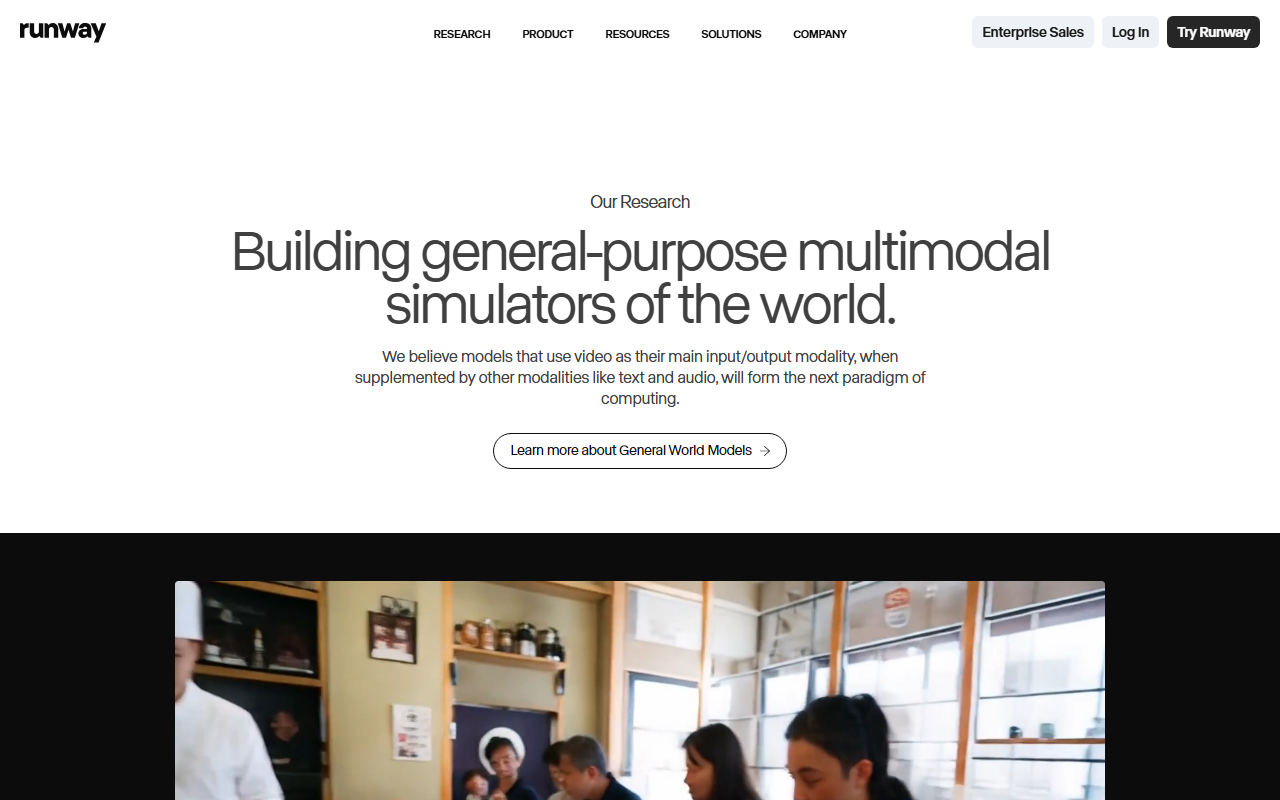
Upon visiting the Runway research site at research.runwayml.com, I was greeted by a clean, minimalistic layout that immediately signals a focus on technical depth rather than flashy marketing. The hero section proclaims a mission to build "general-purpose multimodal simulators of the world," which sets a high bar. Scrolling down, the page is essentially a chronological feed of research papers, blog posts, and product announcements, interspersed with featured work like the introduction of Runway GWM-1 (General World Model) from December 2025. There is no interactive demo or sandbox on this page—this is purely an academic/developer portal. The navigation is sparse: a top bar with links to Enterprise Sales, Log in, and Try Runway, the last of which redirects to the main product site (runwayml.com). For a review focused on the research framework, this is exactly what I expected: a knowledge repository, not a product demo.
What Runway’s Research Platform Offers
Runway is widely known for its commercial video generation tools like Gen-2, Gen-3 Alpha, and Gen-4, but this research page serves a different purpose. It provides access to preprints, technical blogs, and updates on model architectures that underpin those products. For example, a paper titled "Autoregressive-to-Diffusion Vision Language Models" (September 2025) details how to adapt pretrained autoregressive models for parallel diffusion decoding—a technique that likely powers Runway’s latest speed improvements. Another paper, "Dual-Process Image Generation," proposes a distillation scheme using vision-language models to teach new control tasks to feed-forward generators. These are not just product announcements; they are serious technical contributions aimed at the AI research community. The page also highlights research on stochastic 3D Gaussian splatting, robot policy evaluation, and the "Turing Reel"—a concept art project. If you are a developer or researcher looking to understand the theoretical backbone of Runway’s video models, this is a goldmine.
Strengths and Limitations
Strengths: The research page is well-organized and transparent. Runway publishes with frequent dates (some even 2026), showing active innovation. Each paper includes author names and an abstract, with links to PDFs. The inclusion of applied research like "Accelerating Robot Policy Evaluation with General World Models" demonstrates versatility beyond media generation. The page also links to external partnerships (e.g., Lionsgate, Tribeca Festival), hinting at real-world impact.
Limitations: The page is purely informational—there is no way to test any model directly from this URL. The focus is on theory, which may frustrate practitioners looking for code or API access. No pricing is listed anywhere on the research site; commercial tiers are only accessible after logging into the main product. Additionally, the page can feel overwhelming for newcomers due to the sheer volume of papers with technical jargon.
Market Position and Who Should Use This
Runway competes with other dev frameworks for video AI, such as Pika Labs (which emphasizes simplicity) and Sora by OpenAI (still in preview). Unlike these, Runway’s research page positions itself as a serious academic hub, not just a consumer tool. It is ideal for machine learning engineers, researchers, and PhD students who want to stay at the cutting edge of video generation and world simulation. If you are a content creator looking for a quick video generator, skip this page and head directly to the main Runway app. The research portal is best for those who appreciate the "why" behind the AI magic.
Visit Runway Research at https://research.runwayml.com/ to explore it yourself.













Comments