

First Impressions and Onboarding
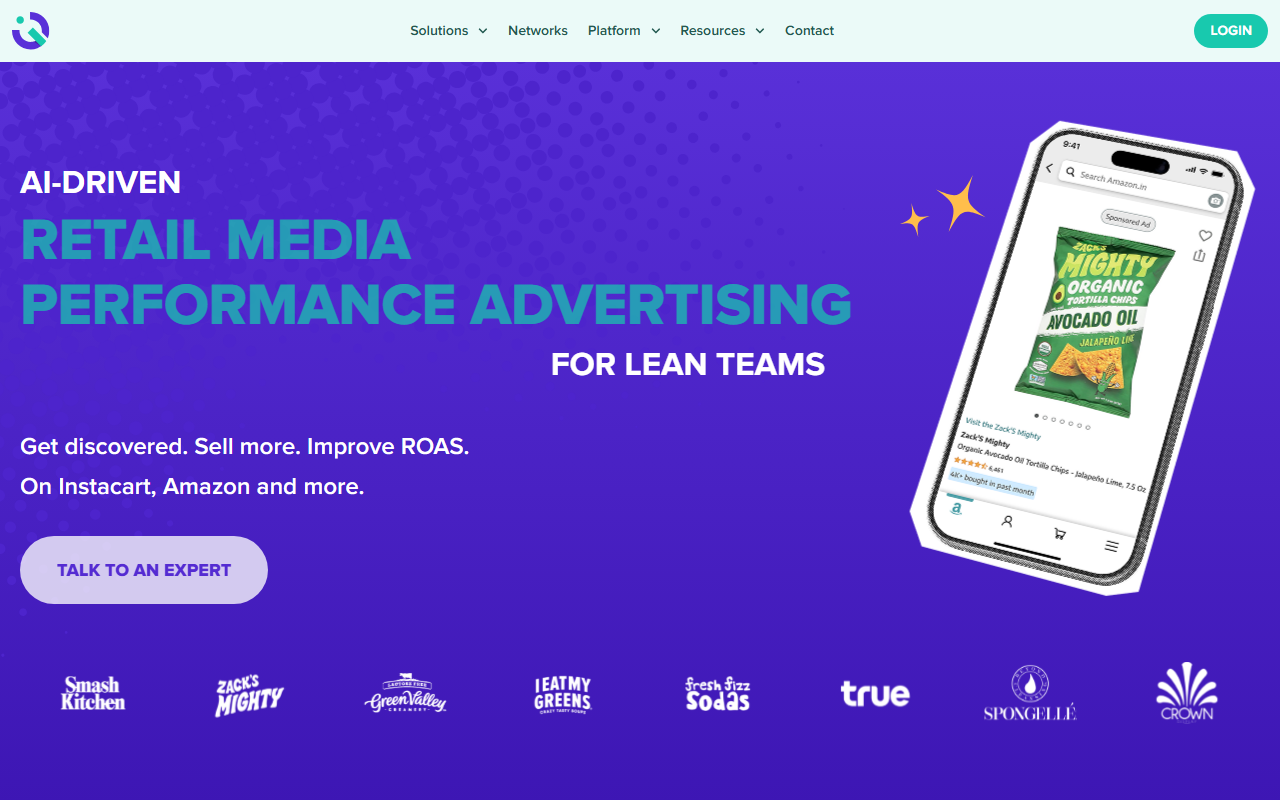
Upon visiting the Retail Media IQ website, I was immediately struck by its focused messaging. The homepage wastes no time declaring its value proposition: AI-driven retail media performance advertising for lean teams. The navigation is minimal — a login button, a call to action to talk to an expert, and a clear hero section that promises to help brands "get discovered, sell more, improve ROAS" on Instacart, Whole Foods, and Walmart. The layout is clean and modern, with bold stat callouts (e.g., +160% ROAS growth on Instacart) that immediately signal credibility.
I clicked through the platform tour sections to understand the onboarding flow. While I didn't sign up for a full trial, the site offers a "Keyword Audit" for $490 (credited if you continue with RMIQ) and a free demo booking. There is no self-service signup visible; the funnel leads to a conversation with the team. This suggests a white-glove onboarding approach, which makes sense given the complexity of retail media management. For a lean team, the lack of an instant free tier might be a barrier, but the pay-for-performance pricing model reduces upfront risk.
Core Capabilities: AI Agents and Cross-Network Optimization
Retail Media IQ’s core technology revolves around what it calls "autonomous agents" — purpose-built AI that continuously optimizes each product’s keywords, bids, and budgets. This is not a simple bulk upload tool; it granularly manages SKU-level campaigns across networks while learning from aggregated cross-network data. For example, if a certain keyword strategy works well on Instacart, the AI applies those learnings to Walmart campaigns without starting from scratch. This is a significant advantage over manual management or using separate dashboards for each retailer.
I found their comparison messaging particularly insightful: "Spicy ≠ Classic" and "Instacart ≠ Walmart" highlight that each SKU and each network requires a different approach. The platform’s custom goals (sales, ROAS, or customer growth) allow brands to align optimization with their specific objectives. The unified reporting dashboard aggregates performance across channels, which is a huge time-saver for lean teams that cannot afford to log into multiple portals. In terms of technology, the website does not specify which AI models power the agents, but the emphasis on continuous learning and cross-network insights indicates a reinforcement learning or rule-based optimization engine.
Pricing and Market Positioning
Pricing is not listed in a traditional tiered structure. Instead, Retail Media IQ uses a "Pay for Performance" model — you pay based on the incremental sales or ROAS improvements generated. This is a bold move that aligns the platform’s incentives with the brand’s success. The only concrete price I saw is the $490 Keyword Audit, which is fully refunded if you continue as a client. This low-risk entry point is smart for skeptical lean teams.
Competitors in this space include Skai (formerly Kenshoo), Pacvue, and third-party agencies that manage retail media manually. Unlike those, Retail Media IQ focuses specifically on lean in-house teams that want AI-driven execution without hiring additional staff. The platform currently supports Instacart and Walmart, with "and more" hinted at but not detailed. This limited network support is a limitation for brands that need Amazon, Target, or other retailer integration. However, for those focused on the supported networks, the specialization likely means deeper optimization logic.
Strengths and Limitations
The strongest aspect of Retail Media IQ is its risk-free pricing model combined with autonomous optimization. For a lean team, the ability to “set and forget” SKU-level campaigns while seeing cross-network learnings is a genuine productivity multiplier. The testimonial from a founder citing 5x ROAS and from Matt Gorella (Senior Brand Manager) showing doubled revenue in two months reinforces the promise. Additionally, the unified reporting and custom goals give clear visibility into performance without data fragmentation.
However, there are notable limitations. First, the supported retail networks are currently limited; brands heavily reliant on Amazon or smaller regional grocers will not be served. Second, the absence of a self-service free tier means you cannot test the platform without a sales conversation. Third, the tool is primarily an ad management optimization platform, not a general-purpose AI writing tool — if you need content generation for product descriptions or ad copy, you’ll need to use it alongside a separate writing tool. The website does not mention API access or integrations with major analytics platforms, which could be a concern for data-driven teams that want to pull reports into their own dashboards.
Retail Media IQ is best suited for lean brand teams managing SKU-heavy catalogs on Instacart and Walmart who want AI to handle the granular optimization. It’s less ideal for enterprises that require full-funnel tools or multi-network support beyond the current roster. If your team is spending hours manually adjusting bids per keyword per product, this platform could drastically reduce that workload while improving performance. I recommend booking the $490 keyword audit to see if hidden revenue is waiting in your existing campaigns.
Visit Retail Media IQ at https://rmiq.net/ to explore it yourself.













Comments