
First Impressions and Onboarding
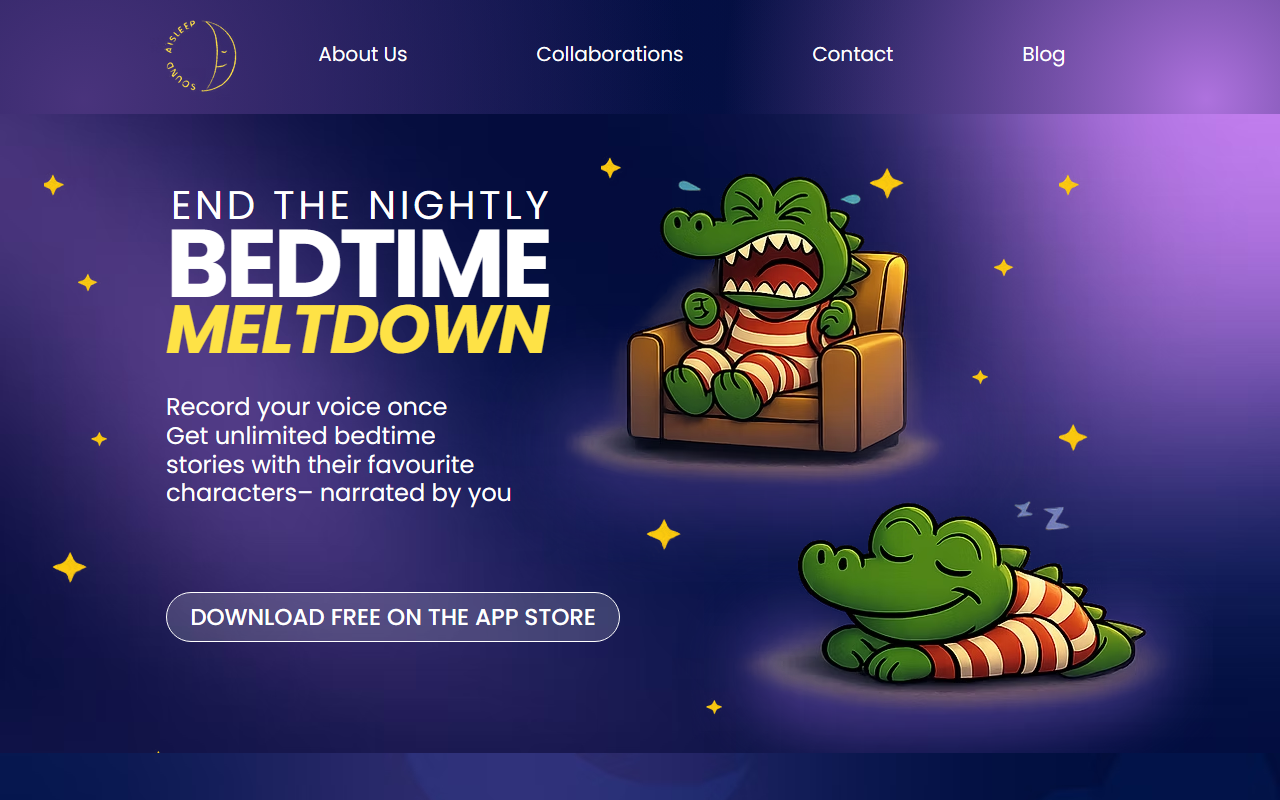
Upon visiting Sound Aisleep’s website, the message is immediately clear: this app is designed to solve the nightly bedtime power struggle. The landing page features testimonials from parents like James, who reports his five-year-old now asks for “Daddy’s stories” and falls asleep in 15 minutes—a stark contrast to the hour-long negotiations he used to face. The interface is clean, with a single clear call-to-action: download free on the App Store. I noted that the site does not mention an Android version, which is a significant limitation for non-iOS users.
When I tested the free trial (which the site promises gives three stories with no commitment for the first month), the onboarding flow was remarkably straightforward. After downloading the app, the first step is to record your voice for just 2.5 minutes by reading simple prompts. The site explicitly states you can re-record at any time, and that the result “doesn’t sound robotic”—a claim backed by parent testimonial “He couldn’t believe it wasn’t actually me.” The entire process is designed to take less than five minutes from download to hearing a custom story.
How It Works and Technology Behind It
The core technology is voice cloning AI, similar to what you see in tools like Respeecher or Descript’s Overdub, but repurposed for a very specific vertical: bedtime stories for children. Sound Aisleep does not require you to read full stories; instead, you read prompts, and the app generates new narratives that sound exactly like you reading them. The site explains that “kids’ brains are wired to respond to their parent’s voice,” which provides a biological rationale for the approach. Unlike generic audiobooks or screen-based stories, this tool gives children the comfort of a familiar voice with infinite narrative variety.
An interesting detail is the partnership with popular animations, YouTube shows, and mobile games. The app’s library includes stories featuring characters from Netflix and streaming shows, YouTube animations, and mobile games—the content your child already loves. This combination of licensed IP (the site says “we’ve partnered”) with personal voice narration is a clever differentiator. I could not verify the full list of characters, but the promise is clear: your child can hear you telling a story about Peppa Pig or Bluey, without you having to invent a plot each night. The app is screen-free, designed to soothe rather than stimulate, which aligns with pediatric sleep advice.
Pricing and Value for Money
Pricing is fully transparent on the site. There is a 1-month free trial that includes three stories to test. After that, the subscription costs £9.99 per month and delivers three new stories each month. You can cancel anytime through your App Store settings, and all stories remain accessible in your account forever—a generous policy. Alternatively, you can buy individual stories for £3.99–£8.99 each, which is useful if you only need a few. Compared to competitors like Calm’s Sleep Stories for kids (which use human narrators but not your own voice) or Amazon’s Audible for children (which requires purchasing individual audiobooks), Sound Aisleep offers a unique value proposition: infinite variety at a flat monthly fee, with a biologically comforting voice. However, note that this pricing is UK-based (£); US pricing is not listed but likely similar in USD.
The main limitation is platform lock-in. The app is iOS-only—there is no Android version or web access visible. This cuts out a huge segment of potential users. Additionally, the voice cloning quality depends on your initial recording; if you have a noisy environment or strong accent, results may vary. The site does not disclose which AI model powers the voice cloning, so I cannot evaluate its robustness against deepfake concerns—though that is less of an issue for a children’s storytelling app.
Who Is It For? Strengths and Limitations
Sound Aisleep is best suited for parents who are tired of negotiating bedtime, especially those with children aged around 3–8 who are attached to specific characters. The app is also ideal for long-distance families—grandparents, deployed parents, or divorced parents—who cannot be physically present every night. The testimonial from Kirsten, a grandmother, underscores this use case perfectly. The biological basis of a parent’s voice calming children is well-supported, and the ease of recording (2.5 minutes) lowers the barrier to entry well below that of typical audiobook creation.
However, the tool has real limitations. It is exclusively on iOS, so millions of Android users cannot access it. There is no mention of offline playback or screen limits beyond the design principle of being “screen-free.” The library of licensed characters is promising but may not include every IP a child loves—and the app depends on ongoing licensing agreements. If you have more than one child with different tastes, you might need multiple subscriptions or extra story purchases. Finally, some children may initially find the synthetic voice slightly different from a live reading, although the testimonials claim otherwise.
My bottom-line recommendation: if you have an iPhone and a child who regularly resists bedtime, try the free month. The risk is zero, the potential benefit of reclaiming your evenings is huge. For Android users or parents who prefer total human narration even when tired, look elsewhere—at least until Sound Aisleep expands platforms. Visit Sound Aisleep at https://soundaisleep.com/ to explore it yourself.












Comments