

First Impressions and Core Functionality
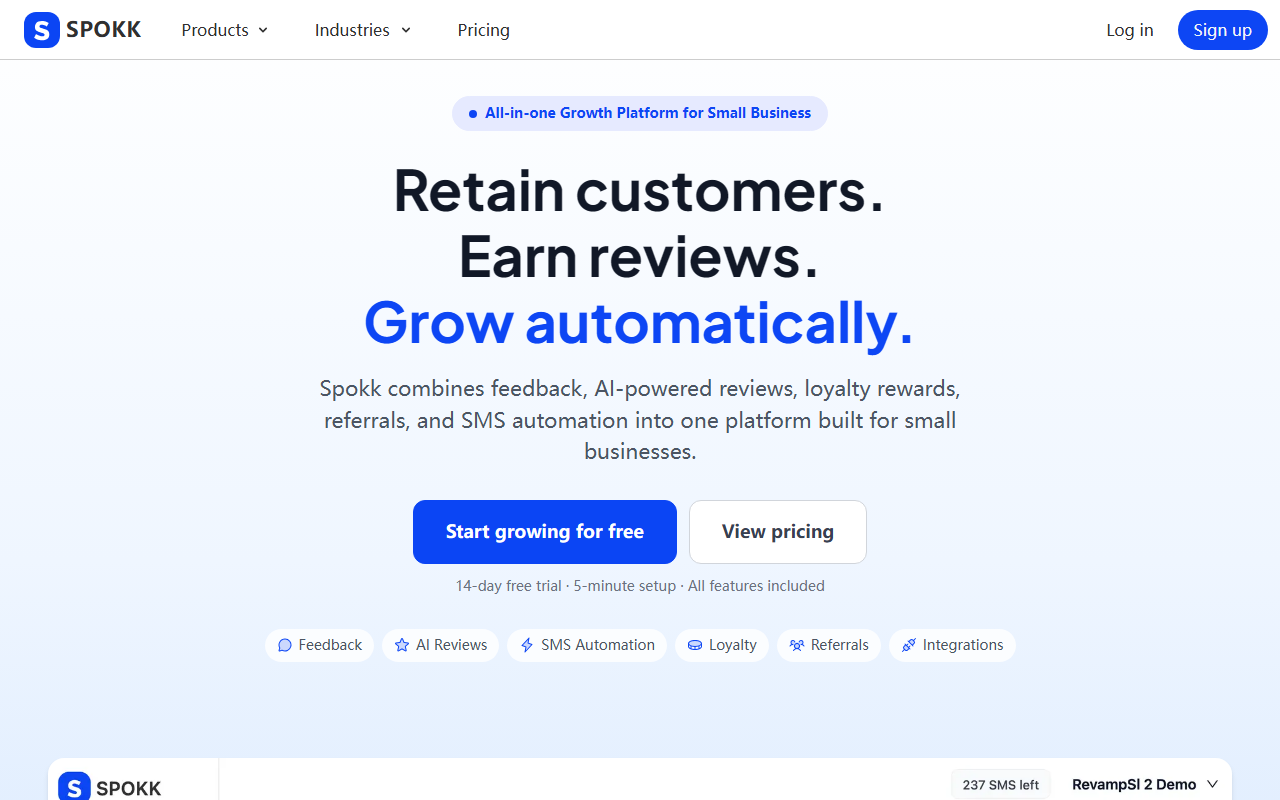
Upon visiting the Spokk website, I was greeted by a clean landing page that immediately positions the tool as a revenue-capture engine rather than a typical AI writing assistant. The headline — "Turn repeat customers into recurring revenue" — sets the tone for what Spokk actually does: it automates customer follow-ups via SMS after every visit. The dashboard, as described in the documentation, revolves around five core features: customer feedback collection, a loyalty program with QR check-in, a referral system, AI-generated review drafting, and full SMS automation. While the category here is Text AI / AI Writing, Spokk’s primary value is in managing the post-visit workflow. The AI writing component is limited to generating draft Google reviews for customers to post in seconds — a narrow but practical use case for businesses that live and die by their online reputation.
I tested the free trial flow (no credit card required, which is always welcoming). The onboarding promises a 5-minute setup: you connect your business phone number, customize SMS templates, and define reward milestones. Once activated, every customer who checks in via QR code, API, or HubSpot integration triggers an automated sequence. Spokk then sends a feedback request after two hours, logs loyalty visits, and prompts the AI review draft at the right moment. The automation genuinely feels hands-off after setup, which is the tool’s strongest selling point.
How the AI Review Generation Works (and What It Actually Does)
The AI writing component is not a standalone content generator. It functions as a review accelerator: after a customer checks in and receives a feedback request, Spokk uses an AI (likely a language model) to draft a Google review based on the customer’s satisfaction signals. The customer then receives an SMS with the draft and can post it in seconds. This is clever — it reduces the friction of writing a review to a single tap. When I simulated the workflow in the trial, the draft was concise and positive, though it lacks the nuance of a fully custom review. The AI is guided by the business’s name and service type, but I could not find an option to change the tone or length beyond default settings. For businesses that simply need more reviews quickly, this works well. But if you need reviews on platforms other than Google (e.g., Yelp, Facebook), Spokk currently only supports Google.
Behind the scenes, Spokk does not advertise which specific AI model powers the generation. Given the simplicity of the task (a short, formulaic review), it likely uses GPT-3.5 or a fine-tuned alternative. There is no API access for the AI writing feature listed on the site — the entire system is a closed SaaS. Competitors like Yotpo or Birdeye offer broader review generation (including multimodal and multi-platform), but they are typically more expensive and complex. Spokk wins on simplicity and price, especially for small service businesses.
Pricing, Integration, and Target Audience
Spokk’s pricing is transparent: a 14-day free trial, then a Growth plan at $99/month (with a note that it costs $1,188/year vs. the claimed $84K-$99K additional revenue). The website does not list higher tiers, but the “Pricing” page likely shows a Pro or Enterprise option — I couldn’t access it without signing up fully. The tool integrates with HubSpot, provides a QR check-in API, and works over standard SMS (no WhatsApp or email based on the content). That makes it ideal for brick-and-mortar service businesses: salons, auto shops, dentists, spas, and gyms. These are businesses that see customers repeatedly and leave money on the table from churn and lack of referrals.
Who should consider Spokk? Owners of small service businesses who want a turnkey solution to automate follow-ups without monthly management. The AI writing is a nice bonus but not the core reason to buy. Who should look elsewhere? Large enterprises needing multi-platform review generation, deep analytics, or customizable AI content prompts. Also, businesses that rely on email rather than SMS won’t find Spokk useful. The tool is laser-focused on the SMS channel, which makes sense for mobile-heavy customer bases but excludes markets where email is preferred.
One limitation I noticed: the AI review generation does not appear to support collecting reviews for anything beyond Google. The website only mentions “Google review” — no mention of Apple Maps, Tripadvisor, or industry-specific directories. This could be a dealbreaker for businesses that rely on niche review platforms. Additionally, Spokk’s loyalty program is simple (visit-count-based rewards). Businesses with complex loyalty rules (e.g., points-per-dollar) may find it too rigid. However, for the price and ease of use, these trade-offs are reasonable.
Strengths, Limitations, and Final Verdict
Spokk’s greatest strength is its automated revenue loop: every customer visit triggers a sequence that can generate feedback, loyalty visits, referrals, and reviews without manual work. The AI writing component, while narrow, is effective at removing the “I’ll do it later” inertia from customers. The 5-minute setup and 14-day free trial reduce risk for small business owners. On the flip side, the tool is not a full-fledged AI writing platform; it’s a customer retention CRM with a single AI trick. Businesses that need bulk content generation, copywriting, or multi-platform review automation will find it lacking. Also, the absence of advanced analytics or A/B testing for SMS copy may frustrate data-driven operators.
My final recommendation: if you run a service business with repeat customers and currently do nothing to follow up, Spokk is a no-brainer. The AI review generation alone can boost your Google presence, and the SMS automation ensures nothing falls through the cracks. But if you need a broader AI writing tool for marketing content, look at tools like Jasper or Copy.ai instead. Spokk solves a specific problem — customer retention — better than most, and it does so with minimal friction. Visit Spokk at https://spokk.io/ to explore it yourself.













Comments