

First Impressions: A Platform Built for Contract Speed
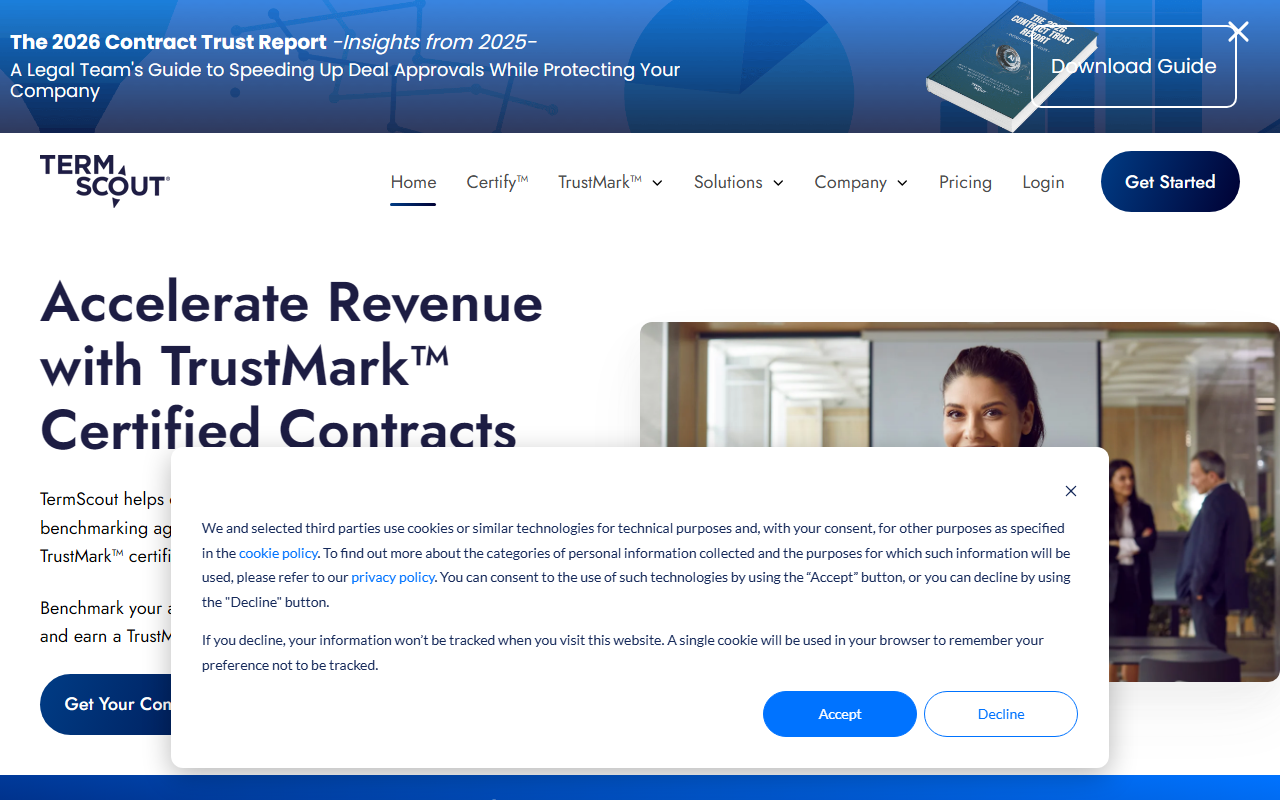
Upon visiting TermScout's website, I was immediately struck by the clarity of its value proposition: "Accelerate Revenue with Contract Certification." The dashboard is clean, with clear calls to action like "Get Your Demo" and "See if Your Agreement Qualifies for TrustMark™." The onboarding flow is designed to guide users toward either submitting a contract for certification or analyzing their portfolio with Certify™. When testing the free consultation option, I found the initial questionnaire intuitive, asking about contract volume and typical deal sizes. Notably, there is no public free tier for self-service; the platform is demo-driven, indicating an enterprise focus. The site prominently features customer quotes, including an 80% reduction in sales cycle times, which sets high expectations.
What TermScout Does and How It Works
TermScout solves a specific bottleneck: contract review stalls because no one knows what fair market terms look like. The platform replaces opinion with data. Its core technology is Certify™, an AI-powered contract intelligence system that analyzes agreements, benchmarks terms against real-world market data, and generates contract signals. These signals then power TrustMark™, an independent certification that verifies an agreement is fair, balanced, and market-aligned. The process is three-step: 1) Analyze agreements at scale using AI, 2) Benchmark against a proprietary market database, 3) Qualify for TrustMark certification. While the exact AI model behind Certify is not disclosed on the site, it appears to use natural language processing and semantic comparison to identify deviations in liability, indemnity, and governance clauses. The platform integrates via API and offers both a procurement-focused workflow and a sales/revenue-facing certification output. Pricing is not publicly listed on the website; the company relies on demo-based sales, which suggests tailored enterprise pricing.
Market Position and Alternatives
In the crowded contract lifecycle management (CLM) space, TermScout differentiates by focusing on benchmarking and certification rather than just repository or redlining. Competitors like Ironclad and Evisort offer AI for contract review, but TermScout adds an external certification layer (TrustMark) that counterparties can trust. This makes it particularly useful for B2B companies that send out their own paper and want to prove fairness upfront. It is best suited for legal, procurement, and sales teams in mid-to-large enterprises that handle high volumes of vendor or customer agreements. Smaller teams with low contract volume may find the cost prohibitive, as the value scales with deal count. The company has notable backing: customer logos include Xactly and Freshworks, and the team has deep legal-tech expertise, but specific funding details are not prominently displayed.
Strengths, Limitations, and Verdict
TermScout's strongest asset is its ability to turn opinion into data. The benchmarking against real-world market standards gives legal and procurement a defensible rationale for approvals, reducing negotiation friction. The certification adds third-party credibility that can accelerate deals, especially in procurement-heavy verticals. However, there are limitations. The platform is heavily dependent on the quality and breadth of its market database; if a company operates in a niche industry, benchmarks may be less reliable. Also, the lack of self-service onboarding means teams cannot experiment without a sales call, which may deter smaller buyers. Additionally, the AI signals are only as good as the contracts ingested; users must have a library of agreements to benchmark effectively.
My recommendation: If your organization processes hundreds or thousands of contracts per year and struggles with approval delays due to subjective fairness debates, TermScout is worth a serious look. The combination of AI-powered signals and an independent certification is unique. For smaller teams or those already invested in a full CLM suite, evaluate whether the benchmarking layer justifies the additional cost. Visit TermScout at https://termscout.com/ to explore it yourself.













Comments