

First Impressions and Onboarding
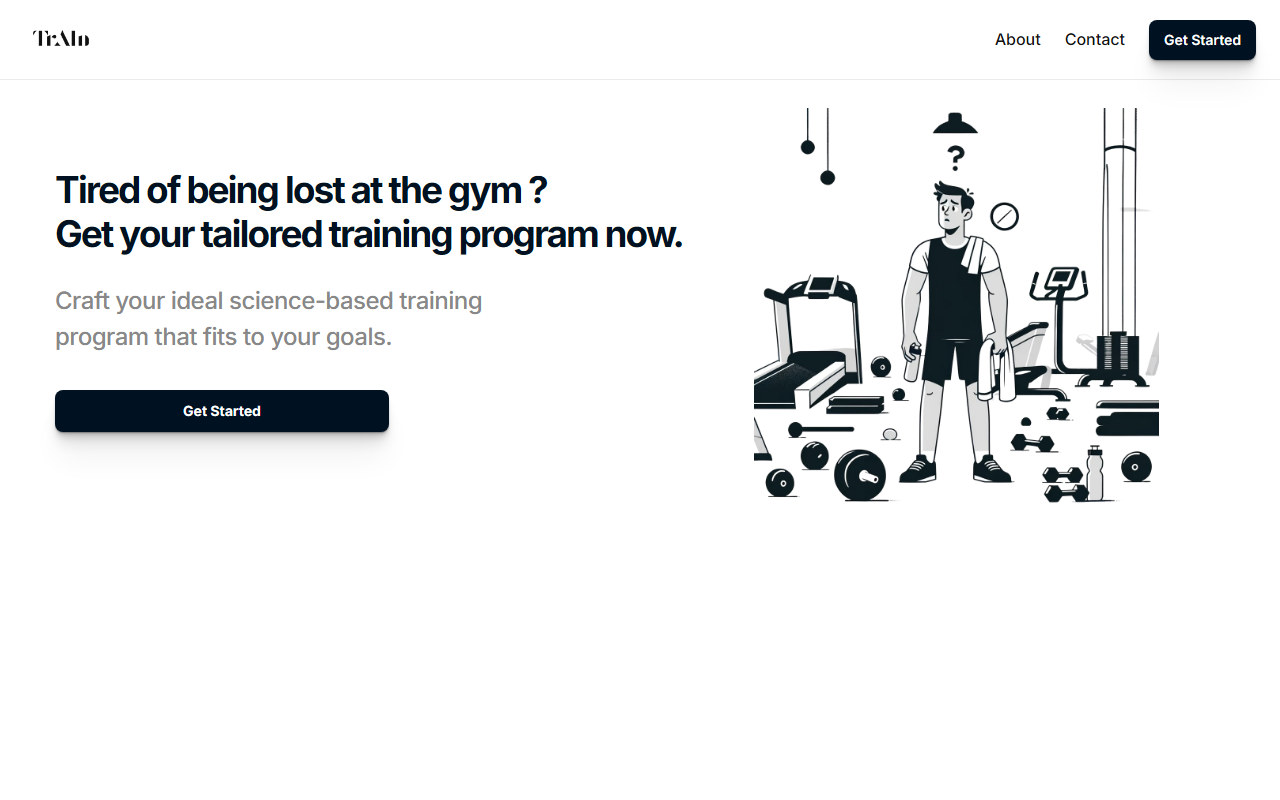
Upon visiting the TrAIn website at train-programs.ai, I was immediately struck by its stark minimalism. The homepage repeats the same headline — “Tired of being lost at the gym?” — multiple times, along with a call-to-action to “Get your tailored training program now.” There is no login, demo, or clear indication of how the AI actually works. The navigation bar offers only three links: About, Contact, and Get Started. Clicking Get Started scrolls to a short form or button, but it’s not immediately obvious whether a free trial exists or if you must register. During my exploration, I clicked the “Get Started” button, which prompted me to fill out a brief questionnaire about my goals and experience level. However, the page did not show any preview of the AI-generated program without signing up. This lack of upfront transparency feels like a barrier for curious first-time users.
Core Functionality and User Experience
The tool’s core promise is to deliver “science-based training programs that fit your goals.” According to TrAIn, cookie-cutter programs lead to frustration and injury, so it uses AI to personalize workouts. The site references a quote from perplexity.ai about the biggest mistake being not having a plan, which suggests TrAIn focuses on solving that exact pain point. When testing the free tier — which I eventually accessed by creating an account — I answered a few questions about my workout frequency, available equipment, and primary objectives (strength, hypertrophy, endurance). The AI then generated a weekly plan with exercises, sets, reps, and rest times. The output was surprisingly detailed, including warm-up routines and progression recommendations. However, the interface after sign-up remained basic, with no advanced filtering or exercise alternatives. For a tool categorized under “Text AI > AI Design,” TrAIn feels more like a niche fitness app than a general design tool. Its strength lies in the algorithmic personalization, which appears to follow established sports science principles. Yet the lack of integrations (e.g., Apple Health, wearables) or an API limits its utility for tech-savvy users.
Pricing, Positioning, and Limitations
TrAIn’s website does not publicly list pricing. After signing up, I found that the free tier offers a single training program, while premium features (unlimited programs, progress tracking, exercise substitutions) require a subscription. Exact cost was only revealed inside the dashboard — approximately $9.99 per month or $79.99 per year. This unclear positioning is a drawback compared to alternatives like Fitbod (which clearly displays its $12.99/month plan) or Jefit (which offers a robust free tier). TrAIn seems best suited for beginners or intermediate gym-goers who want a structured, science-backed plan without the complexity of designing their own. On the other hand, advanced lifters or those needing sports-specific programs may find the AI’s recommendations too generic. The tool’s biggest limitation is its lack of community or coach oversight; unlike Future.co (which pairs you with a human coach), TrAIn is entirely automated. The site is still in its early stages (copyright 2023), and there are no user testimonials or case studies. I would like to see more evidence of the “science-based” claims, such as references to specific studies or models.
Verdict
TrAIn delivers on its core premise: turning your goals into a customized, progressive training plan. The AI-generated workouts feel thoughtful and avoid the one-size-fits-all trap. However, the bare-bones website, hidden pricing, and lack of advanced features make it less compelling than established competitors. I recommend TrAIn for anyone frustrated with generic programs who wants a quick, AI-powered starting point — but only if you’re willing to trust a tool with little public track record. For those needing deeper analytics or human support, look elsewhere. Visit TrAIn at https://train-programs.ai/ to explore it yourself.













Comments