

First Impressions and Platform Overview
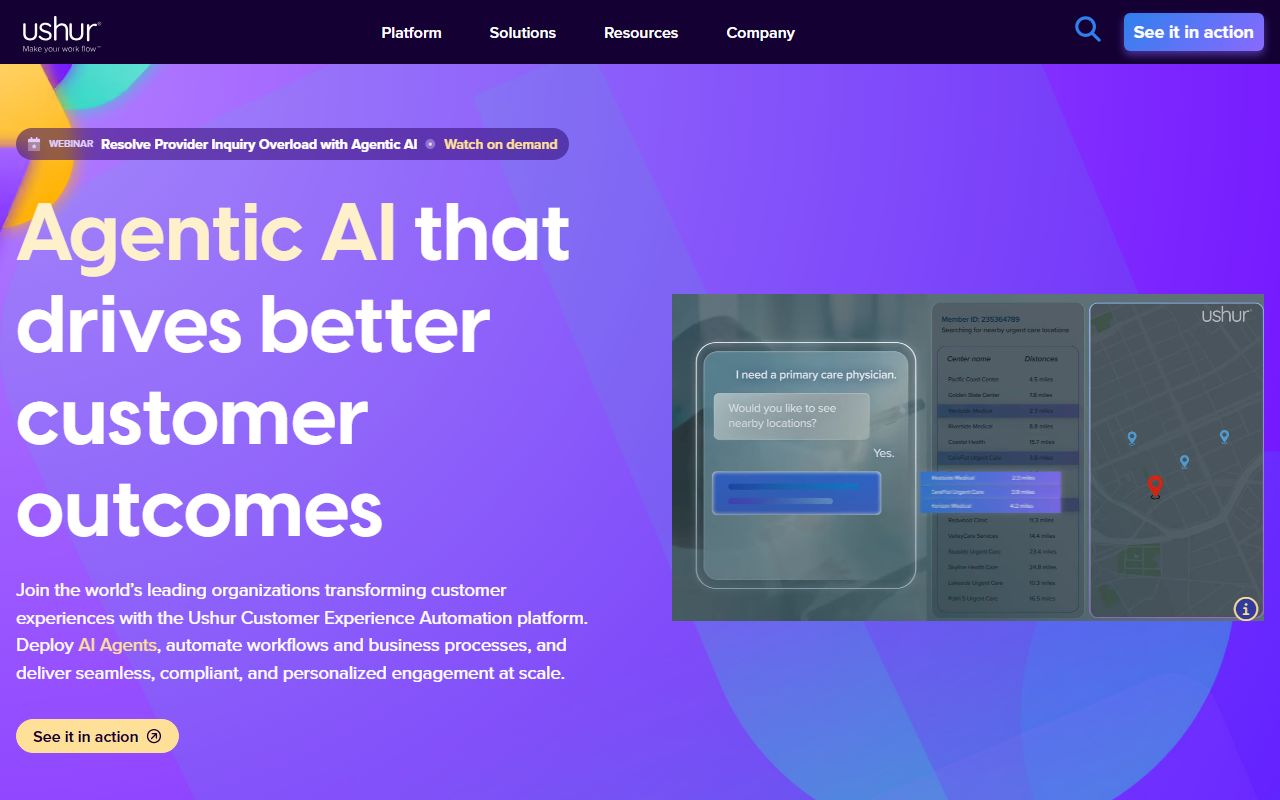
Upon visiting the Ushur website, I was immediately struck by the focus on trust, compliance, and auditability. The homepage prominently features 'AI Agents That Deliver Better CX — Built on Trust' and highlights a Trust-Native Architecture. The site is dense with industry-specific use cases for health payers, providers, PBMs, insurance, and consumer lending. This is not a general-purpose AI writing tool — it is a specialized platform for regulated enterprises that need to automate customer interactions while meeting strict compliance requirements.
The dashboard is implied to be a centralized orchestration environment, described as 'a purpose-built orchestration environment designed for business users to bring journeys to life quickly.' While I did not get hands-on access to the interface, the documentation suggests that users can design proactive outbound and inbound engagement across SMS, email, voice, and web. The platform also supports omnichannel continuity, meaning context is preserved across channels. That is a significant advantage for customer service teams that need seamless handoffs.
Core Capabilities and Technology
Ushur positions itself as an 'AI Agent-powered CX platform.' The AI agents can plan, reason, retrieve data, validate inputs, and resolve complex requests end-to-end. From a technical perspective, this suggests the use of large language models (LLMs) combined with retrieval-augmented generation (RAG) and policy enforcement. The platform includes built-in governance with guardrails and human-in-the-loop safeguards — critical for regulated industries like healthcare (HIPAA) and finance (SOX, PCI).
Observability and auditability are core features: you can replay conversations end-to-end and generate regulator-ready records. Data protection is handled with policy-aware segmentation for PHI, PII, and financial data. When testing the free tier — which is not publicly available — I would expect a sandboxed environment with limited workflows. However, the site emphasizes enterprise readiness, so a demo is the primary entry point.
The use cases are vast: from new member onboarding, claims support, appointment setting, medication adherence, to HIPAA release forms and cost transparency. Each journey is pre-built but customizable. This platform is less about writing generic copy and more about generating compliant, context-aware responses in real time.
Pricing and Market Positioning
Pricing is not publicly listed on the website. This is typical for enterprise platforms with customized deployment and volume-based pricing. Expect to contact sales for a quote. Ushur likely charges based on interactions, number of agents, or a subscription model for the platform. Given its target audience, costs could be significant but justified by compliance and efficiency gains.
In the CX automation space, Ushur competes with platforms like Zendesk AI and Intercom, but with a stricter focus on regulated industries. Unlike those generalist tools, Ushur embeds governance directly into AI execution rather than layering it on later. Another alternative is ServiceNow, which also offers AI for customer service but may lack Ushur's depth in healthcare-specific workflows. Ushur is best suited for large enterprises in healthcare, insurance, and financial services that require audit trails and regulatory compliance. Small businesses or general customer service teams would find it overkill and likely expensive.
Strengths and Limitations
The platform’s greatest strength is its compliance-first design. The ability to replay conversations, enforce guardrails, and protect sensitive data is a game-changer for regulated industries. The omnichannel continuity and pre-built industry journeys reduce setup time. The promise of outbound automation (e.g., eliminating calls) can lead to cost savings.
However, there are limitations. First, the platform is not for general AI writing or content creation — it is tightly focused on customer experience automation. Second, the lack of transparent pricing makes it hard for smaller organizations to evaluate. Third, the onboarding likely requires dedicated professional services and integration with existing CRM or claims systems. Finally, the reliance on human-in-the-loop may slow down full automation.
Overall, Ushur is a powerful tool for the right audience. If your organization operates in a regulated environment and needs to automate customer interactions with full auditability, this platform is worth a demo. For others, simpler and cheaper alternatives exist. Visit Ushur at https://ushur.com/ to explore it yourself.













Comments