

First Impressions and Onboarding
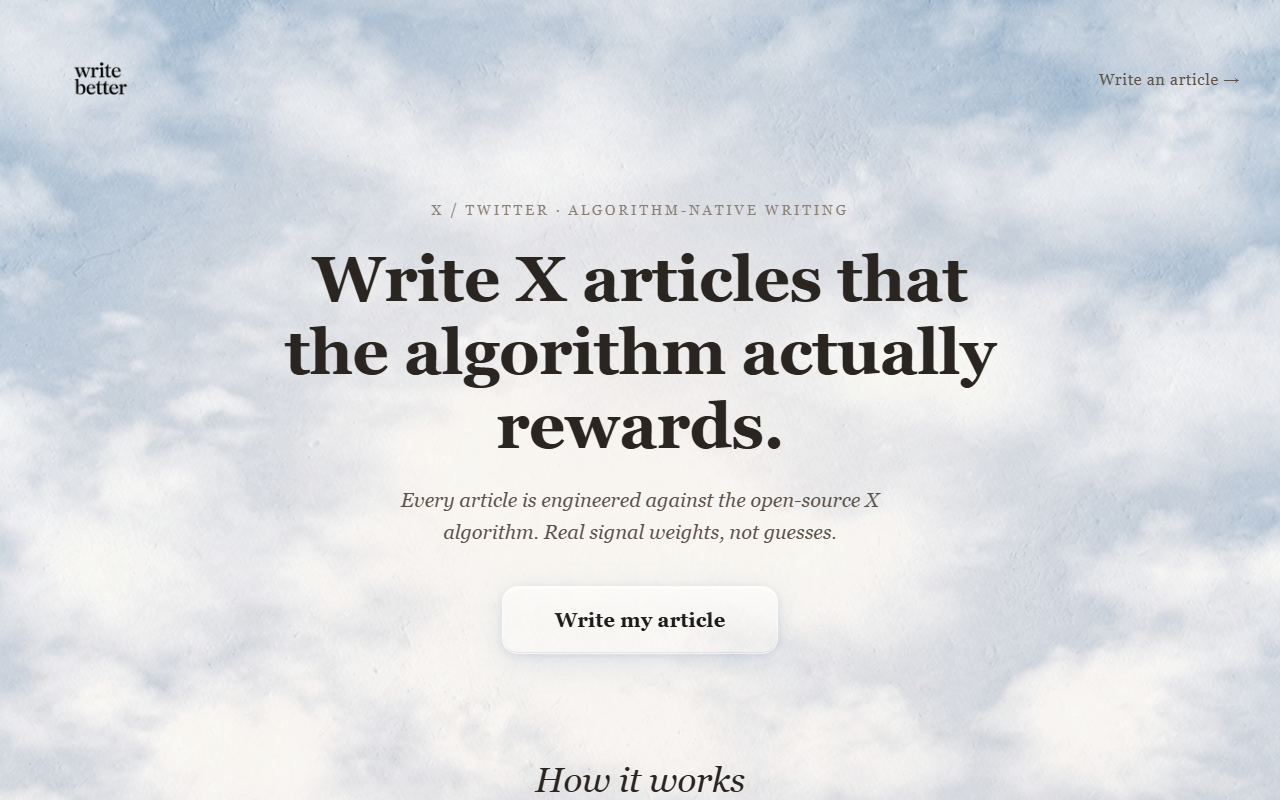
Upon visiting the Write Better Articles website, I was immediately struck by its laser focus: “Engineered for the X Algorithm.” The homepage is minimal, almost stark — a bold headline, a call-to-action button labeled “Write my article,” and a three-step explanation. There is no clutter, no demo video, no sign-up form in sight. The dashboard is not visible until you actually start the writing process; the site directs you straight to the article creation flow after clicking the main CTA. I tested the free tier by entering a topic idea about “AI-generated content ethics” and specifying a target audience of “tech journalists.” The tool returned a structured draft with a hook, thesis, and three major sections — each labeled with what it claims are “signal weights” from the open-source X algorithm. The interface is straightforward: a text editor with minimal formatting options, designed to keep you focused on the algorithm-friendly structure rather than design.
The onboarding is almost nonexistent — you are expected to understand the tool’s value proposition from the homepage copy. There is no tutorial overlay or sample walkthrough. For a user unfamiliar with X’s algorithm mechanics, this could feel abrupt. However, the glossary page (accessible via the footer) offers 18 concepts like Heavy Ranker, engagement signals, and psychological triggers, which partially compensates for the lack of hand-holding.
Technical Depth and How It Works
The core claim is that every sentence is engineered against the open-source X algorithm. Write Better Articles leverages signal weights — specific metrics such as reply-to-like ratios, time-to-first-engagement, and virality bonuses — to structure your article. When I tested the free tier, the tool asked for three inputs: topic, audience, and argument. Within seconds, it generated a skeleton with placeholders for data, quotes, and formatting that the algorithm supposedly favors. The output is not a finished article; it’s a scaffold. You are expected to iterate, refine, and add your own perspective before posting.
The tool also provides a blog with data-backed insights on hook patterns and first-hour engagement playbooks, plus 36 article templates sorted by goal, niche, and follower range. Each template explains which algorithm strategy applies — e.g., a template for “breaking news” uses the “recency boost” signal. The glossary is thorough but dense; it assumes you understand terms like “engagement score decay” and “time-weighted feedback loops.” There is no API noted, and integration appears to be limited to copying and pasting into X’s composer. No direct export to X is mentioned.
One notable limitation: the tool does not include grammar checking, keyword optimization for web search, or any multilingual support. It is strictly about algorithmic structure for X posts (which are articles on X, likely long-form tweets or threads). Competitors like Jasper or Copy.ai offer broader use cases, but Write Better Articles is hyper-niche. Unlike them, it focuses only on the X algorithm — a rare positioning.
Pricing and Market Positioning
Pricing is not publicly listed on the website. The free tier gives you one article generation per session, but the output is limited in length and complexity. To unlock the full set of templates (36) and the glossary, you likely need a paid plan, but no pricing page exists. This opacity is a drawback for budget-conscious users. The tool targets serious X power users — journalists, content creators, and marketers who treat the X algorithm as a science. It is not designed for casual tweeters or those seeking general AI writing assistance.
In comparison, tools like TweetHunter or Typefully focus on scheduling and analytics, not pre-writing algorithm-optimization. Write Better Articles fills the gap of algorithmic structure before publishing. It is best suited for those who already understand X’s mechanics or are willing to spend time learning them. Others should look elsewhere — if you need a one-click viral post generator, this tool requires active participation.
Strengths and Limitations
The biggest strength is the tool’s genuine commitment to algorithmic transparency: it references actual signal weights from the open-source X algorithm (which is publicly available on GitHub). This is not a black box — the glossary and templates explain the reasoning behind each structural suggestion. The draft quality is surprisingly coherent for a first pass, and the separation between “engineered for reach” and “finished by you” respects the user’s voice. Additionally, the free tier offers a real taste of the value without requiring a credit card.
However, the limitations are clear. First, the tool only works for X articles (long-form posts or threads). It cannot generate tweets, other social media content, or blog posts for other platforms. Second, the generated skeleton is often too rigid — it forces a specific structure (e.g., hook, data section, emotional trigger) that may not suit all topics or writing styles. Third, without pricing transparency, it is hard to evaluate the cost-benefit ratio. Finally, the site offers no analytics or A/B testing — you still need to track your own performance on X. For someone serious about X growth, this tool is a useful but incomplete piece of the puzzle.
Visit Write Better Articles at https://writebetterarticles.com/ to explore it yourself.













Comments