
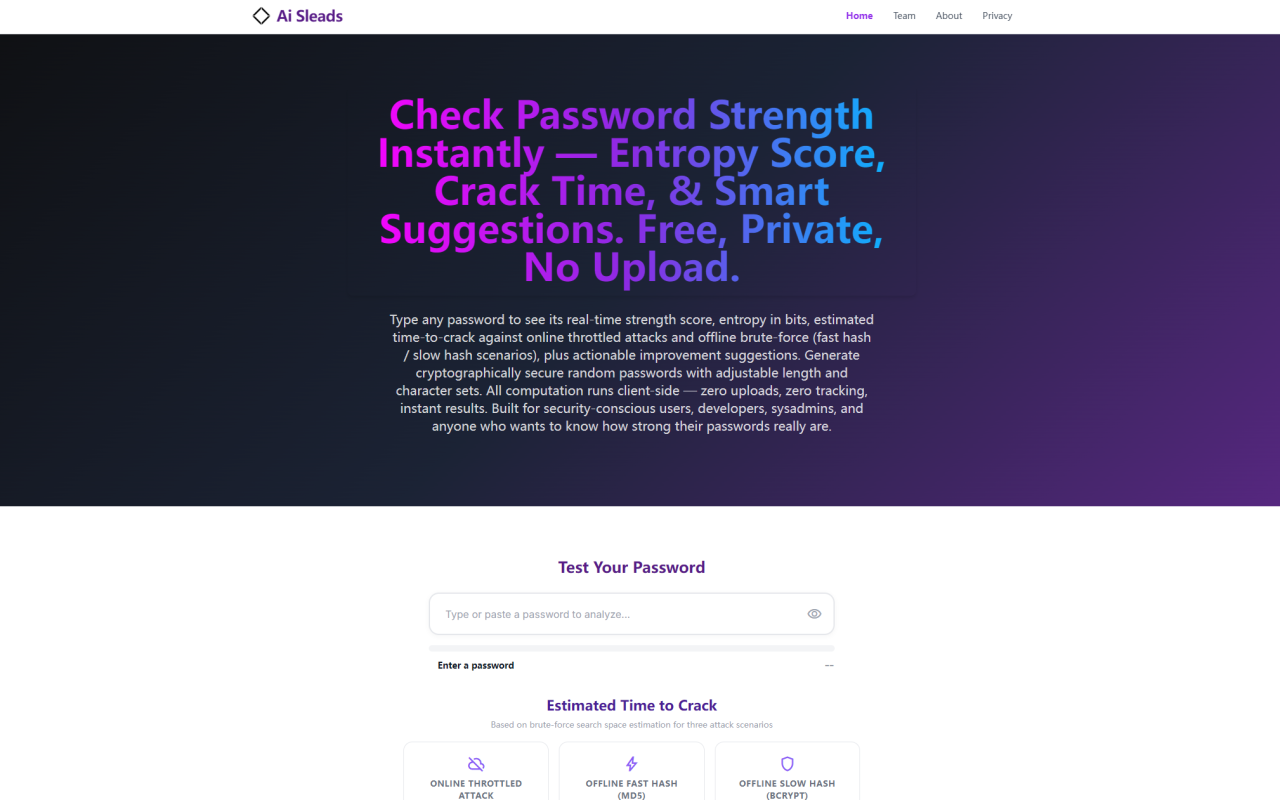
When I first loaded Ai Sleads at aisleads.com, I was greeted by a clean, single-purpose interface with exactly one input field and a reassuring tagline: "100% Private, No Upload." There is no account creation gate, no upsell popup, and no request to sign up before you can type a single character. The page immediately invites you to enter a password and see real-time results. For anyone who has used online password checkers that feel like credential harvesting operations dressed in helpful clothing, this minimalist approach is a breath of fresh air.
First Impressions: A Checker That Doesn't Phone Home
The interface is organized into three clear zones. At the top sits the masked password input with a visibility toggle, flanked by a real-time strength bar that smoothly animates between five color-coded tiers. Below that, three crack-time estimation cards display results for online throttled, offline fast hash (MD5), and offline slow hash (bcrypt) attack scenarios. Beneath those sits a random password generator with adjustable length and character set toggles. Every section updates instantly as you type — no refresh button, no submit action, no loading spinner. I tested this by opening Chrome's Developer Tools and watching the Network tab while typing a dozen test passwords. Zero outbound requests. The entire analysis engine lives in a single JavaScript file called password-checker.js, delivered unobfuscated and fully auditable via View Source. If you disconnect from the internet after the initial page load, the tool continues working perfectly — every function from entropy calculation to password generation remains fully operational.
How the Strength Scorer Actually Works Under the Hood
Ai Sleads does not simply count characters and assign a score. The strength algorithm is a weighted composite that factors in base entropy, length bonuses, character diversity, and pattern penalties. The entropy calculation follows the standard formula H = L log(N), where L is length and N is the character-set size. But crucially, the tool applies a real-world adversarial perspective: a 35-entry common-password blacklist covering the most breached credentials, detection of 14 keyboard-walk patterns across QWERTY, AZERTY, and numeric layouts, sequential character detection for ascending and descending runs, and repetition detection for four or more consecutive identical characters. I tested "P@ssw0rd!" — a password that looks strong to the casual eye with its mixed case, digit, and symbol. Pure combinatorial entropy would calculate roughly 52 bits for an 8-character password from a 94-symbol set. Ai Sleads correctly penalized it for the common pattern substitutions (0 for o, @ for a, ! for 1), dropping the score into the Weak tier. The improvement suggestions panel then explained exactly why: "This password contains common substitutions found in standard cracking dictionaries." This level of specificity is rare among free checkers, which tend to give vague advice like "make it longer." The five-tier scoring system maps to a 0–100 scale with clear visual cues: Very Weak (0–19, red), Weak (20–39, orange), Moderate (40–59, yellow), Strong (60–79, green), and Very Strong (80–100, bright green).
Three Attack Scenarios: Meaningful Crack-Time Estimates
Most password checkers show a single crack-time number that users cannot contextualize. Ai Sleads models three distinct adversarial threat levels calibrated against published hashcat benchmark data. The first is an online throttled attack at approximately 1,000 guesses per second — representing someone trying to brute-force a login form with rate-limiting and lockout policies in place. The second is an offline fast hash scenario at 100 billion guesses per second, simulating a dedicated GPU cluster with eight NVIDIA RTX 4090 cards cracking an MD5 or SHA1 hash database — the worst case for a data breach. The third is an offline slow hash scenario at 10,000 guesses per second, modeling bcrypt with cost factor 10 or similar memory-hard key-derivation functions like scrypt or Argon2id. During testing, I entered a 10-character mixed-case password with no symbols. Against online throttled attack, the estimate read "2,847 years" — reassuring for a live login form. Against offline fast hash, that same password dropped to "2.3 hours." Against bcrypt, it jumped back to "284 years." The dramatic spread between scenarios teaches a more valuable lesson than any single number could: your password security is only as strong as the hashing algorithm protecting it on the server side. The tool presents these estimates in human-readable time units that adapt dynamically — seconds, minutes, hours, days, years, centuries, and millennia — so you never get a cryptic number you have to interpret.
Built-In Cryptographic Password Generator
Beneath the analysis section sits a fully featured random password generator that uses the Web Crypto API's crypto.getRandomValues() — the same cryptographically secure pseudo-random number generator that browsers use for TLS key generation. This is a critical detail because many online password generators rely on Math.random(), which is a deterministic, seedable algorithm unsuitable for security purposes. The generator lets you set length from 8 to 64 characters via a range slider, and you can toggle four character sets: lowercase, uppercase, digits, and symbols. A post-generation enforcement pass guarantees at least one character from each selected set appears in the output, preventing the edge case where a random draw accidentally omits a required class. The default configuration of 12 characters with lowercase, uppercase, and digits selected strikes a practical balance between strength and compatibility — most websites accept these character types. Generated passwords can be copied with a single click, and a refresh button generates a new one instantly. All generation happens client-side with zero network calls, so the passwords you generate never leave your device.
Zero-Upload Architecture: Verifiable Privacy by Design
Ai Sleads takes an architectural stance that is refreshingly uncompromising for a free online tool. There is no backend server to POST passwords to, no cloud-based analysis queue, no third-party API integration, and no tracking cookies. Every computation runs in your browser's JavaScript runtime from a single self-contained file. The tool provides three actionable ways to verify this claim. First, open your browser's Developer Tools and monitor the Network tab while typing — you will see zero outbound requests. Second, disconnect from the internet entirely after page load and confirm that every function continues working without degradation. Third, view the source code directly — it is delivered as readable, unobfuscated JavaScript that any competent developer can audit. Closing the browser tab completely erases every byte of entered text from temporary DOM memory with no residual persistence to localStorage, sessionStorage, cookies, or IndexedDB. The about page confirms this design philosophy was intentional from day one: the developers describe the tool as operating under a "strict zero-server-footprint mandate." For penetration testers working inside air-gapped environments or security-conscious professionals who apply a "trust nothing, verify everything" approach to online services, this architecture is the compelling differentiator. Pricing details are not publicly listed on the website because Ai Sleads is entirely free to use with no premium tiers, no subscription plans, and no paid upgrades of any kind.
Ai Sleads delivers exactly what it promises: a genuine, no-catch password strength analysis tool that does not compromise on privacy or technical rigor. The entropy calculations are mathematically sound, the crack-time estimates are calibrated against real-world benchmarks, and the pattern detection catches the common tricks that naive checkers miss. The zero-upload architecture is not a marketing gimmick but a foundational design choice that any user can verify independently. For security professionals, system administrators, or anyone who values knowing how strong their passwords actually are without exposing them to a third-party server, this tool fills a specific and important niche. Visit Ai Sleads at aisleads.com to explore it yourself.


コメント