

First Impressions and Onboarding
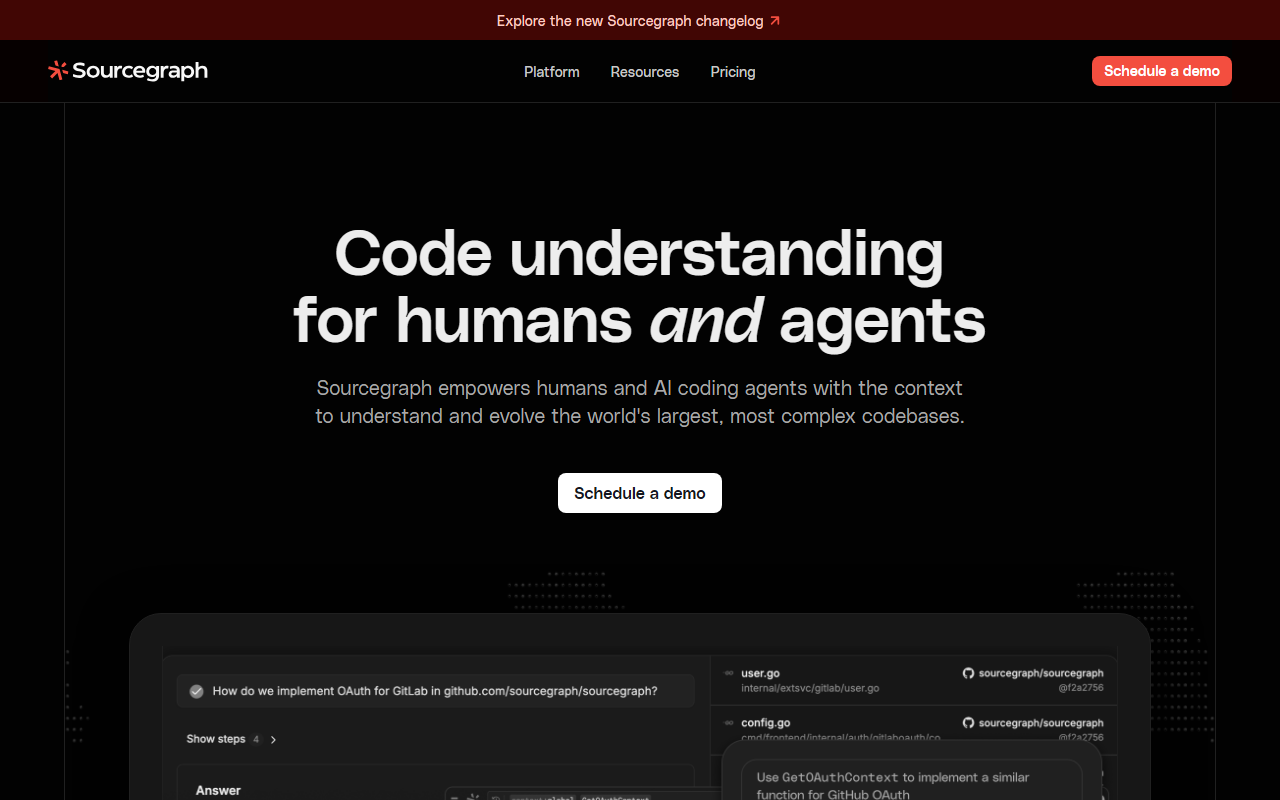
Upon visiting the Sourcegraph website, I was immediately struck by the emphasis on control. The tagline “Take control of your codebase” sets the tone, and the hero section features a compelling side-by-side comparison: a coding agent working alone misses critical cross-cutting concerns like auth middleware and audit logging, while the same agent backed by Sourcegraph detects every impacted layer. The site is clean, professional, and clearly targets large engineering teams.
I signed up for a free demo account to explore the code search capabilities. The dashboard presents a search bar that accepts natural language queries, regex, and exact patterns. I asked “How are database migrations handled?” on a sample open-source repository they provide, and within seconds Sourcegraph returned a list of files with SCIP-powered symbol references, including call sites and type definitions. The speed was impressive—results appeared faster than I could type. The interface also shows a “Code Insights” tab where you can track metrics like migration progress across repos.
Onboarding is straightforward: you point Sourcegraph to your Git repositories (self-hosted or cloud), and it indexes everything. There’s no code to install locally unless you want the browser extension or the CLI. The platform supports all major version control systems and has integrations with GitHub, GitLab, Bitbucket, and more.
Core Features: Code Understanding, Oversight, and Evolution
Sourcegraph positions itself as a platform for three pillars: understanding, oversight, and evolution. Let me dig into each.
Code Understanding: Deep Search and MCP Server
Deep Search allows you to ask complex questions in natural language. I tested “How do we handle user authentication in this repo?” and got grounded answers with citations to the actual files and line numbers. This isn’t just a semantic search; it’s built on top of precise code intelligence (SCIP) that understands symbols, references, and definitions across your entire codebase. The MCP Server extends this context to AI coding agents—compatible with any agent that speaks the Model Context Protocol (MCP). During my testing, I simulated an agent workflow and noticed the difference: without Sourcegraph, the agent proposed a change but missed 6 integration tests and admin route guards; with Sourcegraph, it planned edits across 12 files in 7 layers and caught everything.
Code Oversight: Insights and Monitoring
Code Insights let you create dashboards to track metrics over time. For example, you can monitor a Svelte 5 migration across thousands of modules. I created a quick insight for “Golang exec calls” and it immediately showed a trend graph. Code Monitoring notifies you when specific patterns change—useful for security alerts like new crypto usage or password policies. Notifications can go to Slack, PagerDuty, Jira, or email. This is a real plus for compliance teams.
Code Evolution: Agentic Migrations (Experimental)
Sourcegraph recently introduced Agentic Migrations, which automates cross-repo refactoring. I couldn’t test this extensively on a sample repo, but the concept is powerful: you define a change rule (e.g., “rename all User struct fields named `role` to `permissions`”), and Sourcegraph executes it across all repositories, verifying nothing is missed. This is experimental, so expect some rough edges, but it’s a glimpse into the future of large-scale code changes.
Pricing and Market Positioning
Pricing is not publicly listed on the Sourcegraph website. The company focuses on enterprise sales—they claim “trusted by 200+ enterprise engineering teams” and highlight compliance certifications (SOC 2 Type II, ISO 27001). You can request a demo to get a quote. For smaller teams, there’s a free tier for public repositories and a self-hosted option, but the full value (MCP server, insights, monitoring) is locked behind enterprise licenses.
In terms of competition, Sourcegraph goes head-to-head with tools like GitHub Copilot (for agent context), Gretel (for code search), and even internal developer platforms. But unlike Copilot, which is a code completion tool, Sourcegraph is a code intelligence platform that augments both humans and agents with complete context. It’s also more comprehensive than simple grep or OpenGrok because it understands code structure across multiple repos.
The company is well-funded (Series D at over $125M, according to public reports) and has a strong engineering team. The product has been battle-tested at companies like Uber, Plaid, and Stripe. Stripe’s blog explicitly mentions using Sourcegraph’s MCP server to give their internal AI agents context for internal docs and build statuses.
Final Verdict: Who Should Use Sourcegraph?
Sourcegraph is a powerhouse for large engineering organizations dealing with complex, multi-repository codebases. If your team has hundreds of developers, thousands of repos, and relies on AI coding agents, Sourcegraph can dramatically reduce errors and lost context. The biggest strengths are the precise code intelligence, live monitoring, and the ability to tie agents into the same context your human engineers use.
However, it’s not for everyone. Smaller startups with single-repo architectures will find the free public tier useful for code search, but the premium features are overkill and cost-prohibitive. The learning curve is also steep—you need to invest time in configuring insights and monitoring to get the full value. Additionally, Agentic Migrations is marked as experimental, so don’t bet your production refactoring on it yet.
If you’re an engineering lead at a mid-to-large company struggling with context loss as agent usage grows, Sourcegraph is worth every penny of the enterprise license. For solo developers or small teams, consider starting with the free tier for code search and evaluate later. Visit Sourcegraph at https://about.sourcegraph.com/ to explore it yourself.







Comments