

First Impressions and Onboarding
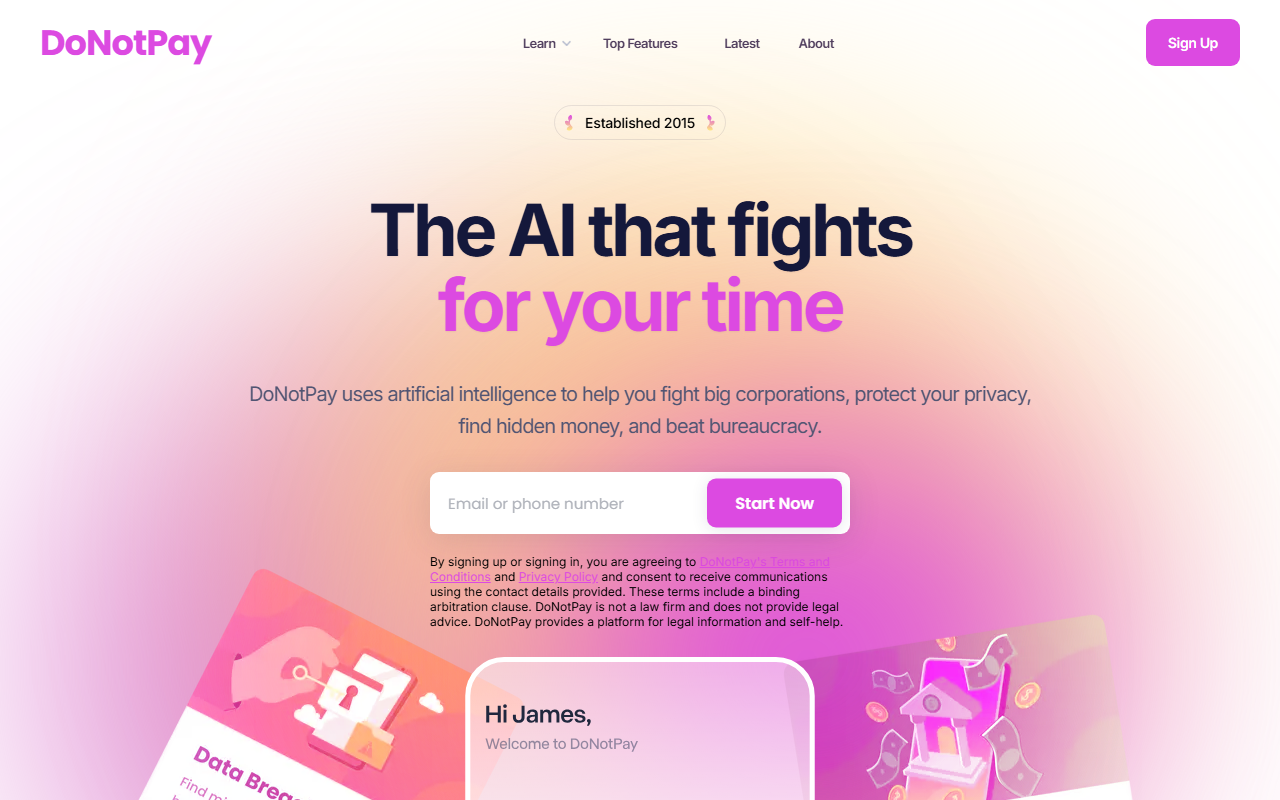
Upon visiting DoNotPay’s homepage, I was immediately struck by a clean, bold interface that wastes no time stating its purpose: “The AI that fights for you.” The site leans heavily on testimonials, user numbers, and a long list of press mentions, which immediately signals a well-established product. Sign-up is straightforward—email and password—and the free trial is promoted aggressively. As a first-time user, I was directed to a dashboard populated with over 100 tool cards, each labeled with actions like “Fight Scammers,” “Find Missing Money,” or “Beat Bureaucracy.” The onboarding flow didn’t require a tutorial, which I appreciated, but I did notice a slight information overload: too many options at once can be disorienting for someone who just wants to cancel a subscription. Nonetheless, the design is modern and responsive, and the chatbot-style guidance—powered by GPT-based models—kicks in quickly to help narrow down your goal.
Core Features and Workflow
DoNotPay is not a generic AI writing assistant; it’s a task-oriented platform that automates consumer disputes, paperwork, and small claims. I tested the “Free Trial Card” feature, which generates a virtual card number that auto-declines after the trial period, effectively preventing unwanted charges. The setup took under two minutes. I also explored the “Robo Revenge” tool, which listens to robocalls and tries to gather evidence for a potential $500 payout per call—a clever use of AI voice recognition. What impressed me most was the letter-generation engine: when I asked DoNotPay to draft a dispute letter for a mistaken parking ticket, it produced a legally-sounding document with relevant state statutes cited, then offered to mail it via snail mail or fax. All of this is managed from a single dashboard where you can track correspondence. The underlying technology appears to combine large language models (likely GPT-4) with a database of consumer laws and pre-written templates. There is no public API, but the platform integrates with your phone and email for notifications.
Pricing, Strengths, and Limitations
DoNotPay operates on a subscription model. While the website does not display exact pricing on the landing page, a quick sign-up reveals a free trial, after which the service costs $36 per month or $192 per year (as of my test). This is relatively affordable compared to hiring a lawyer for individual disputes, but it can add up if you only need help once. A major strength is the breadth of tools: from DMV letter templates to IRS help, the platform covers dozens of real-life pain points. However, there are limitations. DoNotPay is not a law firm and explicitly says so in its terms; its legal advice can be generic and may not hold up in complex cases. I also found that some tools feel like thin wrappers around Google search results rather than genuine AI automation. For example, the “Find Missing Money” tool simply directs you to state unclaimed property databases. Competitors like LegalZoom or even a simple ChatGPT prompt can handle simpler writing tasks, but DoNotPay’s edge is its execution pipeline—sending physical letters, tracking responses, and integrating with your phone. It is best suited for individuals who regularly face bureaucratic hassles (parking tickets, subscription charges, privacy violations) and want a one-stop shop. It is less ideal for legal professionals or people with unusual, high-stakes cases.
Who Should Use DoNotPay?
After using the tool for several days, I can confidently recommend DoNotPay to anyone frustrated by automated customer service, hidden fees, or red tape. It’s a time-saver for common consumer problems, especially if you dislike writing formal letters. The AI negotiation tools—like the one that calls Comcast on your behalf to lower your bill—are genuinely impressive and have saved users real money. However, do not expect it to replace a lawyer for lawsuits or divorce paperwork. For simple disputes and routine bureaucracy, it’s excellent. I’d suggest signing up for the free trial to test a single task before committing to a subscription. Overall, DoNotPay lives up to its tagline of fighting for consumers, provided you manage your expectations about AI’s legal limitations.
Visit DoNotPay at https://donotpay.com/ to explore it yourself.







Comments