

First Impressions and Onboarding
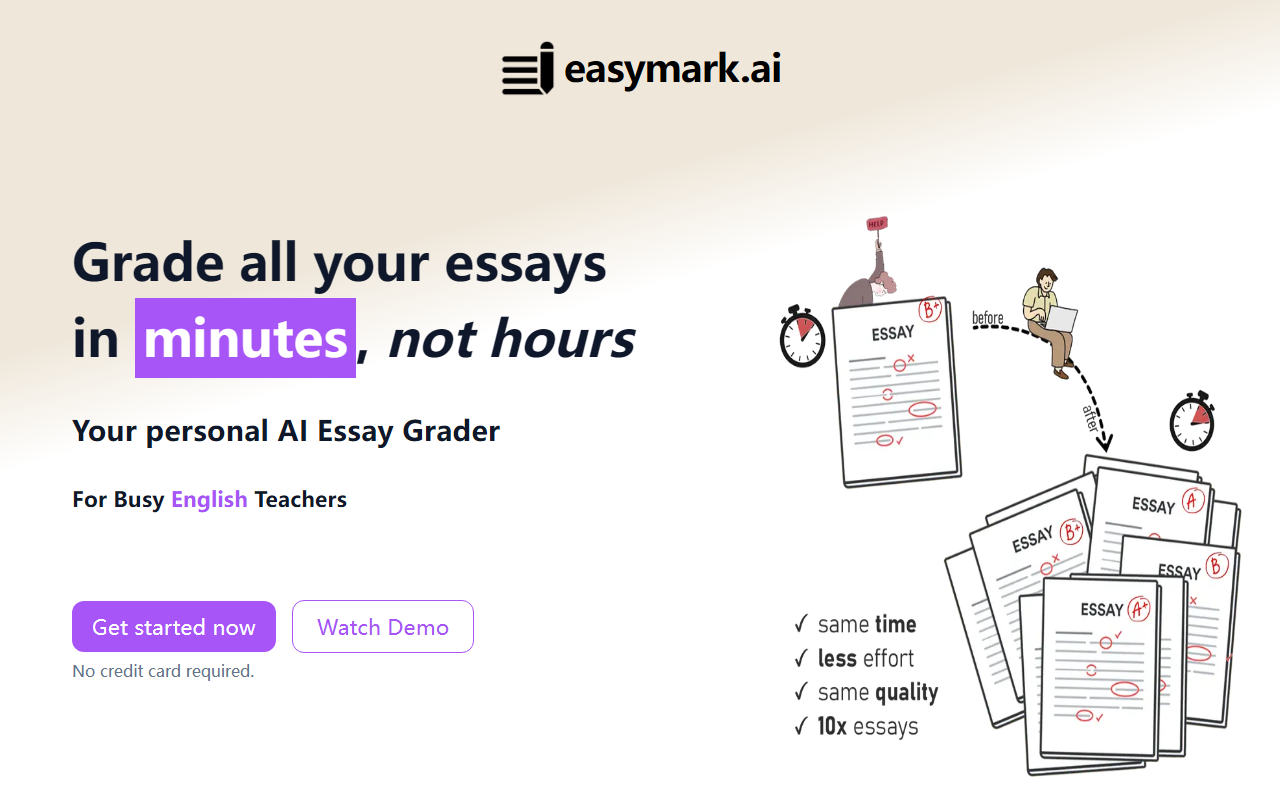
Upon visiting the EasyMark website at easymark.ai, I was greeted by a clean, teacher-focused landing page. The headline, “Grade all your essays in minutes, not hours,” immediately clarifies the value proposition. The call-to-action buttons are prominent, and the promise of “No credit card required” lowers the barrier to entry. I clicked through to the demo watch page, but the site doesn’t offer a live demo without signing up. The registration flow is minimal: name, email, password. Once inside the dashboard, the interface is straightforward and uncluttered – a single text area for pasting essays or a file upload button supporting PDFs, images, and scans. The onboarding tooltip briefly explains how to set a grading rubric and choose a scoring scale. Testing the free tier, I uploaded a sample PDF essay on Shakespeare. Within 30 seconds, the tool returned a detailed breakdown: an overall score, a list of specific errors (grammar, spelling, punctuation), and writing improvement suggestions. The response was surprisingly nuanced, catching not just surface-level mistakes but also structural flow issues. The dashboard also shows a monthly essay count tracker; I started with 750 essays available on the free plan, which is generous.
Core Features and Technology
EasyMark is designed exclusively for English teachers who need to grade large volumes of essays efficiently. The platform uses a proprietary AI model (the website does not specify which underlying LLM, but it appears to be fine-tuned on academic writing) to evaluate essays based on custom rubrics. You can define criteria such as thesis clarity, evidence usage, and organization, as well as assign different point values. The tool then scans the essay and produces a grade with explanations. It also generates a “Writing Errors List” that categorizes issues (e.g., comma splices, run-ons, word choice). One impressive detail: the AI can handle handwritten scans via OCR, though accuracy depends on legibility. The system supports PDF, JPEG, and PNG files, plus direct text input. For integration, there is no API mentioned, but you can export grades as CSV. The tool is web-based, works on any browser, and requires no installation. The developer behind the tool claims it is “designed by teachers, for teachers,” which shows in the rubric customisation – you can save rubrics for reuse across classes. The grade output includes a “reasoned argument” section explaining why each point was deducted, which helps with transparency.
Pricing and Market Context
EasyMark follows a freemium model. The free plan allows up to 750 essays per month and includes all core features. There is no publicly listed pricing for a paid upgrade on the website; the “Get started” CTA leads to the free sign-up without mentioning any limitations. This is unusual – most competitors like Gradescope or Turnitin offer tiered plans with clear price points. The absence of explicit pricing could be a trust issue for some users. However, the generous free tier suggests the tool may rely on future subscription conversions or institutional sales. Compared to other AI grading tools, EasyMark focuses purely on essay grading with a teacher-friendly interface, whereas general AI writing assistants (e.g., Grammarly) cover proofreading but not rubric-based grading. Another alternative, EssayGrader, has similar features but charges per essay. EasyMark’s 750-essay cap is competitive for individual teachers handling multiple classes. The website states “4000+ Teachers already saved 171,280 minutes” – this user base indicates traction, though no venture funding or corporate backing is mentioned. The tool currently supports English only, as per the FAQ, and targets high school and college levels.
Strengths, Limitations, and Final Verdict
Strengths: The biggest win is time savings – grading an essay in under a minute, with detailed feedback that students can review. The custom rubric system is robust and allows for fair, consistent grading across a class. The error list and improvement suggestions go beyond a simple score, fostering learning. The free tier is exceptionally generous. The interface is intuitive for non-technical teachers.
Limitations: The AI sometimes misinterprets creative or unconventional writing styles, giving lower scores for poetic license. The OCR on poor-quality scans produces errors. There is no built-in plagiarism checker – teachers must use a separate tool. The lack of explicit paid pricing may raise concerns about future feature restrictions. Also, the tool cannot handle languages other than English, limiting its audience.
EasyMark is best suited for high school and college English teachers who need to grade many essays quickly and want to provide consistent, rubric-aligned feedback. If you are a tutor or instructor with fewer than 750 essays per month, the free plan is a no-brainer. If you require foreign language support or advanced plagiarism detection, look elsewhere. Visit EasyMark at https://easymark.ai/ to explore it yourself.






Comments