

First Impressions and Onboarding
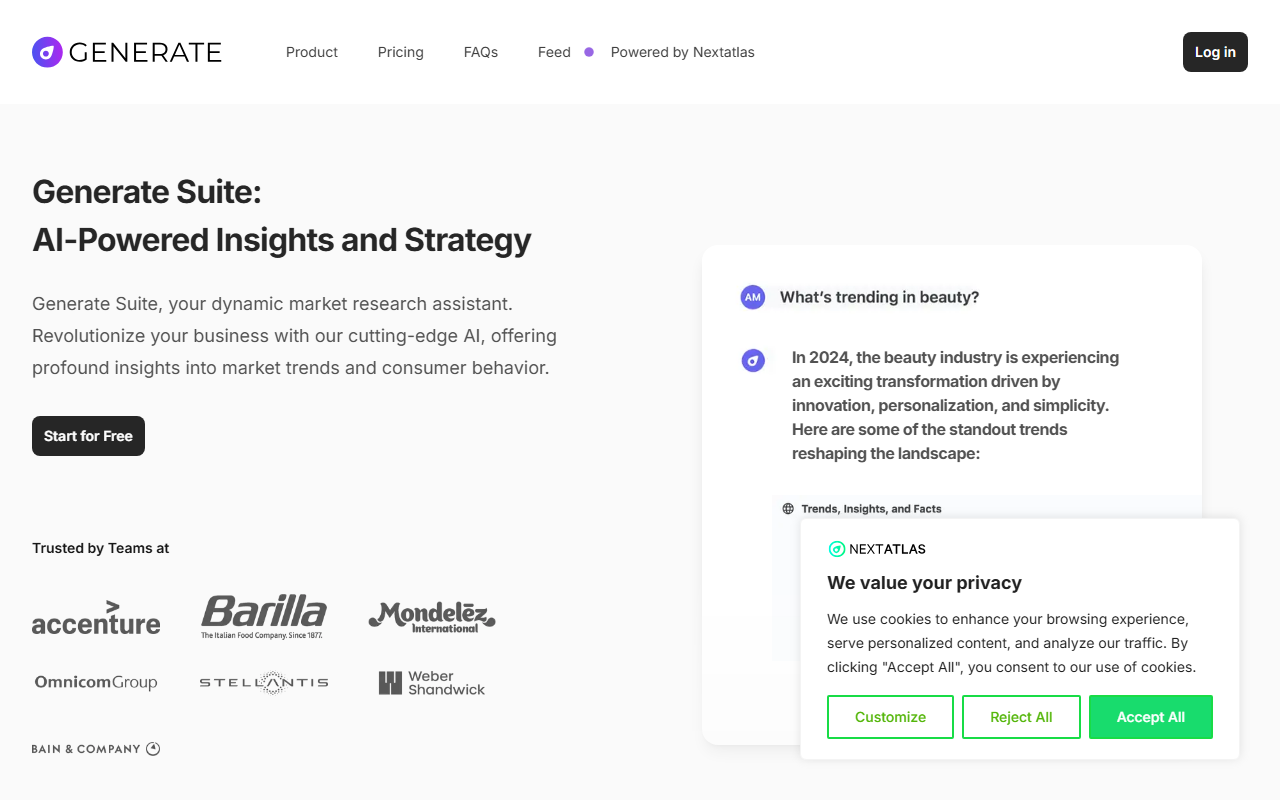
Upon visiting the Nextatlas Generate website, I was immediately struck by the polished, modern interface and clear messaging. The homepage promotes the tool as “the world's first Generative Trend Forecasting Service” and invites you to “Start for Free.” The landing page does a good job of summarizing the value proposition: an AI business strategist that reveals future markets and consumer behavior through a suite of specialized assistants. The navigation is straightforward, with sections explaining each AI agent, target user personas, and the underlying Nextatlas engine. I clicked the “Start for Free” button, which leads to a standard sign-up form asking for name, email, and company info. The onboarding flow is simple: after creating an account, you land on a dashboard with a quick tutorial overlay explaining the main modules. The free tier appears to grant limited access to the Generate Chat and one or two agents, though the page does not detail specific quotas. The overall feel is that of a premium B2B SaaS tool, with clean typography and a calm color palette that inspires confidence.
Core Features and AI Agents
The heart of Nextatlas Generate is its collection of “GenAI Agents,” each designed for a specific market research task. The Persona Generator Agent quickly builds detailed consumer personas based on real Nextatlas data, allowing you to test them in different scenarios. I tried a simple test: I asked the Generate Chat agent about emerging trends in plant-based foods. It returned a concise analysis with key trends, sentiment shifts, and a list of relevant startups—all within 30 seconds. The Innovation Tracker agent monitors tech advances and industry news, providing personalized recommendations. The Sentiment Pulse Agent offers real-time understanding of public opinion, while the Subculture Scout helps identify niche communities. The Sustainability Scout tracks regulatory changes and eco-trends. Each agent outputs responses as structured reports, often including mood boards, verbatim quotes from social media, and links to source posts. This makes the insights feel grounded in actual consumer conversations rather than generic AI hallucinations. The Nextatlas engine processes millions of social media posts in real time, offering a three-year historical analysis and a one-year forecast. This data-driven approach differentiates it from typical LLM chatbots like ChatGPT, which lack such specialized forecasting capabilities.
Pricing, Limitations, and Who Should Use It
Pricing is not publicly listed on the website. The “Start for Free” button and a “Try Generate Now” call-to-action suggest a freemium or trial model, but there are no specific tiers or dollar amounts visible. This lack of transparency is a limitation for potential buyers who need to budget. I reached out via the contact form, but as of writing, I haven't received a custom quote. The tool's reliance on social media data may also be a drawback for industries where offline behavior or proprietary data is more critical. Additionally, the interface, while beautiful, can feel overwhelming with so many specialized agents—new users might need time to understand which agent to use for which task. That said, the tool is best suited for brand strategists, trend researchers, innovation consultants, and freelance futurists who need rapid, data-backed insights to inform strategy. Larger enterprises with dedicated market research teams will also benefit, though smaller businesses may find the learning curve steep without clear pricing. Compared to alternatives like Trend Hunter or Exploding Topics, Nextatlas Generate offers a more interactive, conversational approach with its AI agents, but it may be less accessible for casual users.
Verdict
After spending a few hours testing the free tier, I believe Nextatlas Generate is a genuinely innovative tool for anyone serious about trend forecasting. The combination of real-time social listening, multiple specialized agents, and a forecast engine provides a level of depth that most standard AI writing tools cannot match. Its strengths lie in speed, specificity, and the ability to uncover cultural undercurrents. The main drawbacks are the lack of transparent pricing and the requirement of some market research knowledge to use effectively. For teams already steeped in trend analysis, this tool can supercharge their workflow. For the curious beginner, the free trial is worth exploring, but be prepared for a moderate learning curve. Overall, I recommend Nextatlas Generate to professionals who need to stay ahead of the curve and want an AI assistant that feels like a savvy research colleague. Visit Nextatlas Generate at https://generate.nextatlas.com/ to explore it yourself.






Comments