

First Impressions and Onboarding
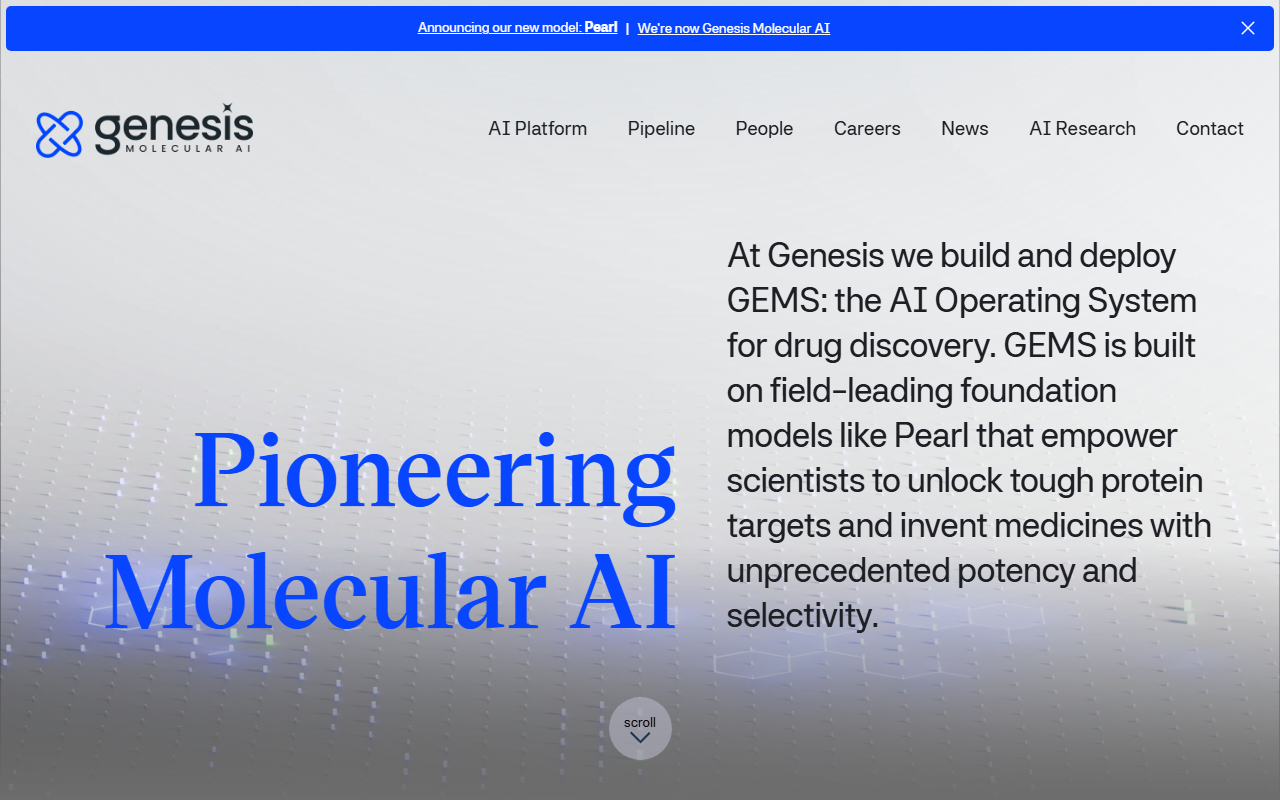
Upon visiting the Genesis Therapeutics website at genesistherapeutics.ai, I was greeted by a clean, visually rich landing page that immediately frames the company's core mission: pioneering molecular AI. The slogan "Pioneering Molecular AI" appears prominently, and a smooth scroll animation invites you to explore further. The site does not offer a public demo or free tier, which is typical for enterprise-grade drug discovery platforms. Instead, it presents a high-level overview of the GEMS operating system for drug discovery and the Pearl foundation model. There is no sign-up flow for individual users, and the onboarding is clearly geared toward pharmaceutical partners rather than hobbyists or academic researchers. Navigation is minimal—just a few links to explore the AI platform, pipeline, and team.
The dashboard-like experience is absent; you are essentially reading a brochure. However, the language is precise: GEMS is described as synthesizing "proprietary AI + physics research" into a state-of-the-art platform. This suggests a deep integration of machine learning and computational chemistry, which I found compelling even without hands-on access.
Technology and Capabilities
Genesis Therapeutics builds and deploys GEMS, which stands for Generative AI for Drug Discovery. At its heart is Pearl, a 3D diffusion foundation model that generates molecular candidates with specified properties. Unlike general-purpose text generation models, Pearl is purpose-built to tackle "tough protein targets" and design medicines with unprecedented potency and selectivity. The website highlights that Genesis scientists use GEMS to find drug candidates against chemically complex targets at "industry-leading speed."
What sets this tool apart is its focus on physics-integrated AI. Many competitors use simplistic ligand-based or sequence-based models, but Genesis combines diffusion-based generation with physics-based scoring. This hybrid approach likely reduces false positives in virtual screening and improves the quality of candidate molecules. The technology is not just theoretical; the company reports that it has achieved highly potent and selective drugs in its pipeline and through pharma partnerships. Unfortunately, the site does not disclose the underlying architecture details, training data size, or benchmarking results, so I cannot verify performance claims with hard numbers. The absence of an API or SDK also limits independent testing.
Pricing and Market Positioning
Pricing is not publicly listed on the website. This is common for bespoke B2B platforms where costs depend on partnership scope, number of targets, and license duration. Genesis Therapeutics operates in a niche within AI for drug discovery, competing with companies like Insilico Medicine (which uses end-to-end AI for target identification to clinical trials) and Recursion Pharmaceuticals (which relies on high-throughput cellular imaging and machine learning). Unlike those competitors, Genesis emphasizes deep molecular generation through its Pearl diffusion model rather than broader drug development services.
The company appears well-funded and has disclosed partnerships with pharmaceutical firms. The website references "pharma partners" but does not name them. The GEMS platform is described as an "AI Operating System," implying it can be integrated into existing drug discovery workflows. For a small biotech or a large pharma, the investment would be substantial but potentially justified by improved success rates. In contrast, individual researchers or startups without significant budgets would likely find the tool inaccessible.
Who Should Use Genesis Therapeutics
Genesis Therapeutics is best suited for large pharmaceutical companies and specialized biotechs that have the resources to deploy a dedicated AI platform and need to solve chemically challenging targets. It is not a plug-and-play solution for small teams or academic labs unless they have strong computational support and high target complexity. The platform's strength lies in its ability to design molecules with exceptional potency and selectivity, which is crucial for targets that have eluded conventional discovery methods.
A real limitation is the lack of public benchmarking or model card. Without transparency, it's hard to assess how Pearl performs relative to open-source alternatives like EquiDock or DiffDock, or commercial competitors. Additionally, the website offers no trial or sandbox environment, making it impossible for reviewers like me to test the output quality firsthand. For now, the tool's effectiveness is primarily supported by the company's own case studies and pipeline disclosures.
Overall, if you are a decision-maker in a drug discovery organization and have the budget to license a cutting-edge AI platform, Genesis Therapeutics warrants a closer look. For everyone else, the tool remains an intriguing but distant promise in molecular AI. Visit Genesis Therapeutics at https://genesistherapeutics.ai to explore it yourself.







Comments