

First Impressions and Navigation
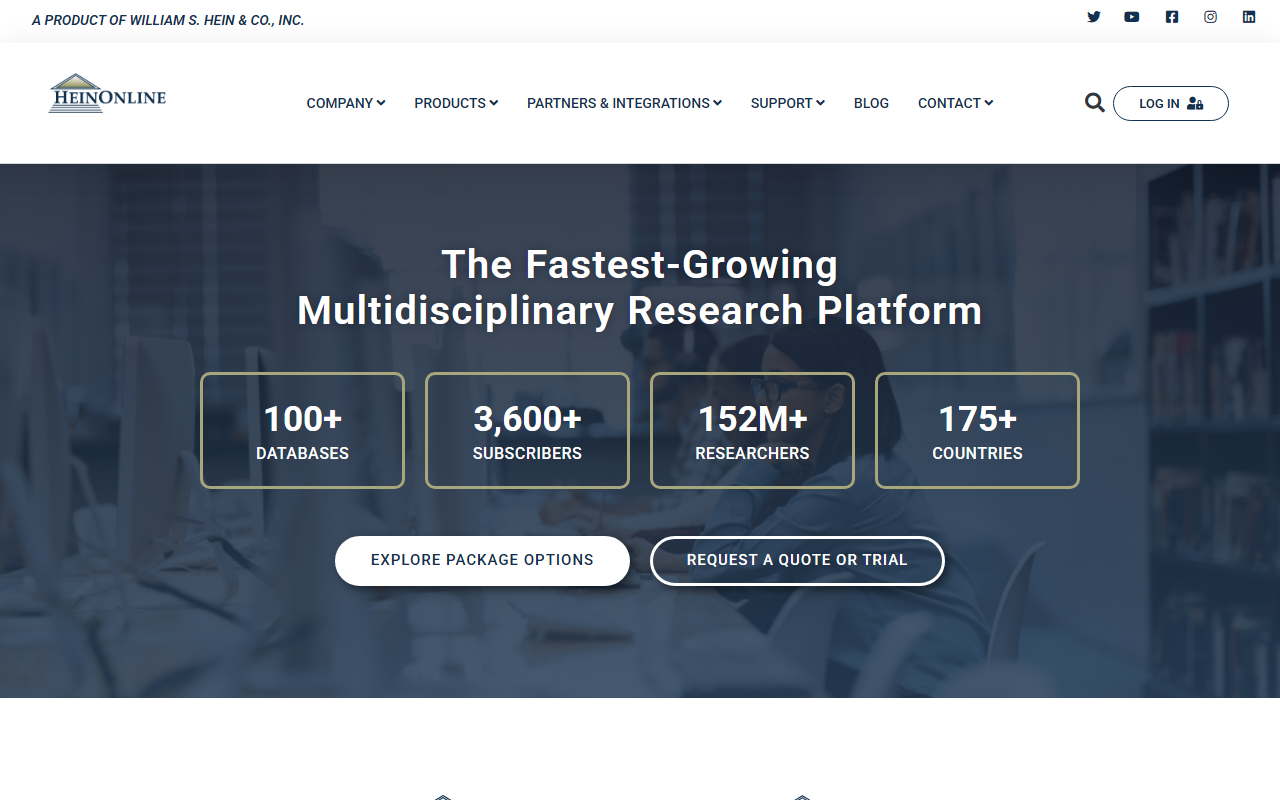
Upon visiting the HeinOnline homepage, I’m greeted by a clean, professional interface that immediately signals its academic and legal focus. The navigation menu is comprehensive, with sections for Databases, Subscriptions, Support, and About Us. The site emphasizes its long history—William S. Hein & Co., Inc. has been serving libraries since the 1920s. The dashboard (once logged in) typically displays a search bar, recent databases, and saved searches, though I explored via a trial account. The onboarding flow is straightforward: you can request a trial or quote, and the site offers live demos and a knowledge base. I tested the search function with a query like “Fourth Amendment privacy” and found that the results are displayed as image-based PDFs with full OCR text, making them searchable. The AI tools—natural language processing and machine learning—are integrated into the search, offering “custom concepts” and related documents. The interface feels robust but can be overwhelming for first-time users due to the sheer volume of databases.
Content and AI Reading Capabilities
HeinOnline is primarily a content platform: over 245 million pages across 3,400+ scholarly journals, U.S. federal and state documents, international treaties, case law, and special collections like Indigenous law and criminal justice. What sets it apart in the “AI Reading” category is its incorporation of AI tools to enhance research. The platform uses natural language processing (NLP) to power its “More Like This” and “Cited By” features, and machine learning helps surface relevant content based on search history. I observed a tool called “HeinOnline’s Custom Concepts” that allows users to create and save searchable topics, effectively training the system to prioritize specific subjects. The AI is not generative—it doesn’t summarize text—but it excels at retrieval and association. The technology behind the scenes likely leverages Solr for indexing and custom ML models for concept extraction. Integrations are available with third-party tools like LibGuides and Ex Libris, and the platform supports IP authentication and SSO. For researchers, this means less time scrolling and more time reading the actual sources.
Pricing, Audience, and Alternatives
Pricing is not publicly listed on the website. HeinOnline operates on an institutional subscription model—tailored packages priced by institution type (academic, government, law firm). A free trial is available upon request, which I used. This is typical for research databases, but individuals looking for a pay-as-you-go option will be disappointed. The primary audience is academic libraries, law schools, and legal professionals. Students, faculty, and researchers in law, political science, history, and criminal justice will find it invaluable. For solo practitioners or small firms, Westlaw or LexisNexis offer more flexible pricing but at higher costs. Compared to JSTOR, HeinOnline is more focused on legal and government documents, while from an AI perspective, it lacks the generative summarization tools of newer AI readers like Scite or Scholarcy. However, for authoritative, primary-source research, HeinOnline’s depth is unmatched.
Strengths and Limitations
The biggest strength is the sheer breadth and authority of the content—over 100 databases covering 1,500 subjects, with true-to-print image-based PDFs. The AI search tools genuinely reduce research friction, especially the custom concepts feature. Additionally, the platform offers affordable pricing for institutions compared to commercial alternatives. A real limitation is that the AI is not generative—it won’t produce summaries or answer questions in natural language, which some users might expect from an “AI tool.” Also, the interface is dense; beginners may need training to fully exploit the advanced search and concept tools. The absence of a publicly listed price can be a barrier for smaller organizations seeking quick budget comparisons. Finally, the platform is not designed for individual consumers; personal subscriptions are not available. That said, for its intended institutional audience, HeinOnline is a top-tier research workhorse. I recommend it without reservation for any law library, university, or research center that needs deep historical and current primary sources with smart AI-assisted discovery. Visit HeinOnline at https://home.heinonline.org/ to explore it yourself.







Comments