

First Impressions and Onboarding
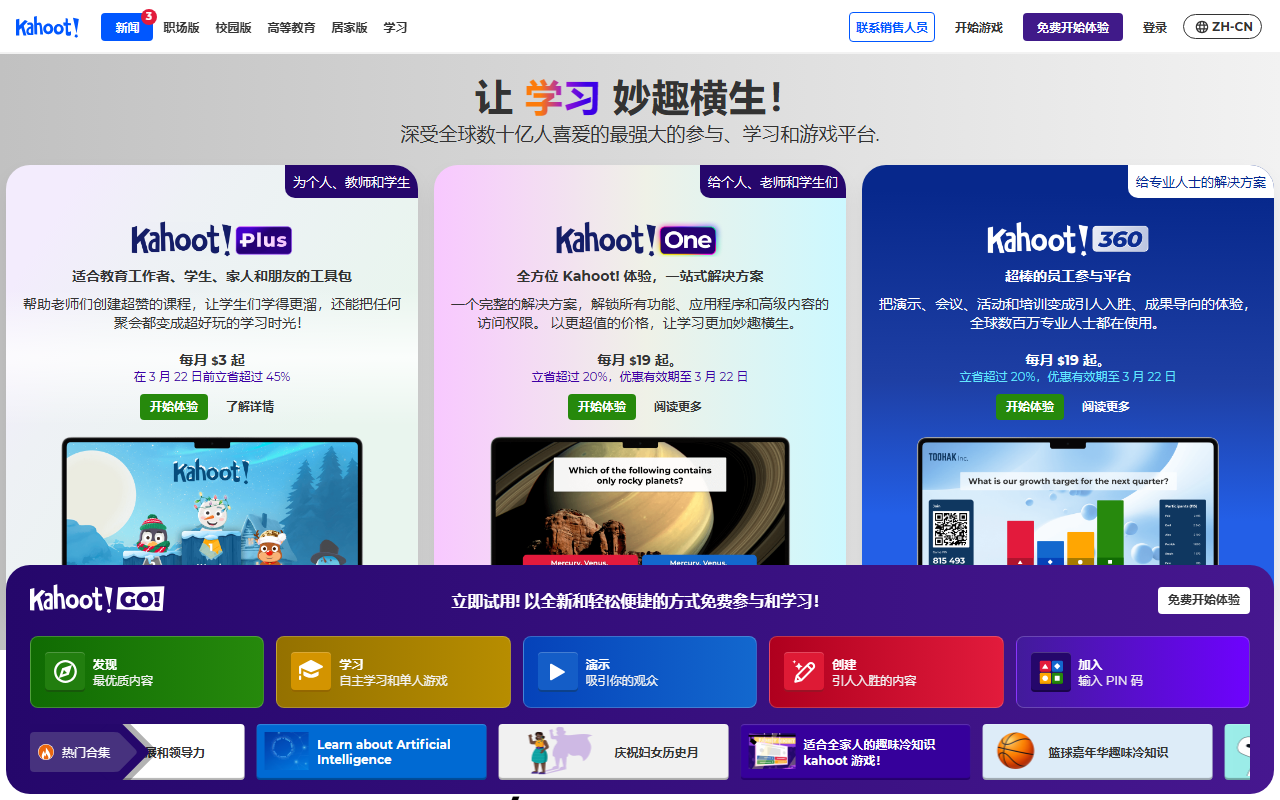
Upon visiting Kahoot!'s website, the first thing that strikes you is the vibrant, energetic design. The homepage immediately leans into fun with bold colors and playful language—"Make learning awesome!" is front and center. The navigation is clean, directing users to three main audience paths: Individuals (Teachers & Students), Professionals, and a combined enterprise offering. The call-to-action for a free start is prominent, and there's no credit card required for the trial. The dashboard, after a quick free registration, presents a library of pre-made kahoots (quizzes) and a creator tool that feels intuitive. You can start building a quiz in minutes by adding questions, answer options, and even embedding images or videos.
What Kahoot! Does and How It Works
Kahoot! is a game-based learning platform that turns any presentation, lesson, or event into an interactive quiz. It solves the problem of passive engagement—whether you're a teacher trying to keep students attentive or a manager needing to liven up a training session. When I tested the free tier, I created a quick trivia game about tech history. The flow is straightforward: you host a live game on a screen (like a projector), players join using a unique PIN on their devices, and questions appear one by one. Points are awarded for speed and accuracy, and a leaderboard fuels friendly competition. Behind the scenes, Kahoot! uses its own proprietary quiz engine, not a specific AI model like GPT, but its strength lies in the gamification mechanics. For educators, there are options for homework challenges (student-paced) and detailed reports on performance. The platform integrates with tools like Microsoft Teams, Google Classroom, and Zoom, making it versatile for remote and hybrid environments.
Pricing and Target Audience
Kahoot! offers several tiers. For individuals, teachers, and students, the basic plan starts at $3 per month (with a limited-time discount until April 30). This includes access to all features, apps, and premium content. For professionals and businesses, the plan begins at $19 per month, also with a discount. There's also a combined solution starting at $19 per month for a more comprehensive experience. Notably, a free tier exists, giving you access to basic creation tools and public kahoots. The site also mentions a specific focus on educators, students, and families, as well as workforce engagement. Compared to competitors like Quizlet (flashcards-centered) or Mentimeter (polling-focused), Kahoot! emphasizes real-time, competitive play. It is best suited for teachers who want to energize classrooms, corporate trainers seeking engagement, and event hosts looking for icebreakers. However, if you need deep analytics or advanced AI-generated content (like adaptive learning paths), you might look elsewhere.
Strengths, Limitations, and Verdict
Kahoot!'s greatest strength is its sheer fun factor. The real-time interaction, music, and point system genuinely motivate participation. The platform is trusted by leading companies and universities worldwide, and its library of millions of user-created kahoots means you rarely have to start from scratch. On the flip side, a major limitation is the lack of sophisticated AI integration—there is no natural language quiz generation or intelligent tutoring. You manually craft every question. Additionally, the free tier is quite restrictive; you get basic functionality, and advanced reporting is locked behind paywalls. For deep learning assessments or personalized study, tools like Khan Academy’s mastery system or Duolingo’s adaptive model might be more effective. Overall, Kahoot! remains an excellent choice for group engagement and formative assessment where excitement matters as much as accuracy. I recommend it for any educator or team leader who wants to turn mundane topics into memorable experiences. Try the free version first—it's enough to see if the platform clicks with your audience.
Visit Kahoot! at https://kahoot.com/ to explore it yourself.







Comments