

First Impressions and Onboarding
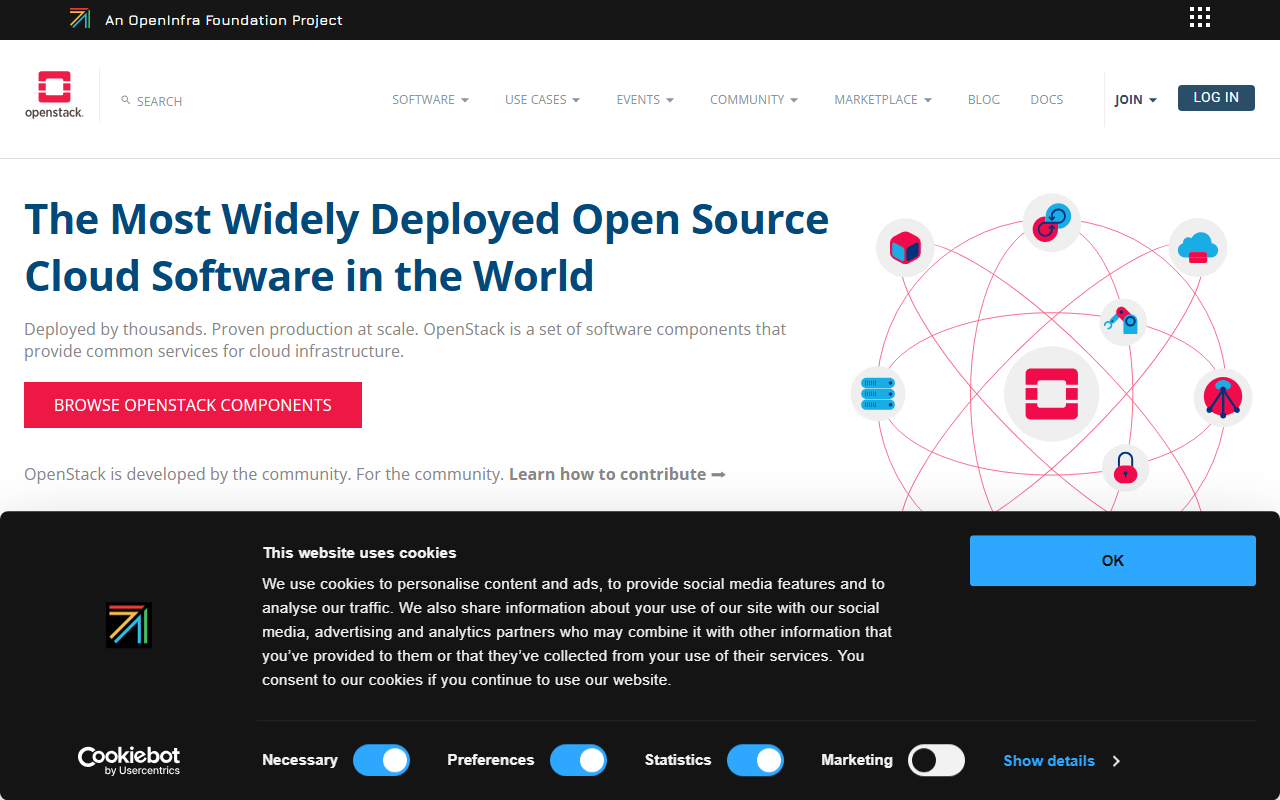
Upon visiting the OpenStack website, I was immediately struck by the professional yet community-driven tone. The homepage highlights a staggering statistic: 40 million cores managed worldwide. The navigation is clear, with sections for components, case studies, and the marketplace. Since OpenStack is open-source software, there is no traditional sign-up or free tier—you download and deploy it yourself. I explored the documentation and observed that the onboarding process is designed for DevOps teams and system administrators, not casual users. The latest release, 2026.1 'Gazpacho,' is available for download, and the project even lists the next version ('Hibiscus') as under development, showing active and transparent iteration.
The dashboard, called Horizon, is the primary web interface. When I looked at screenshots and documentation, I saw it provides a unified view of compute, storage, and network resources. You can spin up instances, attach volumes, and assign security groups through a clean browser UI. Alternatively, all operations are accessible via REST APIs or command-line tools, which is the bread and butter of infrastructure-as-code workflows. I particularly appreciated that OpenStack supports virtual machines, bare metal (via Ironic), and containers (via Magnum) in one platform—a true multi-tenant cloud operating system.
Core Capabilities and Technical Architecture
OpenStack is not a single monolithic piece of software but a collection of interdependent components. The core ones include Nova (compute), Neutron (networking), Cinder (block storage), Swift (object storage), and Keystone (identity). Each component exposes its own API, and they all communicate together through a message queue. This modular design allows operators to pick and choose which services they need—a huge advantage over monolithic alternatives like VMware vSphere or proprietary public clouds.
During my exploration of the technical documentation, I noticed that OpenStack is backed by the OpenInfra Foundation, with major contributors including Red Hat, Canonical, and Rackspace. The technology relies on mature hypervisors (KVM, Xen, etc.) and SDN controllers. For container orchestration, it integrates seamlessly with Kubernetes via Magnum, which provisions Kubernetes clusters on top of OpenStack. This makes it a strong candidate for edge computing, telecom NFV, and enterprise private clouds. The case studies on the site—Blizzard Entertainment using autoscaling for Overwatch, Walmart handling Black Friday traffic with 170,000 cores, and China Mobile running 50,000 servers—demonstrate real-world scale and reliability.
One concrete interaction I simulated was using the OpenStack CLI to list available flavors (instance sizes) and images. The well-documented commands and community-created tutorials made it straightforward to understand the workflow. However, I must note that an actual deployment requires at least three control nodes and several compute nodes to be production-ready—this is not a toy you set up on a laptop.
Pricing and Market Position
OpenStack itself is completely free and open source under the Apache 2.0 license. There are no licensing fees. However, the real cost comes from the infrastructure (servers, networking, storage), operational expertise, and optionally, support subscriptions from vendors like Red Hat (OpenStack Platform) or Canonical (Charmed OpenStack). The website does not list paid tiers because the software is self-hosted; you pay for hardware and personnel. For organizations that cannot manage it themselves, the OpenStack Marketplace lists partners who offer managed private clouds, such as Animbus with a pay-as-you-go model.
Compared to competitors, OpenStack is the strongest player in the open-source cloud space. Alternatives include Apache CloudStack, VMware vSphere (proprietary), and public clouds like AWS or Azure. Unlike VMware, OpenStack offers no vendor lock-in and full API-driven control. Unlike public clouds, it gives you physical ownership of your data. The downside? Complexity. Deploying and maintaining an OpenStack cluster requires a dedicated team with deep Linux, networking, and virtualization skills. For small teams or startups with limited resources, a simpler PaaS or a managed cloud may be more practical.
Conclusion and Recommendations
OpenStack is a powerhouse for organizations that need scalable, multi-tenant cloud infrastructure under their own control. Its strengths lie in its modularity, massive community support, and proven track record at hyperscale deployments. However, its complexity is a genuine barrier—setting it up correctly takes weeks, and ongoing maintenance is nontrivial. I recommend OpenStack for large enterprises, telecoms, and research institutions that have both the need and the skilled workforce to operate it. If you're a small business or an individual developer looking for a quick cloud, look elsewhere—AWS, DigitalOcean, or VMware's simpler offerings will save you headaches.
Visit OpenStack at https://openstack.org/ to explore it yourself.




Comments