

First Impressions and Onboarding
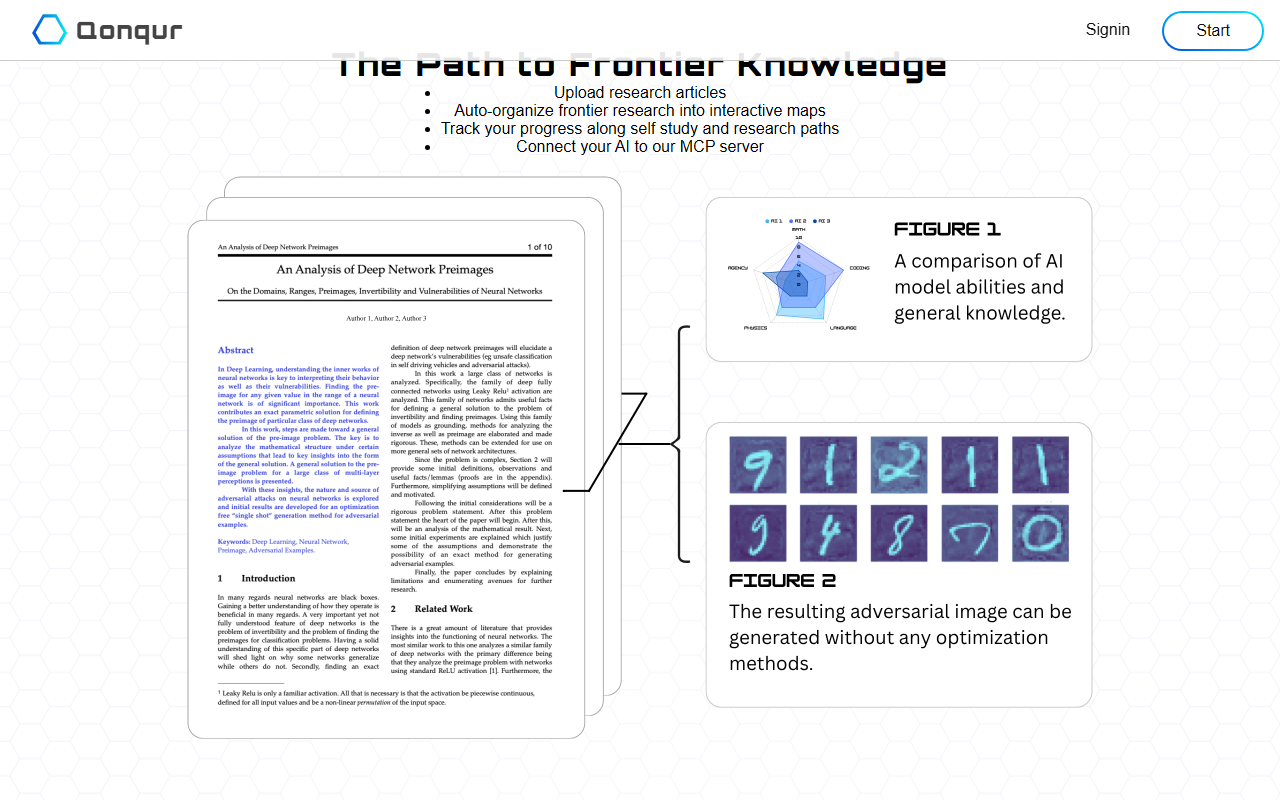
Upon visiting the Qonqur website, I was greeted by a clean, minimalist landing page that immediately signals its futuristic mission: “The Path to Frontier Knowledge.” The onboarding flow is not yet interactive — the page remains a static showcase of concept screens and a list of historical milestones (from Ada Lovelace to quantum supremacy). There is no sign-up button or demo version available for hands-on testing. The only calls to action are “Signin” and “Start,” but clicking them leads to placeholder pages. While the visual design is sleek, the lack of a live product makes it difficult to evaluate the user experience in depth. This is clearly an early-stage tool, likely in pre-release or beta.
How Qonqur Works
According to the website, Qonqur allows users to upload research articles and automatically organizes them into interactive maps based on citation networks and knowledge dependencies. The core idea is to replace the traditional linear reading list with a visual, dependency-aware progression. For example, to understand “Graphene,” the map would first surface foundational concepts like quantum mechanics or materials science, then show how later discoveries build on them. The tool also tracks your progress along self-study or research paths, effectively acting as a GPS for frontier knowledge. Additionally, Qonqur offers an MCP (Model Context Protocol) server integration, suggesting that users can connect their own AI agents to query and navigate the knowledge maps. This is a sophisticated feature that could appeal to advanced researchers using custom language models.
Pricing and Market Position
Pricing is not publicly listed on the website. There are no tiered plans, free trial information, or subscription details anywhere on the page. This is a notable gap for potential users who need to assess cost before committing to a research workflow. In the current AI-assisted research space, Qonqur competes with tools like ResearchRabbit, which visualizes citation graphs, and more general knowledge management platforms such as Notion or Obsidian with plugin overlays. Unlike ResearchRabbit, which focuses on paper recommendations and author networks, Qonqur emphasizes a curated learning path that progresses from foundations to frontiers. It also shares DNA with memory-based AI tools like Mem, but with a stronger emphasis on academic rigor. However, without a working prototype or public demos, Qonqur’s actual differentiation remains unproven.
Who Should Use Qonqur?
Given its stated mission, Qonqur seems best suited for self-directed learners diving into deep, interdisciplinary fields (e.g., AI, physics, bioinformatics) and researchers who need to map the evolution of ideas across many papers. The MCP server integration indicates intended use by AI power users who want to feed knowledge maps into their own models. However, several limitations are clear: no public product to test, no pricing transparency, and an extremely sparse website with only conceptual imagery. The company’s vision — “to liberate intellect and creativity from all limitations” — is inspiring but currently lacks concrete execution. I would only recommend this tool for early adopters who are willing to sign up for a waitlist or follow development closely. For most researchers today, established tools offer more reliable, hands-on value. Visit Qonqur at https://qonqur.xyz/ to explore it yourself.







Comments