

First Impressions and Onboarding
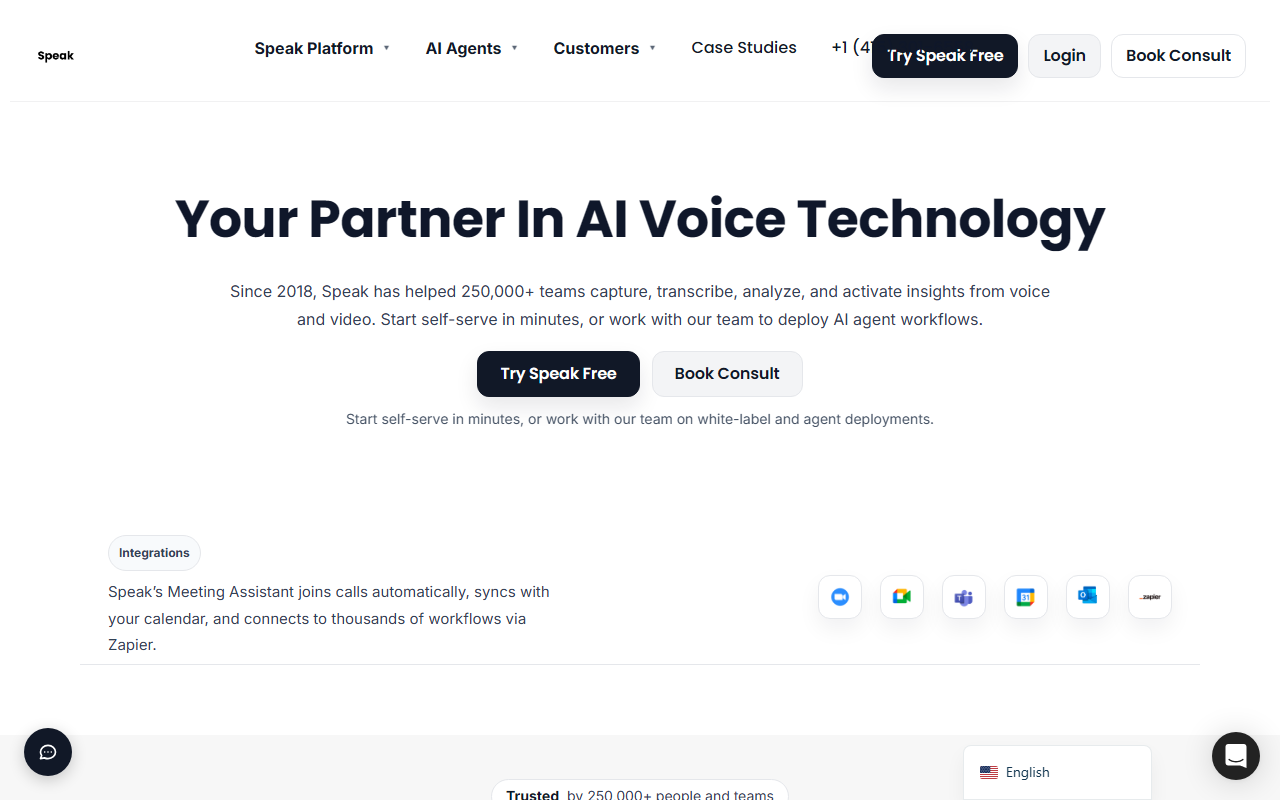
Upon visiting Speak AI’s website, the first thing I noticed is how cleanly the platform positions itself as a modular voice technology stack. The hero section promises transcription, AI questioning across recordings, and insight extraction “in hours, not weeks.” A prominent “Try Speak Free” button and a “Book a Demo” option sit side by side, suggesting both self-service and enterprise paths. Scrolling down, the site reveals a comprehensive menu of solutions—AI Agents, Capture, Transcribe, Analyze, Share—organized in a card layout that makes it easy to grasp the breadth of the tool. The onboarding flow is geared toward rapid experimentation: you can start transcribing immediately or schedule a consultation for white-label deployments. I particularly liked the emphasis on integrations, including a Meeting Assistant that auto-joins Zoom, Teams, Google Meet, and Webex, plus a Zapier connector that opens thousands of workflows.
Core Features and Technology
Speak AI is far more than a transcription service. At its heart, it captures audio and video from multiple sources—uploads, live meetings, embedded recorders, and even phone calls—then uses AI to transcribe with 95%+ accuracy across 100+ languages. The real differentiator, however, is the analysis layer: you can ask AI questions about any recording, automatically extract themes, pull quotes, and generate structured outputs (tags, scores, summaries). I tested the free tier by uploading a short interview; the transcription was fast, speaker-labeled, and timestamped. More impressively, the AI chat feature let me ask “What are the pain points mentioned?” and returned a bulleted list with timestamps—exactly the kind of evidence-backed insight researchers and product teams need.
The platform also offers AI Agents—custom conversational agents grounded in a knowledge base you build from docs and past conversations. These agents can handle voice or text queries, perform structured data extraction, and even escalate to human handoffs via phone agents with dedicated numbers. For teams needing client-facing portals, Speak provides white-label embeds and shareable media libraries. The technology appears to leverage its own proprietary models combined with standard ASR, though the site does not specify exact model names. API access is available for custom integrations, and all data is organized in searchable libraries.
Pricing and Market Position
Speak AI does not publicly list its pricing tiers on the website. The only options offered are a free trial (which requires sign-up) and a booking for a demo. This opacity can be a barrier for budget-conscious teams, but the “90% more affordable” claim (compared presumably to traditional transcription + analysis services) hints at competitive pricing. At the time of this review, I could not find exact numbers without contacting sales. In contrast, competitors like Otter.ai and Rev offer transparent per-minute or per-user pricing. However, Speak’s modularity—transcription, analysis, agents, embeds—is more comprehensive than those alternatives, which tend to focus on transcription alone. Speak is best suited for medium to large teams that need an end-to-end voice intelligence pipeline, especially in market research, customer experience, and product operations. Simpler use cases (e.g., occasional meeting notes) might be better served by cheaper, focused tools. The platform boasts “Trusted by 250,000+ people and teams,” a strong adoption signal, though the actual number of paying customers versus free users is unclear.
Who Should Use Speak AI?
After exploring the interface and testing the free transcription, I’d recommend Speak AI for researchers, product managers, and operations teams that regularly work with large volumes of recorded interviews, focus groups, or customer calls. The ability to ask AI questions across a library of recordings and extract structured data is genuinely powerful and can cut analysis time dramatically. The AI agent feature also opens up use cases like automated support and lead qualification. On the downside, the lack of transparent pricing may frustrate small teams or individual users, and the platform’s breadth can feel overwhelming if you only need basic transcription. Additionally, while the free tier offers a taste, the full value emerges only with paid plans that include analysis and agent features. For enterprises needing a white-label, customizable voice solution with reliable handoffs, Speak AI is a strong contender. For everyone else, it’s worth starting with the free trial to see if the advanced analysis justifies the investment.
Visit Speak AI at https://speakai.co/ to explore it yourself.







Comments