
First Impressions and Onboarding
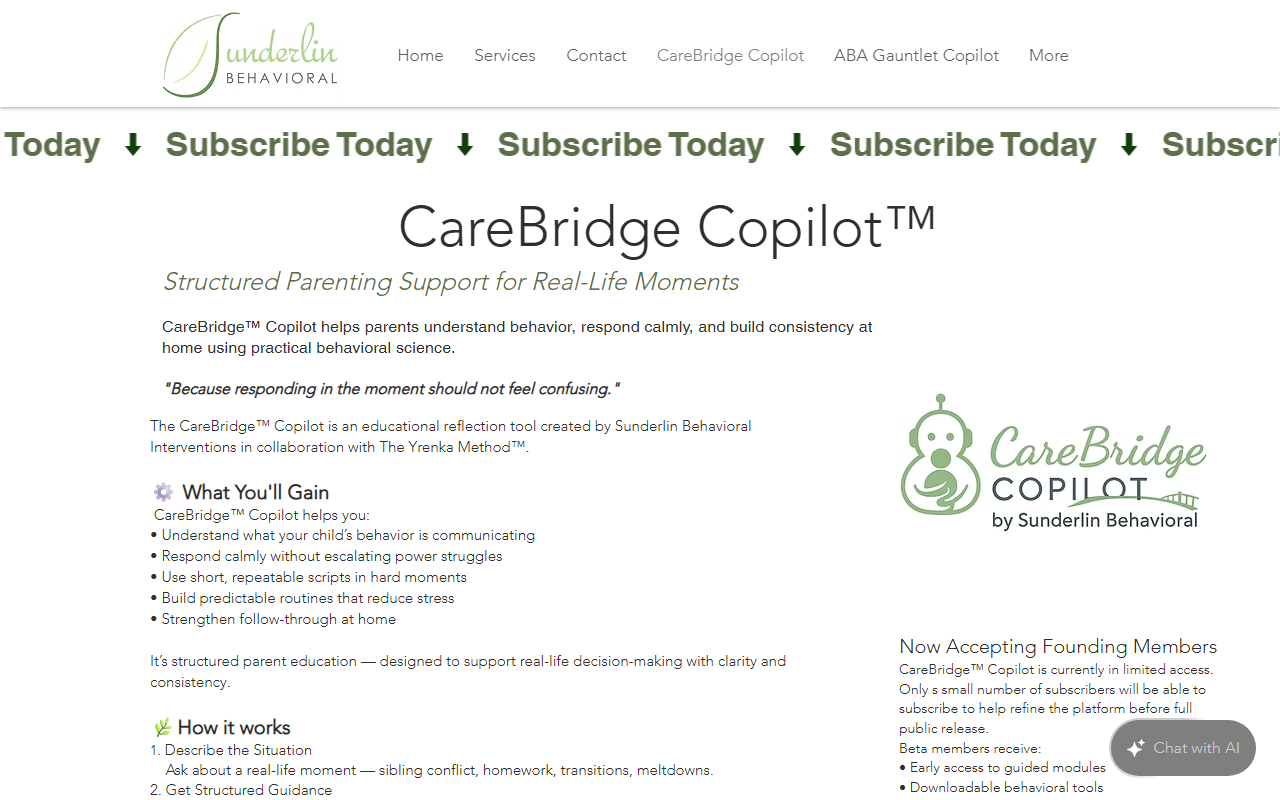
Upon visiting sunderlinbcba.com, the first thing I noticed was the clean, modern design that immediately positions Sunderlin Behavioral as a hybrid care innovator. The hero text “Where Learning Meets Innovation” and a bright “Start Today!” call-to-action set the tone for a service that blends human-led ABA therapy with AI-powered tools. The site does not offer a free trial or a sign-up for a digital product—instead, it’s a landing page for a clinical service. As a tech journalist, I expected a dashboard or a software demo, but this is a therapy provider using AI internally. The onboarding flow is absent; the site is purely informational, directing visitors to contact the clinic or join their team.
Scrolling through the page, I found clear sections outlining services: school consultation, child and family services, and teen/young adult coaching. Each section explains how AI assists therapists with paperwork, data collection, and real-time progress dashboards. For example, under “Children & Family Services,” the copy states: “while our AI systems handle data collection and progress reporting in the background.” This was the only concrete workflow described—there is no interactive demo or free tier to test. The footer emphasizes HIPAA compliance, BACB guidelines, and a “human-led, AI-enhanced” philosophy.
How Sunderlin BCBA’s AI Actually Works
From an expertise standpoint, Sunderlin Behavioral claims to use AI for two main tasks: automating administrative workflows (clipboards, forms) and generating real-time progress tracking dashboards for families and insurers. The underlying technology is not named—no mention of specific LLMs or machine learning models—but the promise is that AI handles data collection and reporting, freeing therapists to focus on client interaction. This is not a standalone AI tool you can purchase; it is a proprietary system embedded within their clinical practice. Pricing is not publicly listed on the website, which is typical for a healthcare service rather than a software-as-a-service product.
I looked for API documentation or integration details—none found. The system is clearly built for internal use, with dashboards available upon request. For families, this means faster insights and more accurate reports for insurance providers. For therapists, the AI reduces time spent on documentation. The site claims “Our AI systems handle the paperwork, data, and progress tracking in real time.” This suggests a backend infrastructure that likely includes natural language processing for session notes and automated data aggregation. However, without seeing a live dashboard or case study, the technical depth remains opaque. Compared to tools like CentralReach or Kipu Health (which offer ABA practice management software), Sunderlin’s AI is less a product to buy and more an internal efficiency engine.
Who Should Use This Hybrid Care Model?
Sunderlin BCBA is best suited for families seeking ABA therapy for children with autism or developmental delays, especially those who value technology-enhanced transparency. The hybrid model aims to give therapists more face time with kids while providing real-time data to parents and payers. Schools and school districts looking for behavior plans with digital progress tracking could also benefit. Additionally, BCBAs and RBTs seeking employment at a forward-thinking agency that leverages AI to reduce burnout might find this appealing—the site explicitly invites therapists to “join a team.”
However, this is not a tool for tech enthusiasts looking to experiment with AI independently. There is no self-service platform, no API key, and no community forum. Those seeking a purely software-based ABA data collection tool should look elsewhere—for example, BIPP or ABA Excel give practitioners direct control over data without being tied to a single provider. Sunderlin’s offering is location-dependent (implied United States) and requires enrollment as a client or employee.
Strengths, Limitations, and Final Verdict
Strengths: The transparency about HIPAA compliance and BACB ethical guidelines builds trust. The focus on reducing therapist paperwork is a genuine pain point solved by AI, and the real-time dashboard feature is a clear benefit for families. The site’s commitment to “human-led, AI-enhanced” care is a balanced approach that doesn’t overhype automation.
Limitations: The lack of a free trial or demo means reviewers like me cannot thoroughly test the AI capabilities. Pricing is hidden, and the website provides no case studies or user testimonials with quantified outcomes—only a general statement that “families have reported significant improvements.” The technology stack remains undisclosed, which limits technical validation.
In conclusion, Sunderlin Behavioral offers a compelling vision for ABA therapy augmented by AI, but it functions as a service, not a standalone tool. I recommend this for families already seeking ABA therapy in the US who want a more data-driven, efficient experience. Tech-savvy individuals curious about AI in healthcare may appreciate the model but will not find a product to experiment with. Visit Sunderlin BCBA at https://sunderlinbcba.com/ to explore it yourself.







Comments