

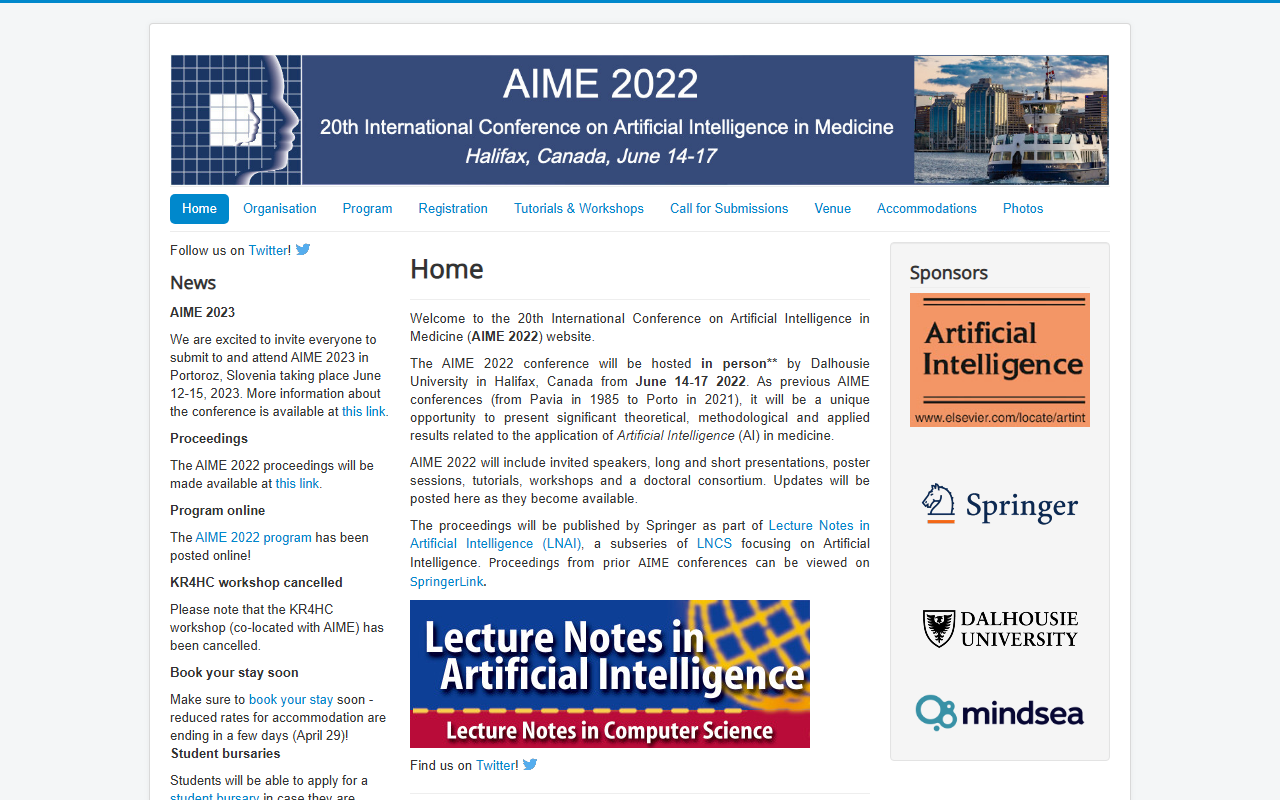
Initial Impressions and Confusion
Upon visiting https://aime22.aimedicine.info/, I expected to find an interactive learning platform for AI in medicine. Instead, the website is a static informational hub for the 20th International Conference on Artificial Intelligence in Medicine (AIME 2022), held in Halifax, Canada in June 2022. The homepage announces calls for papers, registration details, accommodation bookings, and award nominations. There is no dashboard, no interactive AI tool, and no course modules. This is a conference website, not a learning platform in the traditional sense.
The site is clearly outdated: the conference ended in June 2022, yet the homepage still shows “Registration is open!” and “Call for Papers published.” The news section lists items from 2022, with no updates for 2023 or 2024. A single link to “AIME 2023” (Portoroz, Slovenia) appears, but it is not functional within the reviewed site—it points to an external link. For a tool categorized as “Text AI > Learning Platform,” this is a major mismatch.
What AIME 2022 Actually Offers
The AIME conference series, established in 1985, focuses on theoretical and applied AI in medicine. The website provides details on proceedings published in Springer’s Lecture Notes in Artificial Intelligence, student bursaries (sponsored by the Artificial Intelligence Journal and Springer), and a Rising Star award for young researchers. The program includes invited speakers, paper sessions, tutorials, workshops, and a doctoral consortium.
From a technical perspective, there is no AI model, API, or software to test. The “tool” here is the conference itself—a venue for researchers to present and learn. The website serves as a static information portal. If you are looking for a hands-on AI learning platform (like Coursera, DataCamp, or fast.ai), this is not it.
Pricing and Audience
Pricing is not listed on the main page. However, typical AIME conference fees range from €400–€700 for early registration, with discounts for students. The website mentions student bursaries covering a portion of registration fees. No free tier or trial exists—it is a paid academic event.
This “tool” is best suited for established researchers, PhD students, and professionals in medical AI who want to present papers, network, and stay current. It is not for beginners, self-learners, or anyone seeking online courses. Alternatives like the MICCAI conference or AAAI Spring Symposiums offer similar academic focus. For actual learning platforms, consider Coursera’s AI for Medicine or Udacity’s AI in Healthcare.
Strengths and Limitations
Strengths: The conference has a strong history (since 1985) and high-quality proceedings published by Springer. The Rising Star award and student bursaries encourage early-career participation. The site clearly outlines calls and deadlines for 2022.
Limitations: The website is outdated and no longer updated for the 2023 edition (only a link is provided). There is no interactive learning content, no AI tool to experiment with, and no self-paced material. The site lacks any modern learning platform features like quizzes, coding environments, or video lectures. For anyone expecting a “Text AI” tool, this is misleading.
In summary, AIME 2022 is a well-organized academic conference website, but it does not function as a learning platform tool. Researchers may find value in attending future editions, but learners seeking an AI tool should look elsewhere. Visit the AIME conference series at https://aime22.aimedicine.info/ to explore it yourself.













Comments