

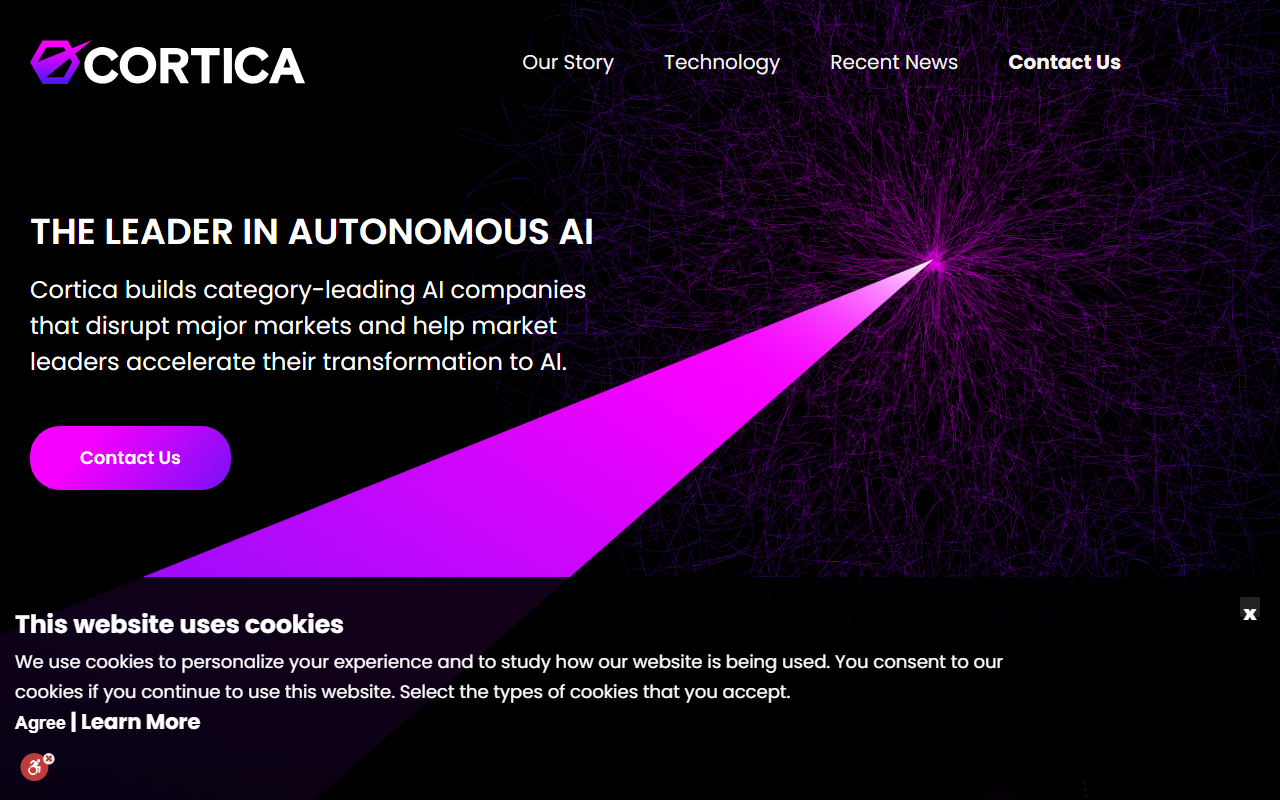
First Impressions: A Corporate Technology Showcase
Upon visiting Cortica's website, I encountered a polished corporate landing page that immediately positions the company as a leader in Autonomous AI. The navigation includes sections like "Our Story," "Technology," and "Recent news," but notably lacks a developer portal or API documentation. This is not a tool you can sign up for and start using today—it's a technology platform that Cortica uses to build spin-off companies. Over 15 years and $250M in investment have gone into a portfolio of 300+ patents, which they claim enable machines to "think" by mirroring the human cortex. The dashboard analogy doesn't apply here; instead, the site functions as a showcase for the underlying technology and its commercial offspring.
Core Technology: Signatures and Self-Learning
Cortica's technology revolves around four pillars: Signatures, Adaptive Architecture, Self-learning, and Speed & Scalability. The Signature approach shifts from traditional AI labeling to generic representations, compressing information into neural responses. Adaptive Architecture applies scenario-focused contextual adaptivity, using sparse resources for superior performance. Self-learning is critical—the system trains without manually labeled data, theoretically eliminating human bias and adaptation overhead. Finally, the platform claims to handle high-volume data on low-compute hardware and is generic enough to process visual, audio, radar, and time-series signals. While these claims are ambitious, I observed no interactive demos or code samples to verify them. The technology description remains high-level, suitable for executive audiences but less useful for engineers seeking technical specifics.
Portfolio Companies: Real-World Deployment
Cortica's portfolio includes six companies that apply its Autonomous AI to specific verticals. Autobrains focuses on autonomous driving perception, competing with Mobileye. Corsight offers facial recognition with claimed resilience to masks and low light. Qualisense revolutionizes quality inspection with self-learning defect detection. SeeTrue automates threat detection in airport security X-ray and CT scans. Cordiguide brings AI to cardiovascular imaging, and Corsound provides voice-to-face biometrics. Each company represents a commercial spin-off leveraging Cortica’s core technology. This structure suggests the framework is not a standalone product but a foundation for building specialized AI businesses. I found the case studies compelling, but they lack performance benchmarks or comparison data. For developers, the lack of direct access to the underlying SDK or API is a significant limitation.
Strengths, Limitations, and Target Audience
Strengths: The self-learning paradigm could dramatically reduce the cost and effort of data labeling, a major bottleneck in traditional AI. The broad signal support (visual, audio, radar) indicates versatility, and the portfolio companies demonstrate real traction across multiple industries. The $120M Series C for Autobrains and partnerships with Johnson Electric and Smiths Detection add credibility.
Limitations: Cortica’s offering is not a developer framework in the conventional sense—there’s no public API, no pricing tiers, and no self-service onboarding. The website provides no documentation, SDKs, or trial access. Pricing is not listed. The technology is essentially proprietary and accessible only through partnership or investment in spin-offs. Additionally, while the claims of mimicking the human cortex are intriguing, independent verification of performance against alternatives like Mobileye or standard convolutional neural networks is absent.
Who should use it? This platform is best suited for large enterprises or investors looking to co-create AI companies in specific markets (manufacturing, automotive, security, healthcare). It is not for individual developers or small teams seeking a ready-to-use AI library. If you need an image AI framework for rapid prototyping, consider open-source alternatives like TensorFlow or PyTorch, or commercial APIs from Google Cloud Vision or Amazon Rekognition.
In summary, Cortica represents a formidable but opaque AI ecosystem. Its autonomous approach is promising, but the lack of direct developer access limits its immediate utility. I recommend it only for organizations prepared to enter a deep partnership to build a dedicated AI company.
Visit Cortica at https://cortica.com/ to explore it yourself.













Comments