

Platform Overview and First Impressions
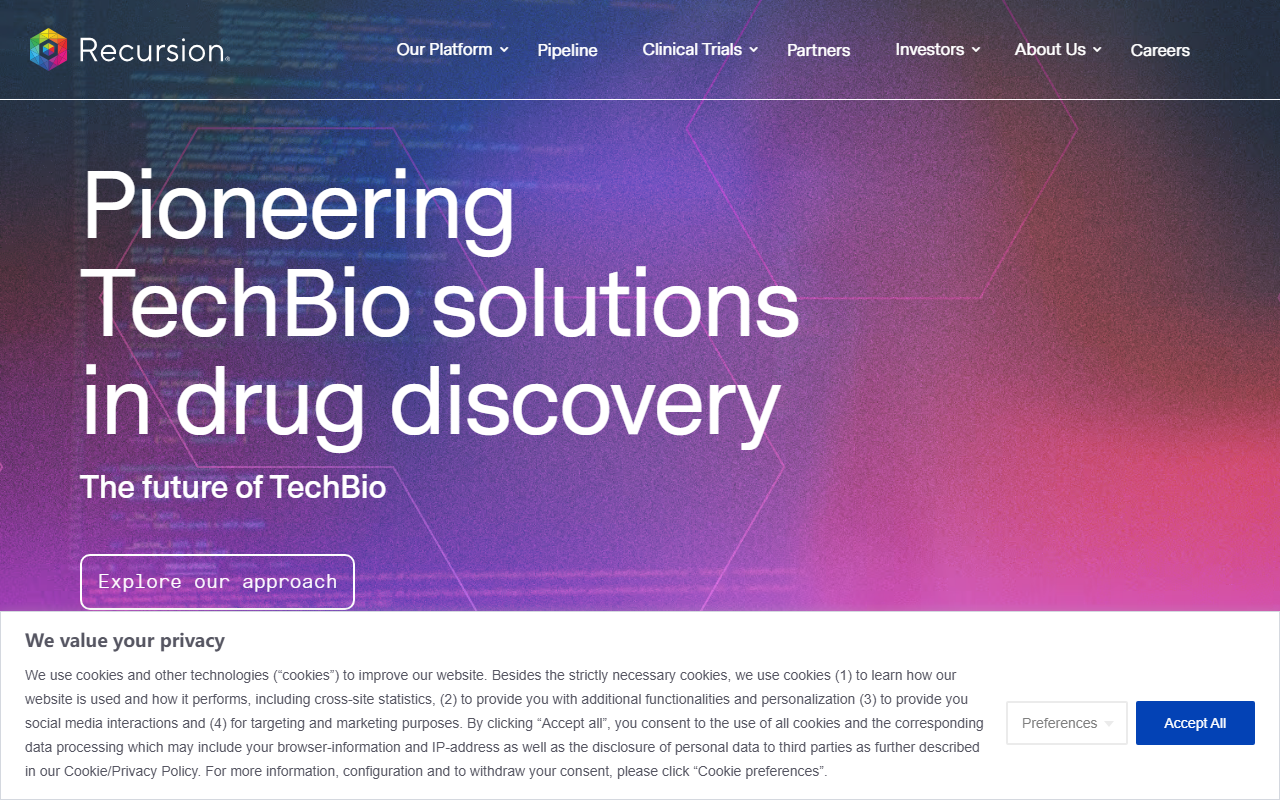
Upon visiting exscientia.ai, I was immediately redirected to a site branded as Recursion. The tagline, “Pioneering AI Drug Discovery | Recursion,” suggests a rebranding or merger—Exscientia’s identity now lives within Recursion’s operating system. The homepage is a clean, corporate landing page that highlights clinical pipeline progress, partnerships, and the core technology stack. There is no interactive dashboard or demo; instead, the site functions as a portfolio and investor relations hub. The navigation leads to sections on pipeline, partners, and about us, with a strong emphasis on their Recursion OS drug discovery platform. For a tool categorized under Text AI and AI Design, this is less about user-facing generation and more about pharmaceutical R&D automation. The company claims to have been founded over a decade ago on the idea of using cellular imaging and AI to reduce the traditional 90% drug failure rate.
Technical Capabilities and Pipeline
The core offering is the Recursion Operating System, which integrates three key ingredients: data, models, and compute. The site claims one of the largest proprietary biological and chemical datasets—over 50 petabytes spanning phenomics, transcriptomics, proteomics, ADME, and de-identified patient data. Their automated wet lab uses robotics and computer vision to capture millions of cell experiments per week. This data feeds machine learning models that identify new targets and design optimized molecules. To handle the scale, Recursion partnered with NVIDIA to build BioHive-2, described as “biopharma’s most powerful supercomputer.” The pipeline includes multiple oncology and rare disease programs, with several candidates in Phase 1/2 and even a Phase 3 for Familial Adenomatous Polyposis. The platform appears to be end-to-end: target identification, molecule design, and clinical development. Partnerships with pharmaceutical leaders and computational titans are highlighted, suggesting the platform is used both internally and through collaborations.
Strengths, Limitations, and Target Audience
A major strength is the breadth of proprietary data and the integrated feedback loop that continuously improves models. The use of supercomputing and automation also gives Recursion a speed and cost advantage over traditional pharma. However, there are limitations. The platform is not accessible as a public API or SaaS tool; it is primarily an internal R&D engine for drug development. Therefore, individual researchers or small biotechs cannot directly use it—they can only partner with Recursion. Additionally, drug discovery inherently takes years, so immediate results are impossible. Pricing is not publicly listed on the website; instead, partnerships are likely negotiated case-by-case. Unlike competitors like Insilico Medicine or BenevolentAI that offer some open platforms or software licenses, Recursion keeps its OS internal. This tool is best suited for large pharmaceutical companies seeking collaborative R&D, or for investors tracking AI-driven biotech. Others, especially those looking for a text-to-molecule API, should look elsewhere. For its specific mission, Recursion (over Exscientia) demonstrates a serious commitment to data-driven biology. Visit Exscientia at https://exscientia.ai/ to explore it yourself.













Comments