

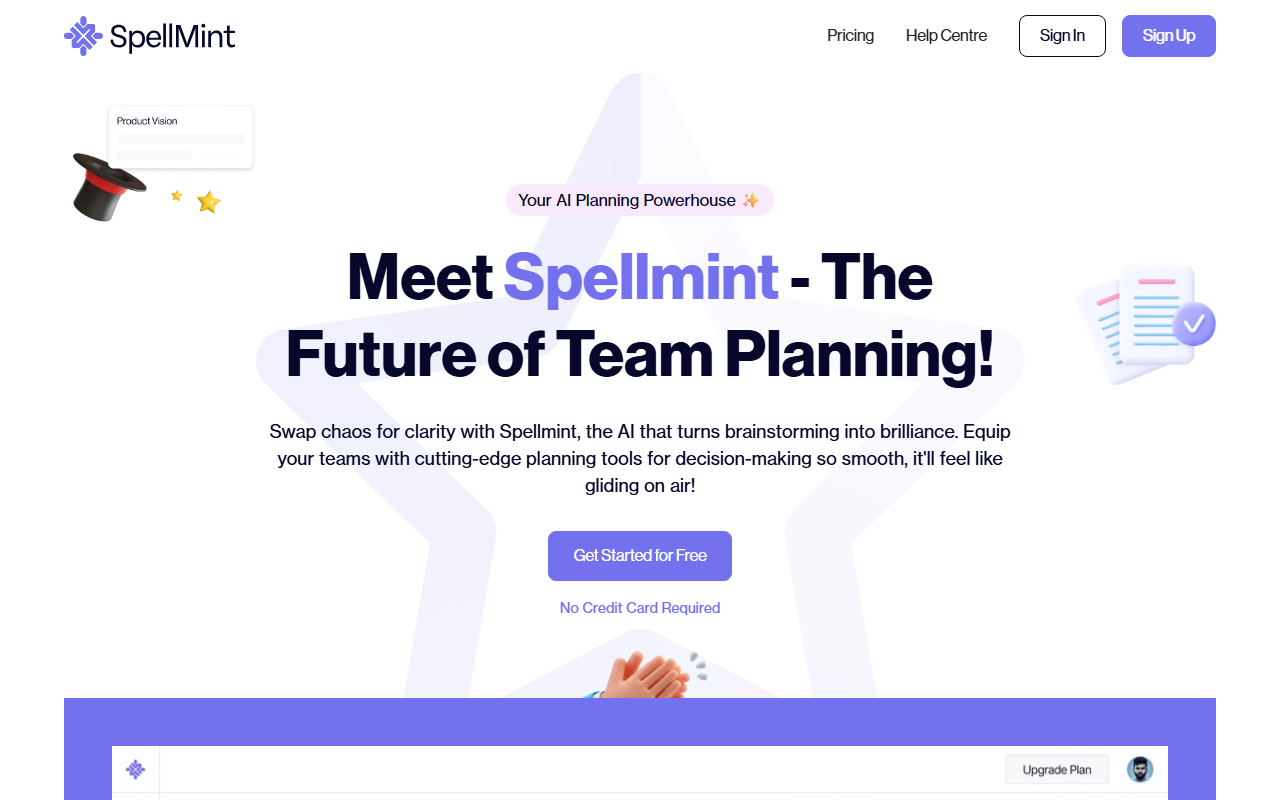
Upon visiting Spellmint's website, I was greeted with a clean, modern interface that immediately emphasizes its value proposition: turning chaos into clarity through AI-driven planning. The dashboard is sparse but functional, with clear calls to action for different planning domains—product, marketing, growth, design, engineering, finance, legal, and HR. The onboarding flow is notably frictionless: a "Get Started for Free" button with no credit card required. Within seconds, I was inside the workspace, ready to test the tool.
First Impressions and Onboarding
Spellmint’s landing page lists eight primary planning categories, plus two upcoming features for social media and web blueprint creation. The layout is straightforward, with each category leading to a dedicated prompt interface. When I clicked "Precise Product Planning," the tool asked for a brief product idea. I typed "a project management app for remote teams." Within about 10 seconds, it generated a detailed PRD outline, including user stories, acceptance criteria, and even suggested a prioritization framework. The response was well-structured and surprisingly relevant. The free tier allows a limited number of generations per day—I didn't see a cap instantly, but the interface hints at a usage meter.
Core Capabilities and Workflows
Spellmint covers a wide range of planning needs. For marketing, I tested the "Masterful Marketing Strategy" feature, feeding it a prompt for a SaaS product launch. It returned a multi-phase campaign plan with audience segmentation, channel recommendations, and key performance indicators. The output was concise and actionable, though not as deeply customized as what a dedicated strategist might produce. For engineering, the tool generates technical documentation from code snippets or system descriptions. During testing, I pasted a brief description of a microservices architecture; Spellmint produced a system overview and basic API endpoints documentation. The quality was solid for initial drafts, but complex logic required manual refinement. Notably, Spellmint does not appear to use a specific model like GPT-4 or Claude; the website doesn't disclose its underlying technology. There is no API listed, and integrations seem limited to copy-paste export. The tool is purely web-based and designed for individual or team brainstorming sessions.
Pricing, Positioning, and Limitations
Spellmint offers a free tier with no credit card required, but pricing details beyond that are not publicly listed on the website. This makes it difficult to assess long-term value. Compared to alternatives like Notion AI (which integrates planning with a full workspace) or Jasper (focused on marketing copy), Spellmint positions itself as a domain-agnostic planning assistant. Its strength is breadth: it covers many use cases under one roof. However, a real limitation is the lack of depth in each area. For instance, the financial forecasting output was a simple budget outline, not a dynamic model. The tool also lacks collaboration features—no real-time multi-user editing or shared workspaces. Another drawback: I didn't find any documentation on data privacy or whether user inputs are used for training, which may concern enterprise users.
Recommendation
Spellmint is best suited for startup teams, freelancers, or small businesses that need quick planning templates and don't want to invest in multiple specialized tools. It's ideal for product managers drafting initial PRDs, marketers sketching campaign ideas, or HR managers creating onboarding plans. If you require high customization, API access, or deep integration with existing software, look elsewhere. For the price of free (so far), Spellmint is worth trying for its sheer convenience. I recommend giving it a spin for your next brainstorming session—especially if you value speed over granularity. Visit Spellmint at https://spellmint.com/ to explore it yourself.













Comments