

First Impressions and Onboarding
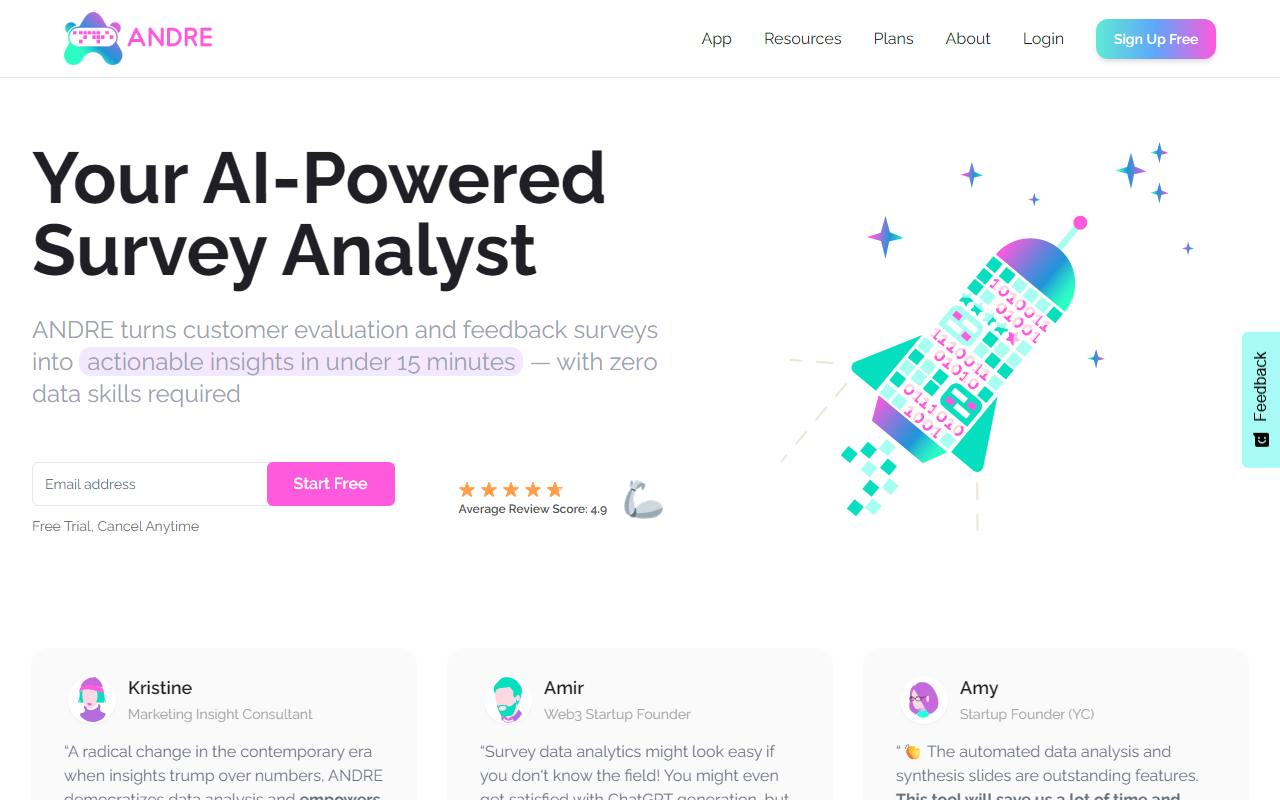
Upon visiting ANDRE’s website, I was greeted with a clean, modern dashboard that immediately communicates its purpose: turning customer feedback surveys into actionable insights. The homepage highlights a 4.9 average review score and several glowing testimonials from startup founders and market researchers. I signed up for the free trial, which requires no credit card—a welcome touch. The onboarding flow is minimal: you’re prompted to upload a survey file in CSV, XLSX, or SAV format. I tested it with a sample CSV containing mock customer satisfaction scores. Within seconds, ANDRE began processing—no configuration or data cleaning setup needed. The interface stays lean, with a drag-and-drop zone and a progress bar. After about 10 minutes, I received a full analysis report with narrative summaries, trend visualizations, and action-oriented recommendations. The entire experience felt guided and noob-proof, exactly as promised.
What ANDRE Does Best
ANDRE automates the entire survey analysis pipeline—from data cleaning to narrative extraction to report generation. It uses what appears to be a combination of structured data mining and large language model processing (likely GPT-based) to handle missing values, parse open-ended responses, and produce evidence-backed stories. During my test, the tool flagged incomplete rows and imputed plausible values, then grouped similar comments into themes. The final report included a “Narrative Suggestion” section which translated raw percentages into human-readable insights—like “70% of respondents found the onboarding process confusing; suggested improvements include a guided tutorial.” This is a stark contrast to generic ChatGPT outputs, as one user testimonial noted. ANDRE also integrates with common survey platforms: Google Forms, Typeform, SPSS, so you can import data directly. For teams that need to iterate quickly, the “Expedite” feature fully automates the process from start to finish. The output is a synthesis slide deck (downloadable as PPTX or PDF) that management can act on immediately.
Pricing, Limitations, and Competitors
Pricing is not publicly listed on the website; the only option visible is a free trial with no mention of paid tiers. This lack of transparency could frustrate budget-conscious buyers. Given its focus on survey analysis, ANDRE competes with tools like MonkeyLearn (for text classification) and Qualtrics (for full CX platforms). Unlike Qualtrics, ANDRE is purely post-survey analysis with no survey creation or distribution capabilities. It is also lighter than SPSS or SAS, which require statistical expertise. A real limitation is that ANDRE only works with structured survey data—it cannot handle free-form text from social media or CRM logs without prior formatting. Also, while the automated cleaning is impressive, I noticed that it sometimes oversimplified nuanced responses, grouping “fairly satisfied” and “slightly satisfied” together as “positive.” For academic research requiring granular statistical controls, this may be insufficient. However, for business teams needing speed over precision, it’s a game-changer.
Final Verdict
ANDRE delivers exactly what it promises: professional-grade survey analysis in under 15 minutes, with zero data skills required. Its strengths are speed, simplicity, and narrative-driven outputs that make insights accessible to non-technical stakeholders. The tool is ideal for startup founders, marketing professionals, product managers, and CX specialists who need to iterate on customer feedback rapidly. It is less suited for data scientists or academics who require deep statistical rigor or custom modeling. If you’re tired of wrestling with Excel pivot tables or waiting days for a data analyst, ANDRE is worth the free trial. Just be prepared to navigate unclear pricing if you decide to upgrade. Visit ANDRE at https://andre.ai/ to explore it yourself.













Comments