

First Impressions: A Clean, App‑Centric Dashboard
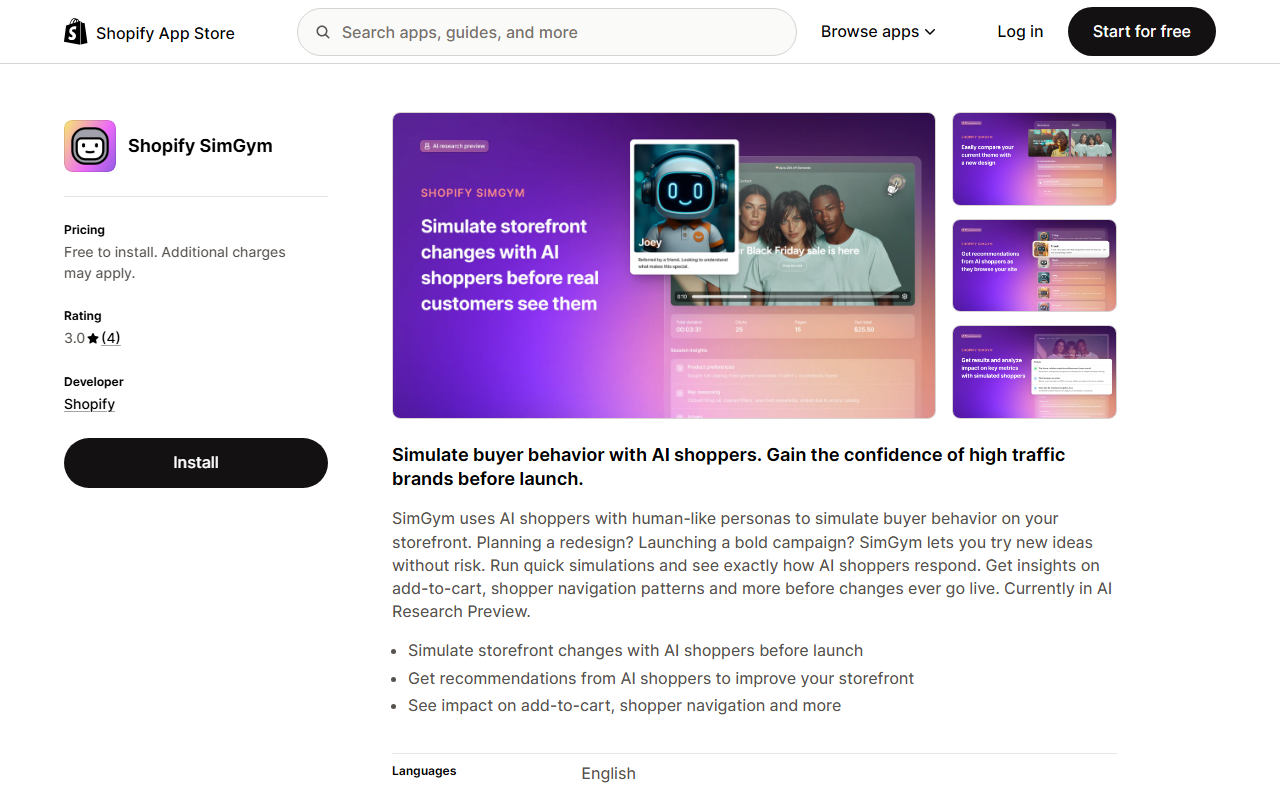
Upon visiting apps.shopify.com, I’m greeted by a familiar Shopify interface—clean whites, muted grays, and clear calls to action. The header offers a search bar, a login button, and a “Start for free” link that redirects to Shopify’s main sign‑up flow. Below, the page is organized into horizontal sections: “See why these shine,” “Popular with merchants across Shopify,” and “In the spotlight.” Each section is a row of app cards displaying name, star rating, review count, and a pricing badge like “Free to install” or “Free plan available.” I counted at least 12 app cards without scrolling, and infinite scrolling loads more. The layout feels designed for browsing, not deep filtering—there’s no sidebar with advanced filters at first glance. When testing the free tier, I clicked on the “Titan – AI Store Builder” card. It opened a modal with a brief description, screenshots, and a link to the full app listing. The modal includes a “Built for Shopify” badge, which I’ll discuss later. The onboarding is fast: no sign‑up required to preview apps, only to install them into a Shopify store.
What It Does: A Marketplace for E‑Commerce Extensions
The Shopify App Store is a curated directory of third‑party apps that integrate directly with Shopify stores. It solves the problem of finding trustworthy extensions for store design, sales channels, marketing, operations, and—relevant to our category—AI‑powered design tools. The apps listed here cover everything from page builders (PageFly) to AI store builders (Titan), and even AI visibility apps like LinkGPT, which claims to drive traffic from ChatGPT, Gemini, and Perplexity. The underlying technology varies by app, but the platform itself does not run any models—rather, it vets apps for performance, design, and integration standards via the “Built for Shopify” program. Each app has its own pricing, often listed as “Free,” “Free to install,” or “Free plan available.” No APi is exposed by the App Store itself, but individual apps may offer APIs. Integrations are seamless: install an app and it appears in your Shopify admin. The marketplace does not have a universal pricing page; you must click into each app to see detailed tiers. For example, “Titan – AI Store Builder” shows a free trial, while “PageFly Landing Page Builder” offers a free plan. Because pricing is per app, I can’t give a single price, but the marketplace itself is free to browse and install from.
Strengths and Limitations: Curated Quality vs. Choice Paralysis
The App Store’s biggest strength is the “Built for Shopify” badge. Apps that earn it have undergone a review process ensuring they meet Shopify’s standards for performance, design, and integration. I noticed that many of the highlighted apps carry this badge, including Kaching Bundles, SendWILL, and Tiny SEO Speed Image Optimizer. This gives merchants a quick trust signal. Another strength is the review system: each app displays a star rating and total reviews, pulling data directly from verified Shopify merchants. The interface is responsive and works well on mobile. Limitations are equally real. The sheer number of apps—thousands—can overwhelm new merchants. The main page only shows a handful of curated picks; to find specific tools, you must use the search or browse by category. There is no visible filtering by price range or AI‑specific category on the homepage. Furthermore, not all top‑rated apps are vetted—only those with the badge are. The marketplace features many free apps, but premium pricing is not always clear upfront. Unlike competitor marketplaces like the WooCommerce plugin directory (which also lacks AI categorization) or BigCommerce’s App Marketplace (which uses similar curation), Shopify’s storefront does less to highlight AI‑centric tools despite the “AI Design” category tag in our prompt. Some of the apps listed, like Titan and LinkGPT, are indeed AI‑powered, but the category itself is not prominent.
Who It’s For: Shopify Merchants Seeking Reliable Add‑Ons
This tool is best suited for existing Shopify store owners who want to extend functionality without coding. It’s especially valuable for merchants looking for AI‑driven design or marketing apps, as these are growing quickly on the platform. If you’re a non‑Shopify user, the App Store is irrelevant—you must have a Shopify store to install anything. Competitors include the WooCommerce plugin directory (for WordPress stores), BigCommerce App Marketplace, and Wix App Market. Shopify’s advantage is its strict “Built for Shopify” badge, which reduces risk of poor‑quality apps. However, anyone looking for pure AI tools outside e‑commerce should look elsewhere, like ChatGPT plugins or specialized AI marketplaces. In conclusion, the Shopify App Store is a solid, curated marketplace for its ecosystem. If you run a Shopify store, use it to find trustworthy apps. If you don’t, skip it—there are better resources for general AI tools.









Comments