

First Impressions and Onboarding
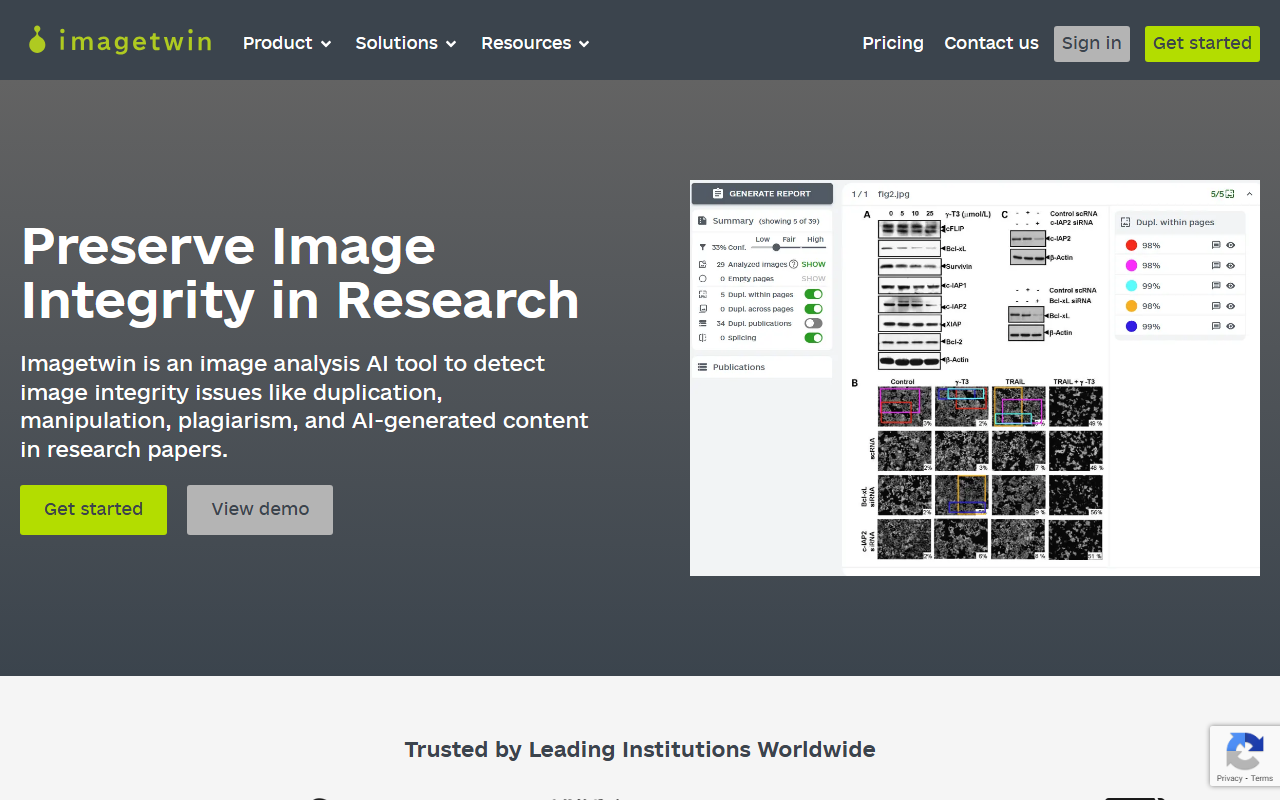
Upon visiting the Imagetwin website, I was greeted by a clean, professional interface that immediately signals its focus on research integrity. The call-to-action offers both a demo and a free account, so I signed up to test the free tier. After a quick email verification, I was taken to a dashboard where I could upload a PDF or a set of image files. Imagetwin provides a few example documents to scan free of charge, which I used to get a feel for the tool without needing my own data. The upload process was seamless: I dragged in a PDF containing microscopy images and western blots, and within seconds the system returned a color-coded analysis showing duplication and manipulation flags. Confidence scores next to each detection let me toggle through findings – a feature that helps researchers prioritize which issues to investigate further.
Core Detection Capabilities
Imagetwin is purpose-built for research image integrity, tackling four specific problem areas: duplication, manipulation, plagiarism, and AI-generated images. The duplication detection automatically finds identical or near-identical panels within a manuscript – useful for spotting reused control images. The manipulation detection uncovers splicing, copy-move forgeries, and edits that might distort data. For plagiarism, Imagetwin compares uploaded figures against a database of over 120 million published figures, providing matches and attribution suggestions. During my testing, the AI-generated image detection caught a synthetic microscopy figure I fed it, and the interface even credited the model likely used to create it. The forensic toolbox, which includes matched keypoints and filter overlays, allowed me to dive deeper into suspicious areas. I appreciated the private repository feature, which lets institutions build a database of their own articles for auto-checking new submissions. The API access is a strong addition for integrating Imagetwin into editorial workflows – platforms like Morressier and TNQ Technologies already partner with Imagetwin to automate integrity checks.
Pricing and Market Position
Pricing is not publicly listed on the website, which is common for enterprise-focused research tools. Imagetwin likely operates on a subscription or per-scan model tailored to publishers and institutions. The website states that eight of the ten largest academic publishers and over 120 academic organizations already use the tool, indicating strong adoption in the scholarly community. Competitors include Proofig, which also focuses on image duplication and manipulation for scientific papers, and the open-source tool Forensics. Unlike Proofig, Imagetwin places greater emphasis on AI-generated content detection and offers a more extensive reference database. Its partnership with leading publishing workflow providers gives it an edge in integrations, but the lack of transparent pricing could be a barrier for smaller labs or individual researchers evaluating cost.
Strengths, Limitations, and Recommendation
Imagetwin’s greatest strength is its specialized focus on research integrity – it isn’t a general image analysis tool, but that focus yields highly accurate detections for scientific figures. The confidence scores and detailed forensic views empower users to make informed decisions rather than blindly trusting algorithm flags. Endorsements from experts like Elisabeth Bik and Jana Christopher, both well-known in the research integrity space, add credibility. However, the tool has limitations. It is not designed for everyday photo editing or creative work – casual users will find little value here. The absence of public pricing may frustrate potential users, and the tool requires an internet connection since the heavy lifting happens on Imagetwin’s servers. For researchers, journal editors, and institutional integrity officers, Imagetwin is a powerful ally in maintaining publication quality. I recommend trying the free demo if you routinely screen manuscripts for image issues. Visit Imagetwin at https://imagetwin.ai/ to explore it yourself.







Comments