

First Impressions: A No-Nonsense Clinical AI Platform
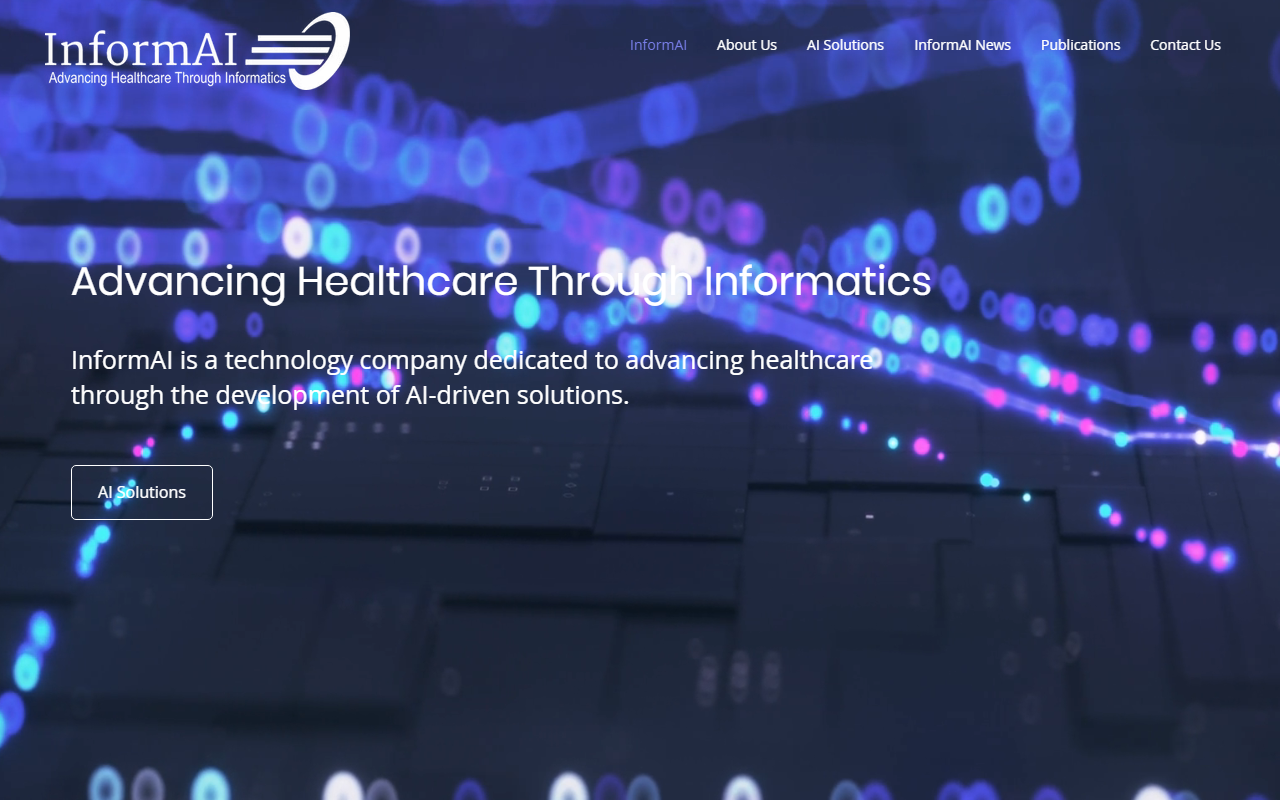
Upon visiting informai.com, I was greeted by a clean, product-focused homepage that immediately states the company's mission: advancing healthcare through informatics. Unlike many AI writing tools that promise broad content generation, InformAI is laser-focused on solving targeted clinical problems in radiology, radiation oncology, and transplant medicine. The site layout is straightforward – a hero section with key messages, followed by three product cards (RadOncAI, TransplantAI, SinusAI), and a news feed showing recent grants and awards. There is no free trial or demo for the public, which makes sense given the enterprise nature of these solutions.
Product Portfolio: AI Targeting Specific Clinical Pain Points
InformAI’s three products are each designed to address a concrete pain point in modern healthcare. RadOncAI is an AI-driven dose prediction platform for radiation therapy. It generates optimized radiation plans that target tumors while minimizing exposure to healthy tissues – a workflow that traditionally takes hours can now be streamlined. The company boasts a Phase II NIH grant (SBIR Fast-Track) for TransplantAI, a donor-recipient informatics platform that enables granular AI-powered transplant decisions at the point of care. This addresses organ scarcity and allocation inefficiency. SinusAI advances CT imaging diagnostics with AI-enabled precision and efficiency. The “Learn More” buttons likely lead to detailed product pages, but even from the homepage, the value proposition is clear: these are not general-purpose AI tools, but fit-to-purpose software designed to integrate with existing clinical workflows and reimbursement frameworks.
Because the site does not disclose the underlying models or technical architecture, I can only infer that the solutions rely on deep learning – likely convolutional neural networks for imaging (RadOncAI, SinusAI) and transformer-based models for structured data in TransplantAI. This is consistent with industry standards for medical AI.
Pricing and Ecosystem
Pricing is not publicly listed on the website, which is typical for enterprise healthcare software. InformAI positions itself as a partner to elite medical institutions and channel partners, meaning costs are negotiated per deployment. The company has secured notable non-dilutive funding: a supplemental grant from the Cancer Prevention and Research Institute of Texas (CPRIT) for $465,188 to support RadOncAI commercialization, and a Phase I/II Fast-Track NIH grant for TransplantAI. These endorsements add credibility. The website also mentions the company was named a 2024 Houston Innovation Awards finalist. There is no API or integration documentation visible, so developers would need to contact the sales team.
In terms of alternatives, Aidoc and Viz.ai are competitors in the radiology AI space, but they focus on detection and triage of acute conditions. InformAI differentiates by targeting therapy planning (RadOncAI) and transplant decision support – a more niche but critical area.
Target Audience and Verdict
InformAI is best suited for hospital systems, cancer centers, and transplant networks that need validated, enterprise-grade AI to improve clinical outcomes and operational efficiency. The strengths are clear: NIH-backed validation, targeted solutions for real clinical pain points, and a partnership model that ensures integration. The limitations are equally real: no publicly available pricing or self-service trial, a narrow product scope (not for general AI writing or other text tasks), and a website that lacks technical transparency. This is not a tool for individual doctors or researchers – it’s for organizations ready to invest in custom AI deployment.
If you work in a hospital or cancer center evaluating AI for radiation planning or transplant matching, InformAI deserves a serious look. For anyone seeking a general AI writing assistant, look elsewhere. Visit InformAI at https://informai.com/ to explore it yourself.









Comments