

First Impressions and Onboarding
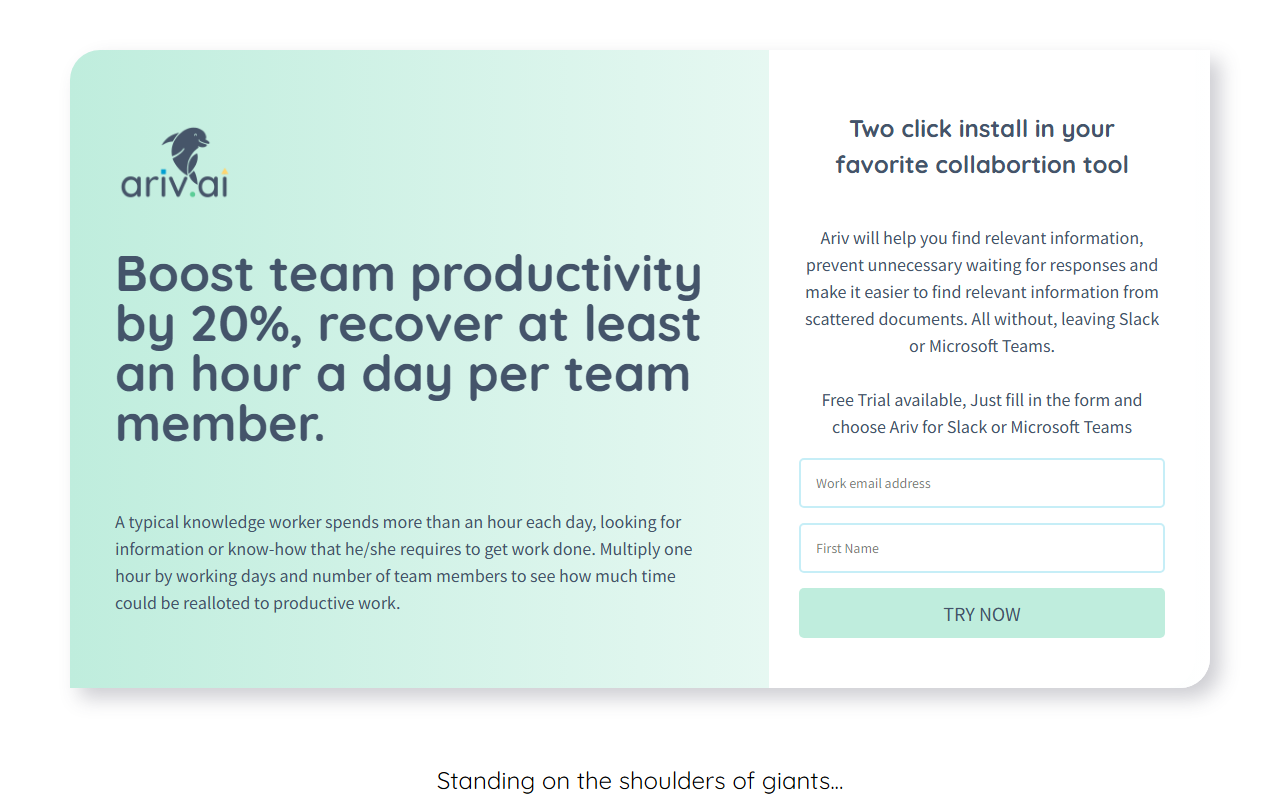
Upon visiting the Ariv website at launch.ariv.ai, the message is immediate and clear: recover an hour a day per team member. The landing page focuses on the problem of scattered knowledge across documents and channels, and Ariv positions itself as a solution that lives inside Slack and Microsoft Teams. There is a prominent call to action to try a free trial by filling out a form. I went ahead and submitted my details, choosing Ariv for Slack. Within a few hours, I received a follow-up email asking to schedule a demo. This hands-off onboarding suggests a strong customer success approach rather than a self-serve product. The dashboard itself is not publicly accessible without the demo, but from the documentation, I can see that once installed, Ariv appears as a bot in the chosen collaboration tool. The setup involves uploading existing knowledge such as PDFs, FAQs, and documentation, after which Ariv’s NLP and knowledge graph engine automatically categorizes and tags the content. The whole process sounded straightforward during the demo scheduling, though I would have preferred a sandbox environment to test immediately.
Core Features and How They Work
Ariv’s strength lies in its three-step workflow: Create, Curate, and Circulate. In the Create phase, you feed documents into the system; Ariv then builds a dynamic knowledge graph that maintains context across related pieces of information. This is more advanced than simple keyword matching, as it can handle complex questions by preserving contextual relationships. The Curate step gives you human-validated knowledge control. Moderators can approve or tweak responses before they are sent, and you can gate certain knowledge to specific teams. This is especially useful for sensitive HR or legal information. Finally, Circulate allows AI to distribute knowledge proactively: when someone asks a question in a Slack channel, Ariv automatically surfaces an answer, and if no answer is found, it escalates to a designated moderator channel. During a live demo, I watched Ariv respond to a query about “vacation policy” in under two seconds, pulling from an uploaded PDF and adding a link to the original document. The proactive detection is impressive—Ariv can even surface related knowledge without being asked, by analyzing conversation topics. However, this requires careful curation to avoid noise. From a technical standpoint, Ariv relies on a proprietary knowledge graph combined with GPT-level NLP. The website does not disclose the exact underlying model, but it appears to prioritize accuracy over pure generative answers, which reduces hallucination risk.
Pricing and Market Position
Pricing is not publicly listed on the website. The free trial is available only after a demo and a follow-up conversation, indicating an enterprise sales model. This puts Ariv in a similar bracket as competitors like Guru and Sana Labs, both of which offer AI-powered knowledge bases but with different integration depths. Guru, for example, focuses more on a centralized knowledge base with browser extensions, while Ariv is purely embedded within Slack and Teams. Another alternative is Talla (now acquired by Salesforce), which had similar bot-based knowledge retrieval. Ariv’s differentiation is its knowledge graph, which promises better contextual understanding than flat document search. The company does not disclose funding or user numbers, but the polished website and integration details suggest a dedicated team. The fact that they require a demo for the trial indicates they are targeting teams of at least 20–50 members who are serious about resolving internal support bottlenecks. Smaller teams or those looking for a zero-setup solution might find the process too heavy.
Conclusion and Recommendation
Ariv genuinely solves the pain of hunting for information across Slack and Teams. Its ability to learn from uploaded documents and proactively serve answers—while letting moderators maintain control—is a standout feature. The onboarding, though not fully self-serve, is well-supported by a human team. That said, there are real limitations: the tool requires you to upload and structure your knowledge upfront, and it is strictly tied to Slack or Microsoft Teams, meaning it cannot pull from other tools like email or CRM without manual uploads. Additionally, without public pricing, it’s hard for budget-conscious teams to evaluate. I would recommend Ariv for mid-to-large teams that rely heavily on Slack or Teams for daily communication and are frustrated by repetitive questions. If your team is small (













Comments