

First Impressions and Onboarding
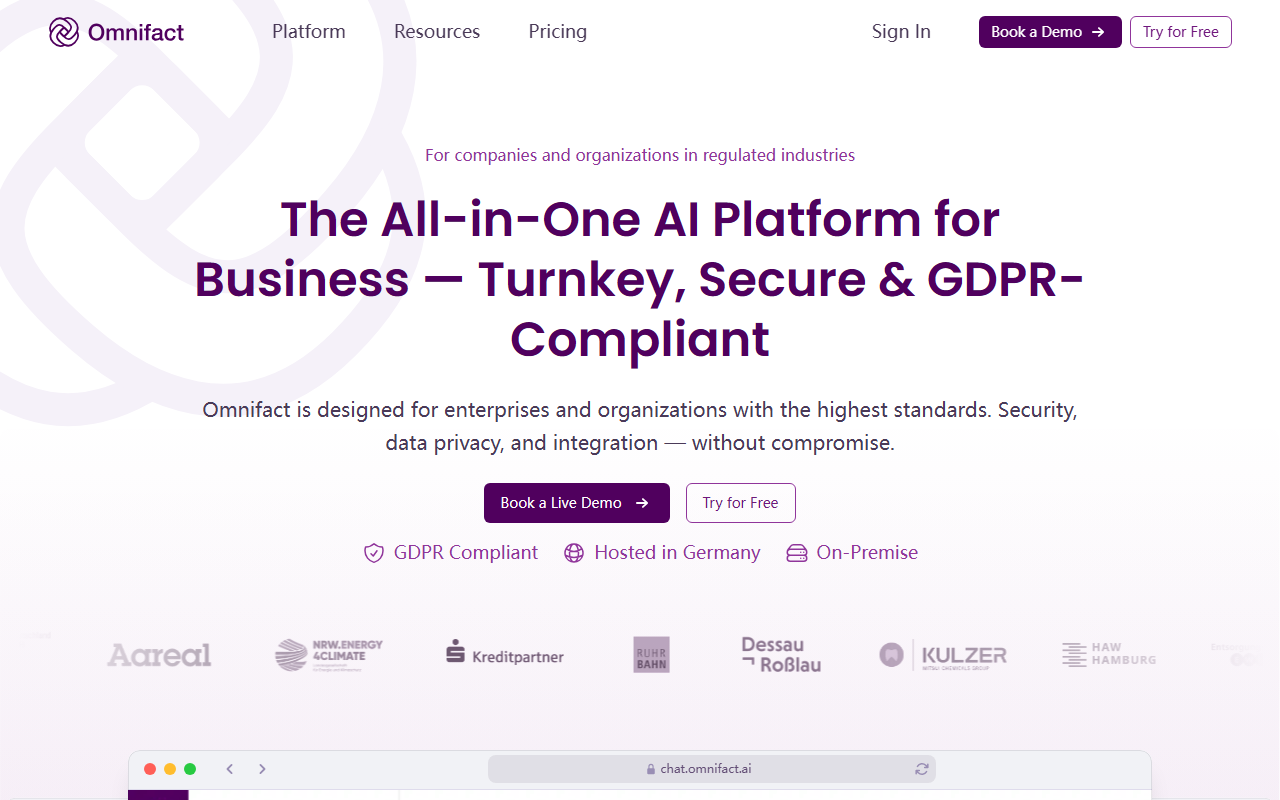
Upon visiting omnifact.ai, the landing page immediately signals its enterprise DNA: crisp, professional, and centered on compliance badges like GDPR and ISO 27001. The navigation is straightforward, with clear paths to Platform, Pricing, and a Try for Free button. I signed up for the free trial, which required only a work email and a quick verification. The onboarding walked me through creating a “Space” — a personalized AI assistant bound to internal documents. The interface is clean, with a chat window on the left and a configuration panel on the right. It felt polished, though the initial setup of a knowledge base (uploading PDFs or connecting to a CRM) took a few minutes. The Privacy Filter™ is toggled on by default, which is reassuring for sensitive data. Overall, the process was smooth and well-documented, with tooltips explaining each step.
Core Features and Technology
Omnifact positions itself as an all-in-one AI platform for businesses that cannot compromise on data sovereignty. The standout feature is the Privacy Filter™, which automatically masks sensitive information (like patient IDs or customer data) before it reaches any external large language model. This is not just a prompt-level filter; it uses pattern matching and customizable rules to redact data in real time. The platform supports models from OpenAI, Anthropic, Mistral, and Google, giving IT teams control over which model to deploy for each Space. Integration capabilities are extensive: standard REST APIs, enterprise SSO (SAML/OIDC), role-based access control, and multi-tenancy are all built-in. For high-security environments, Omnifact offers optional air-gapped deployment. The logging and audit trail features are thorough, recording every user interaction for compliance. I tested the “Space” feature by uploading a set of internal HR policy PDFs. The assistant retrieved specific sections with citations, and the Privacy Filter correctly masked employee names mentioned in the documents. Response latency was acceptable (around 2-3 seconds for a query), and the answers were contextually accurate. The platform also includes a model hub where admins can select and enable different models per Space — an unusual granularity that enterprise architects will appreciate.
Pricing and Market Positioning
Pricing is not publicly listed on the website. The “Pricing” page takes you to a contact form or a “Book a Demo” call-to-action. This is typical for enterprise-focused tools, but it does create a barrier for smaller teams wanting to estimate costs. From what I gathered during the demo request flow, Omnifact uses a subscription model based on users, storage, and model usage. They also offer professional services for onboarding and training. Competitors in this space include Writer’s Palmyra (strong on compliance but US-hosted) and Mendable (open-source focused). Unlike those, Omnifact is explicitly built for European and regulated industries: GDPR compliance, ISO 27001 certification, and Germany-based hosting are front and center. Their marketing emphasizes moving away from “shadow IT” and tool silos, directly targeting IT leaders in banking, healthcare, public administration, and finance. The claim of “120 minutes saved per employee per day” from their internal case studies is plausible if the tool is used for document-intensive tasks, but I would want to see independent validation. Omnifact positions itself as a premium, turnkey solution — best for organizations that are willing to invest in compliance infrastructure rather than cobbling together open-source tools.
Strengths and Limitations
The platform’s greatest strength is its uncompromising approach to data privacy. The Privacy Filter is genuinely innovative, and the ability to run models on-premise or in a sovereign EU cloud addresses a real pain point for regulated sectors. The Spaces feature for personalized assistants on internal data is intuitive and practical. However, the lack of transparent pricing is a notable limitation. Without a public price list, small businesses or startups may hesitate to engage. Additionally, while the interface is clean, it can feel opaque for non-technical users — the admin panel has many configuration options that might overwhelm a junior content manager. Another limitation: Omnifact currently depends on third-party LLM providers for the underlying intelligence; while models are controllable, the platform is not entirely model-agnostic in the sense of supporting open-weight models on your own GPU infrastructure. This means you still pay a token premium. For whom is this tool? It is best suited for enterprises in banking, healthcare, public sector, and any organization with a dedicated IT or compliance team that values data sovereignty over agility. Companies with simpler needs — like startups wanting a quick ChatGPT clone — should look elsewhere. Omnifact delivers exactly what it promises: enterprise-grade, privacy-first generative AI for those who must follow the strictest rules.
Visit Omnifact at https://omnifact.ai/ to explore it yourself.







Comments