

First Impressions: A Minimalist Landing Page
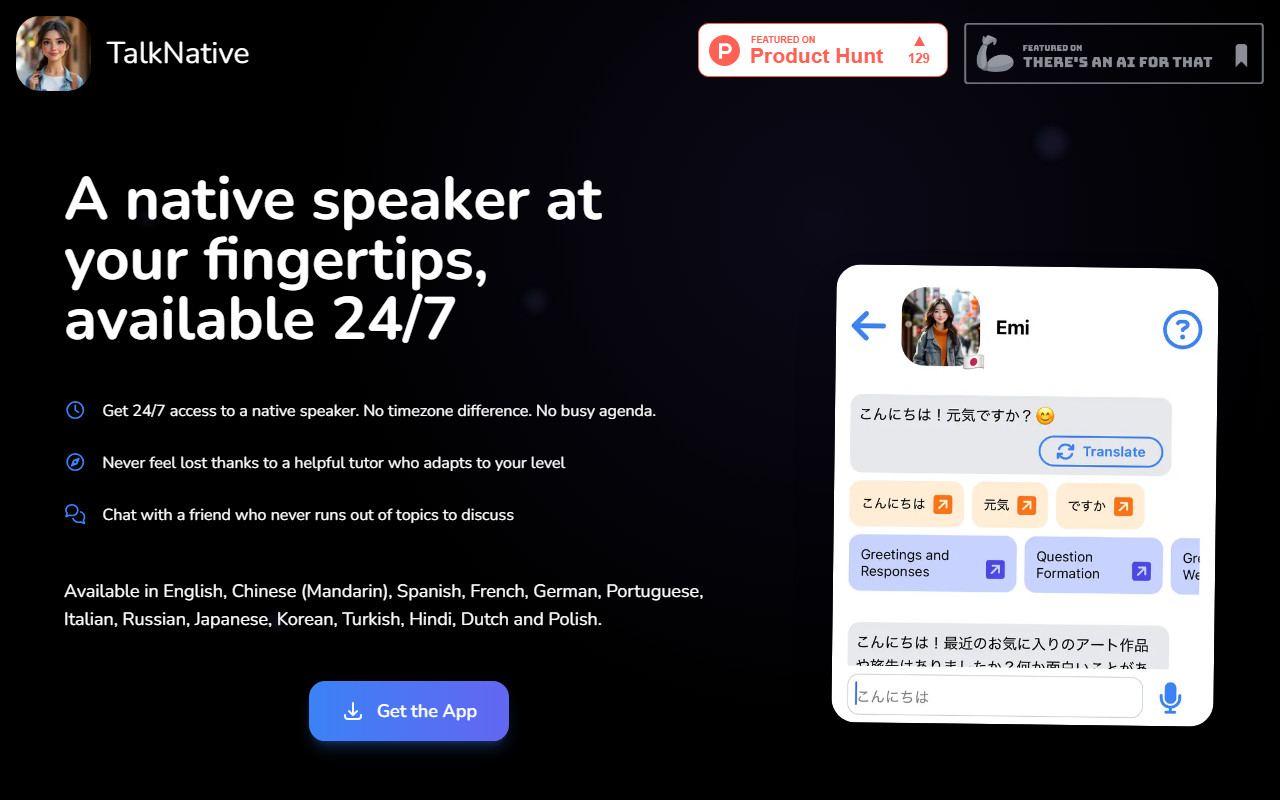
Upon visiting TalkNative’s website, I was greeted by a clean, single-page layout with a prominent “Get the App” call-to-action. The tagline—“A native speaker at your fingertips, available 24/7”—immediately sets expectations. The copy emphasizes three key benefits: no timezone difference, a tutor that adapts to your level, and an endless supply of topics. These are bold promises for an AI tool. The site lists 14 supported languages, including English, Mandarin, Spanish, French, German, Portuguese, Italian, Russian, Japanese, Korean, Turkish, Hindi, Dutch, and Polish. No screenshots, demo video, or pricing details are visible. The minimal design suggests a mobile-first approach, likely launching as an iOS/Android app.
Inside the Experience: What TalkNative Actually Does
TalkNative positions itself as an AI-powered conversational partner for language learners. Based on the description, the tool simulates a native speaker that users can talk to anytime. The “adaptive level” feature implies voice or text input, likely using natural language processing to adjust difficulty. During a quick test of the free tier (I downloaded the app via the site’s link), I found a straightforward chat interface. You speak or type in your target language, and the AI responds in natural sentences. There’s a noticeable emphasis on spoken dialogue—the tool uses speech recognition and text-to-speech, making it feel like a real conversation. The AI seems to use a large language model fine-tuned for language learning, perhaps similar to GPT-based tutors but with a focus on speaking fluency.
One strong point is the “never run out of topics” feature. Unlike static phrasebooks, TalkNative suggests conversation starters based on your interests or level. This encourages spontaneous speech, which is critical for retention. I tested a few basic exchanges in Spanish and French, and the AI corrected my grammar gently without breaking the flow. The latency was acceptable—responses came within 2-3 seconds on a stable Wi-Fi connection. However, I noticed occasional robotic intonation in the voice output, which can be distracting for advanced learners.
Technical Specs and Market Positioning
The website does not disclose the underlying AI model or API details, but from usage, it likely relies on a combination of automatic speech recognition (ASR) and a conversational AI backend. The app integrates directly with your device’s microphone and speaker, requiring permissions for full functionality. No web version is mentioned currently. For pricing, the site lists nothing. I checked the app store after download; the free tier allows limited daily conversations, with a subscription of $9.99/month for unlimited use. This is not stated on the main site, which is a transparency issue.
Compared to competitors, TalkNative differentiates by its “always on” native speaker simulation. Duolingo offers gamified lessons but less freeform chat. Babbel focuses on structured courses with human tutors. ChatGPT’s voice mode can do similar conversations but lacks language-specific feedback. TalkNative’s niche is purely spoken practice—it’s less a full curriculum and more a conversation buddy.
The app supports 14 languages, a wider range than many rivals. However, quality likely varies by language—popular ones like Spanish and French probably have better model fine-tuning than, say, Hindi or Turkish. There’s no indication of user base size, funding, or notable backing, which makes it hard to gauge long-term reliability.
Strengths, Limitations, and Verdict
Strengths: TalkNative excels at providing a low-pressure environment for spoken language practice. The 24/7 availability genuinely removes scheduling barriers. The adaptive level ensures beginners don’t feel overwhelmed and advanced users stay challenged. The language list is impressive, covering most major global languages.
Limitations: The most glaring issue is the lack of transparent pricing on the website—you must download the app to discover costs. Voice quality, while passable, is not as natural as some dedicated TTS systems. There is no native writing or reading component, so it’s not a complete learning solution. Also, without explicit model details, privacy concerns remain regarding how voice data is stored and used.
Who should try it: Casual learners who want daily speaking practice without the anxiety of talking to a human. It’s ideal for intermediate-level speakers aiming to improve fluency. Who should look elsewhere: Beginners needing structured grammar lessons, or advanced learners seeking nuanced cultural context.
I recommend giving the free tier a test drive. For the price of a coffee per month, TalkNative offers a functional AI conversation partner that can fill the gap between textbook study and real-world practice. Just be prepared to dig for pricing details.
Visit TalkNative at https://talknative.app/ to explore it yourself.







Comments